
Content Creation
How to succeed on YouTube
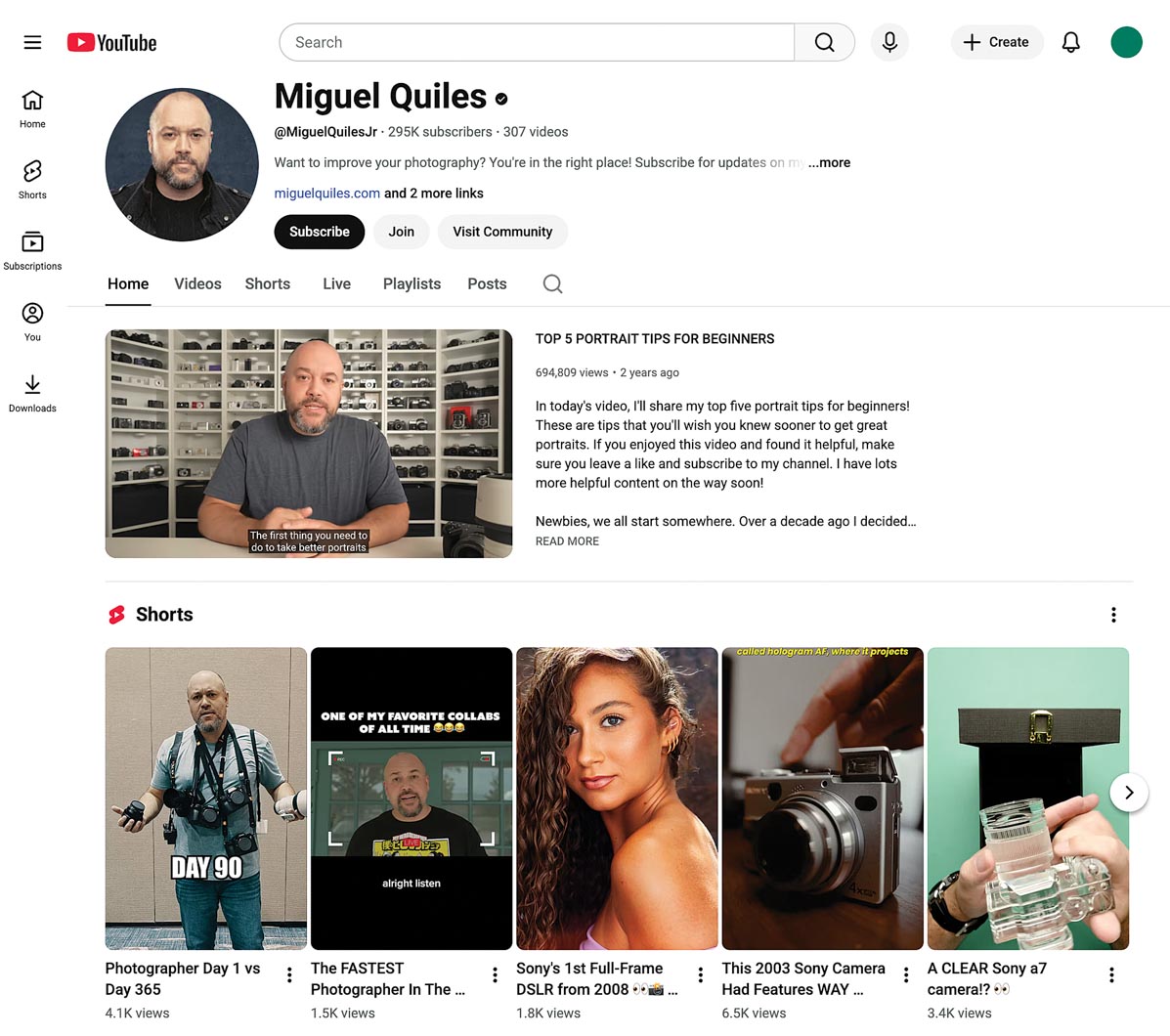
Miguel Quiles uses different parts of his brain depending on how he is using his photography skills: capturing images, creating YouTube content, or teaching, he tells “Professional Photographer” podcast host Pat Miller. The two sat down during Imaging USA 2025 in Dallas, Texas, last February to record the episode, “Stop Hiding Behind the Gear: Photography YouTube Secrets with Miguel Quiles.”
“For me, I find photography to be very easy. You get in, you have your concept, you take your shots, call it a day, everything’s nice and smooth,” says Quiles, a beauty and portrait photographer based in Orlando. On the other side, he explains, “Content creation takes a lot.”
Producing a YouTube video involves researching, planning a topic, and packaging it in a unique way, Quiles says, so it’s not, for example, just one of “a million videos on YouTube of how to take a portrait.” The content and presentation should be approachable and useful, and “that takes a lot of different parts of the brain [to] activate and fire.”
For the last few years, Quiles has been creating content not only for his personal YouTube channel but also for Sony’s channel, Alpha Universe. He talks about new products and gear, and techniques such as ways to set up your camera. Whatever his subject, Quiles says, he keeps in mind his standard viewer: someone seeking skills and knowledge about photography packaged accessibly. “Essentially, at the end of the day, I make content that I would have liked to have seen when I first started,” he says. “So, I put myself in the shoes of, like, the Miguel of 2008, who didn’t know anything about photography and who was trying to figure things out and who would hit YouTube. How would he find this content? And then, what would he need to hear from this content to gain value? That’s what drives every decision, every action, every bit of research. It’s all through that lens.”



Quiles cites several SEO, optimization, and YouTube growth tools that help him save time, including TubeBuddy, Answer the Public, VidIQ, and Keywords Everywhere. But ultimately, when creating content, he says he trusts his gut and his core viewers. And it’s paid off, he tells Miller, sharing one example of a video that, when he researched its interest level, “it literally was like a zero out of 100,” he says. But he still created and packaged the content and the video ended up with some 350,000 views in about three weeks. “I knew in my heart, this has to be something that’s approachable for people. This is going to do well,” he says during the podcast. Patience and trust are key. “The cool thing about YouTube is that [a video] may not do well today, but that doesn’t mean that I can’t repackage it and revisit it half a year from now, a year, two years,” he adds. “I’ve done stuff, repackaged it from five years ago, and it just hits differently. It hits at the right time.”
Though he is confident, Quiles says imposter syndrome is real, especially when you know there are bigger and more well-known YouTubers and streamers online. “And so you think about that, and then it’s very easy to just be like, ‘Yeah, I’m just not going to put this video out today,’ or just leave it. And then it never gets put out,” he says. “But you have to put it out. You have to do it.” And you never know what might hit, Quiles chuckles, sharing the story of a video from 2019 that he posted uneventfully before running errands, coming home and finding it had 30,000 views and a bunch of comments. Many of the comments joked an iteration of, “My left ear loved this video.” It turned out the audio was damaged. He could have re-uploaded it but instead, he left it as-is, to capitalize on its upward trajectory. That instinct, too, was spot-on. “Today it’s at like, I don’t know, a million and a half views,” Quiles says. “And so all of that is to say, your audience just wants you to show up. I didn’t show up perfectly for them at that point. But the content was good. The information was helpful, and it did great. It’s been my best-performing piece of content.”
Much of his most viewed content is in the nuts-and-bolts-of-photography space, an area that overall is lacking, he says. “I personally would love to see more photography content creators that actually talk more about the nitty gritty,” he explains, discussing what lens they used in an image and how they chose their settings and lighting, for example. “They don’t put themselves in the shoes of somebody who’s new, who wants to walk in their footsteps. So, I’m more of that, ‘Hey, let me take your hand and show you exactly how I did it.’ And I would love to see more of that because then, even for me, I feel like I’m a student of the game even though I’ve been doing this for a very long time. I hope that 20 years from now, I’m still a student of the game, and I try to just learn as much as I can. And I hope that people who are into that will also want to do the same.”
Quiles treats his personal YouTube more like a digital diary, but agrees that approach isn’t for all creators, nor should it be. He recommends finding a formula, making it scalable, and posting frequently. Also, ignore your inner critic, he advises. “You don’t go to the gym and all of a sudden you work out once and you’re buff or you’re fit. It’s a consistency that you have to apply,” he says. “If you can, just be OK with the fact that you’re going to be on camera, you’re going to sound funny to yourself, but to other people, they don’t see that. And if they do, then OK, over time the awkwardness goes away. But if you’re not creating consistently, you’re going to take yourself out of the game before you even ever get a chance to get into it.”
Succeeding on YouTube means knowing your viewer, relating to them, and trying to take the personal out of the project, Quiles says. “I think that the hardest thing for people when they’re getting started is that they’re too worried about their self-image. They’re in their own heads,” he adds. “They’re like, ‘Oh, well, there’s already somebody else who’s talked about this, and they’re way better, way more famous, way, whatever.’ They give themselves a lot of excuses to not get started.” What does he tell those people? “You need to create a lot of content before you could find yourself, find your voice, find your approach. Your first, I don’t know, 30, 40, 50 videos, they are probably not going to be great. And if they are, wonderful. But realistically, I can only think of a handful of creators that I’ve ever seen that come right out of the gates on YouTube that just kill it.”
Quiles’ intention, patience, and consistency working YouTube has changed his life, he says: introduced him to countless people, given him another career, and provided a living for his family. He encourages others to take the chance. “I would tell people that whatever it is that’s holding you back from doing it, understand that on the other side of that awkwardness and that challenge,” he says, “could be a whole different life.”
Melanie Lasoff Levs is director of publications.
Tags: social media