
Beauty in the Details
Chris J. Evans shares his wedding photography secrets
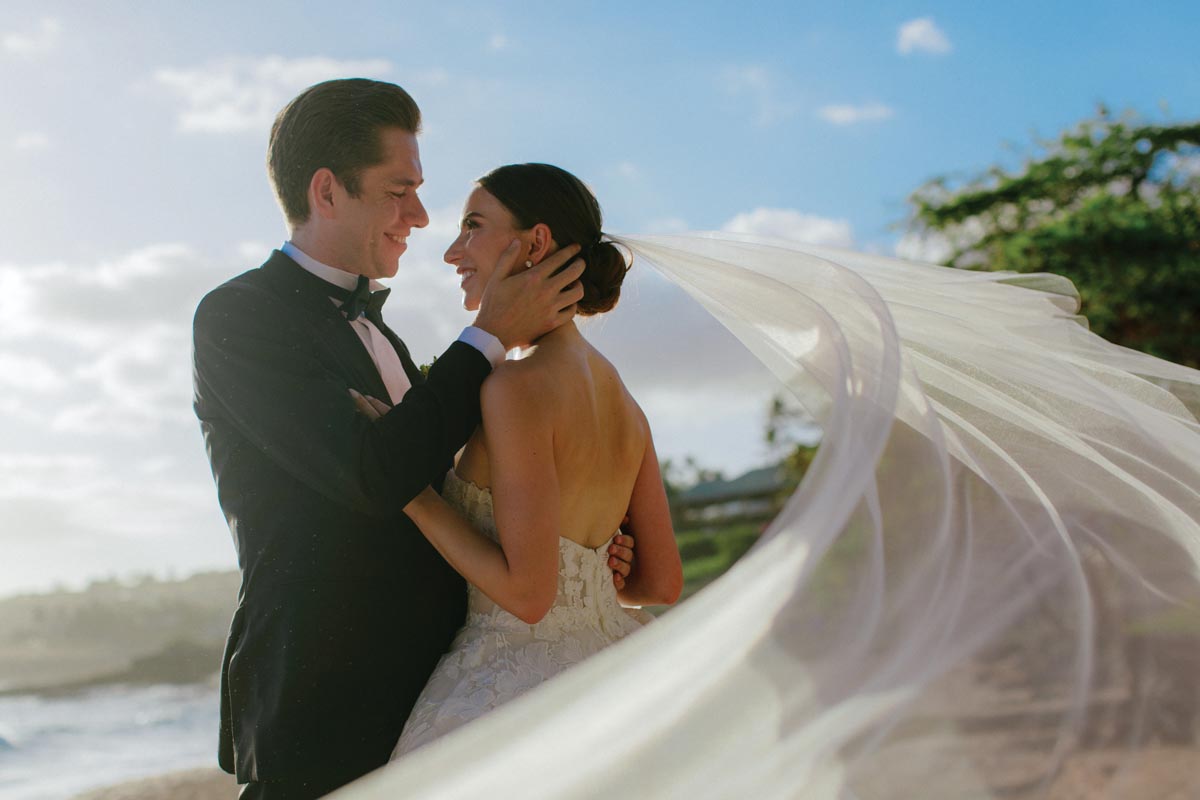
The apple didn’t fall far from the tree for globetrotting Ventura, California-based lensman Chris J. Evans. The renowned luxury wedding photographer was born into a family of artists. His mother, D.N. Evans, was a jewelry designer and couture wedding dress and fashion designer, and his father, Michael, was a sculptor, painter, and philosopher. Raised in an environment that nurtured creativity, Evans recognized that art could not only be a career but a way to contribute beauty to the world. His interview has been edited for length and clarity.
Mark Edward Harris: When did photography enter your life?
Chris J. Evans: My mom’s best friend, Roberta, gave me my first camera, a Canon AE-1 with a 50mm f/1.8, when I was 14. Growing up in Laguna, I was a surfer and a skateboarder and always had this camera with me taking pictures of my lifestyle, my friends, and other cool things. I got signed to a big modeling contract when I was 18 and that’s how I fell into fashion photography. Being photographed by some of the top photographers in the world, including Mario Testino, John Russo, and Patrick Demarchelier, informed my eye. I started photographing fashion, and then a girlfriend asked me to photograph her wedding in 2010. The bride was a model and it was in Hawaii, so I had a destination wedding with a model bride for my first time out of the gate. There are no reshoots on a wedding. But I got to be a product photographer when I photographed her shoes and the flat lay; and I got to be a photojournalist, doing a documentary style; and I got to be a fashion photographer, photographing her in her dress. I was like, A wedding is actually everything I love about photography in one incredible day. I was hooked.
 View Gallery
MEH: You mention the “Vogue moment” in one of your PhotoVision videos. What exactly is that?
CJE: It’s a moment where the bride or groom feels celebrated for their beauty and for just being themselves. Most of them are not models and have never been photographed for so many hours straight. That’s really the biggest thing, when they feel safe enough to let down their guard. When I show them that image, which is a version of themselves they’ve never seen, and they think, Whoa, I look so amazing, that’s the Vogue moment. I learned that from my time in front of the camera. I worked with photographers who made me feel amazing and others who made me feel terrible. So, I know how much power we have as photographers when we point a camera at someone.
MEH: How do you get Vogue energy out of non-models?
CJE: It’s vibration, it’s how you enter a space, it’s how you hold yourself, it’s the tone and speed of your voice. In the morning when I first walk into the room, the bride’s still getting her hair and makeup done. It’s high stress, high anxiety. If you enter that space and you’re part of this chaos, that energy reverberates. When I enter, it’s the opposite. I walk in very calm, in a finely tailored suit, very professional, no cameras. “Susan, how are you? So nice to see you. You look amazing. I couldn’t wait for this special day. I’m gonna go set up in the corner. Enjoy the hair and makeup process. Can I get you a water or anything?” I set up a dynamic that I’m there to serve them at the highest level. Most of the time I get a sigh of relief that everything’s going to be all right, just from that initial energy. That kickstarts the entire chain of events leading up to that Vogue moment.
MEH: What is “flat lay” in the wedding photography lexicon?
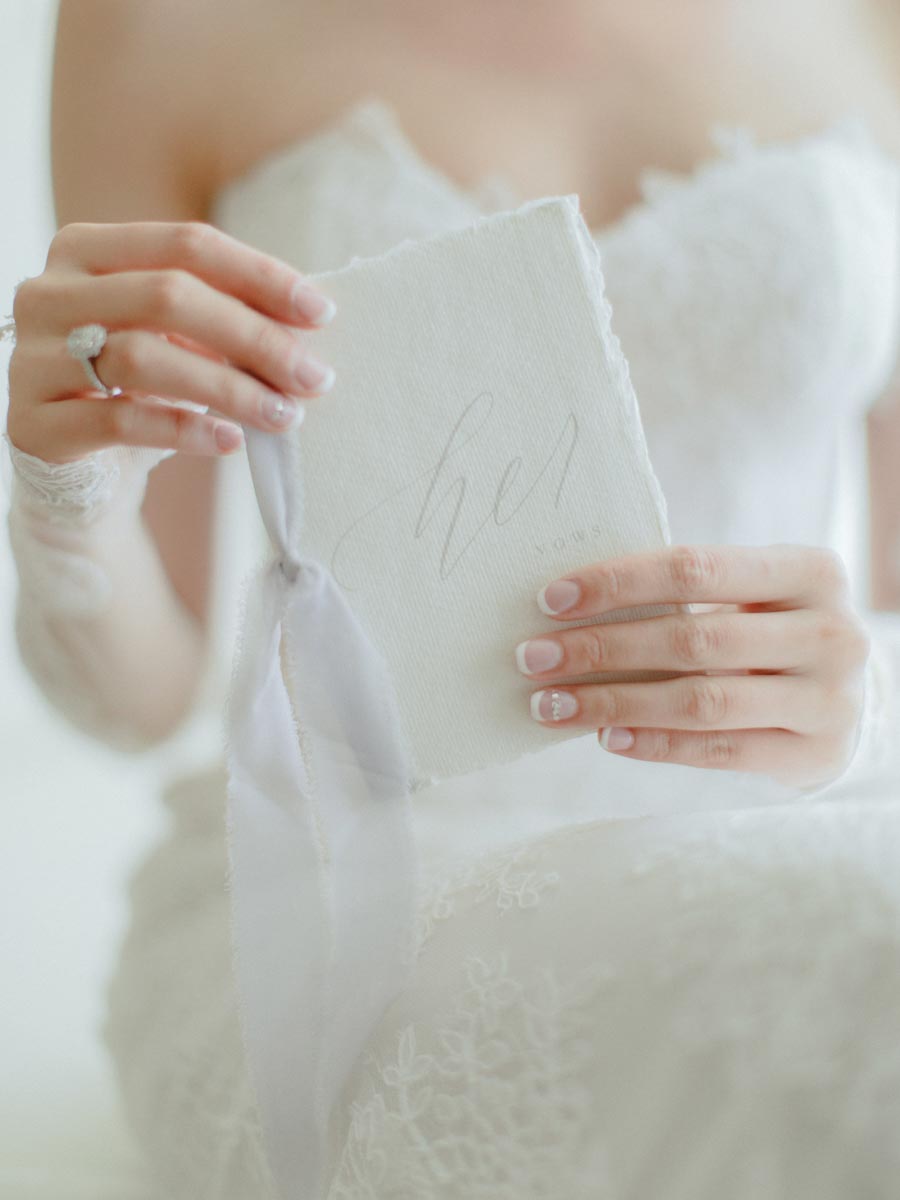
CJE: Basically, the flat lay is that overhead view of the invitation laid out very graphically to create an artistic opening to the couple’s story. It’s evolved from precise, perfect lines where every corner lines up to something looser. Gen Z clients want a slightly different aesthetic than the flat lays of the past. Now I’m photographing them to look mucked up a bit stylistically. That’s also how I photograph the shoes and the perfume to tell the story of the details in an artistic way.
MEH: Your PhotoVision videos provide great tips on the subtleties of styling, including for the reception. For example, what is your rule about salt and pepper shakers?
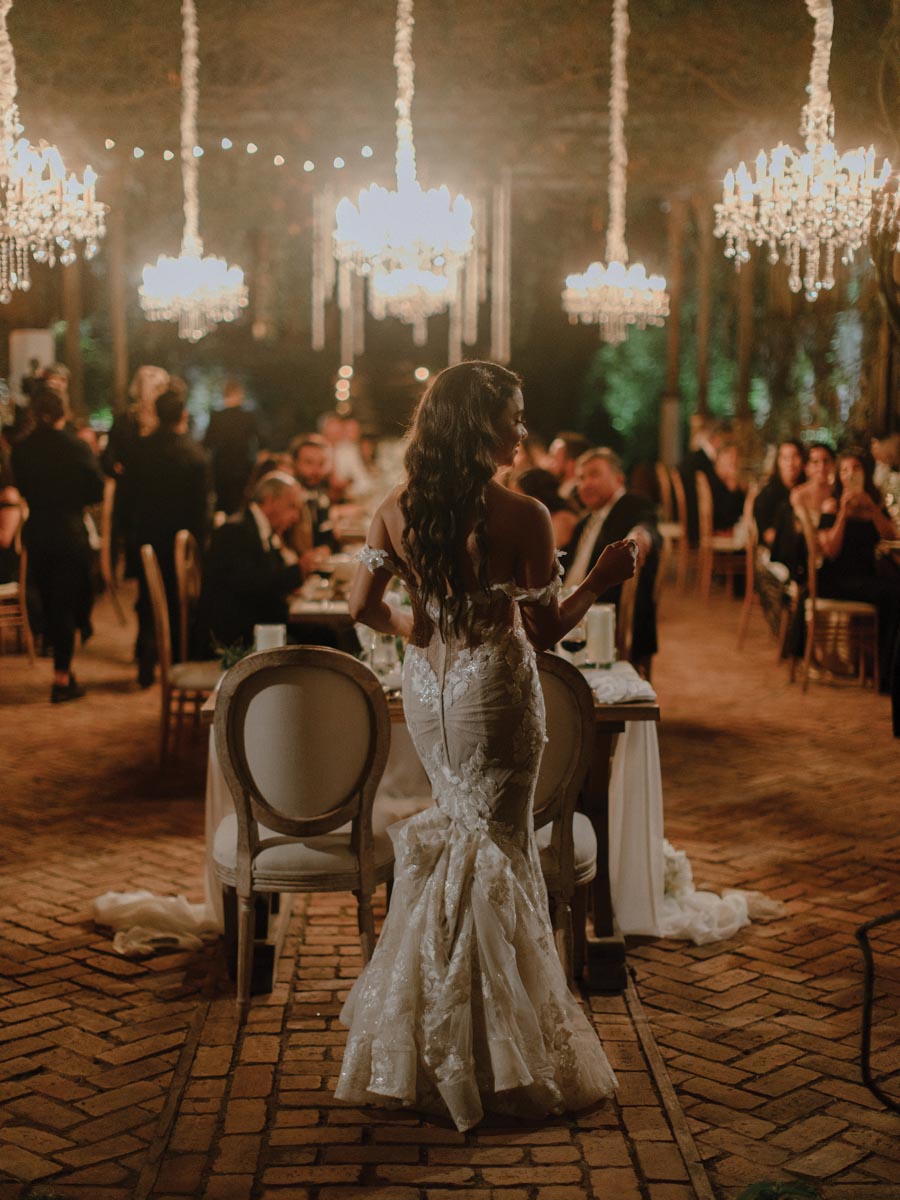
CJE: Unless they’re bespoke, one-of-a-kind salt and pepper shakers, they will ruin good décor. I’m servicing the highest-end, top 1% of clients, so every single item on that table should be there by design. You want to capture that scene pristine. For example, the minute ice water goes into glasses, you get condensation, which will result in water drops on the tablecloth, and that’s going to change up the entire vibe. It’s not just a pretty table, it’s a work of art. It’s all about aesthetics. For a wide, establishing photo of the table, I’ll open up to f/2 or f/2.8, and if it’s a super dark ballroom, I hit the whole room with a strobe. So, I might stop down to f/4 or f/5.6. Either way, I want the picture to look like the doors just swung open and you’re taking that first step in. If everything is tack sharp, ultra-bright, in your face, you lose the sense of wonder that shallower depths of field create.
MEH: I was surprised that the 50mm lens is your go-to focal length.
CJE: I’ve built my whole career on that lens. For me, it’s the perfect lens because it puts you into the story. If you want a tighter shot, you have to come in closer, so it really makes you a part of the experience. It’s the truest representation of the dream aesthetic of a wedding, especially when opened up to f/1.2. A lot of my friends in the industry love the 35mm, but I make a lot of vertical images, especially for social media, and the 35mm focal length distorts too much for me and it’s not as magical.
MEH: How do you design your clients’ wedding albums?
CJE: I tend to go chronologically. When my team produces the videos, we like to go a little more Tarantino: We open with peak action, dance floor, crazy montage, and then soften it, and then open it back up again. But for the still albums, I like to move chronologically and create that visual anticipation and arc of the day. For albums, the clients get to pick their favorite 50 to 75 images, and then I design around those. If I feel other images will enhance the storytelling, I add them. I use this amazing company out of Portugal called Floricolor. Their albums are so beautiful. It’s like an eggshell paper, but with this very soft sheen. I don’t do leather products; I’m a vegetarian.
MEH: Is video automatically part of your wedding package?
CJE: It’s an upgrade. It started during COVID-19, when I began to work again. All my cameras did video and clients wanted a minimal crew. I would create stills and switch to video. I’m a musician as well, so linear music editing was already in my brain. Linear video editing is similar, but with moving pictures. So, I taught myself how to do that. Now I have a full video team, but it’s my vision and I direct the final edits. Typically three- to five-minute editorial, fashion-forward videos are the main deliverable. But we can also do an extended documentary-type film if the client wants speeches and dances.
MEH: What equipment do you bring on location?
CJE: I believe in less is more to the highest order. I used to travel the world with one Pelican case but now it’s a Tenba case. I go with two Canon EOS R5 Mark IIs, my 50mm, which never comes off camera A, a 24-70mm, and a 14-24mm from Sigma, a beautiful piece of glass for dance party stuff. I also have a vintage toy camera lens for a film look, very dreamy. For lighting I travel with a Godox AD100Pro, an AD200Pro, and a V100 speed light. I also have a drone and two fold-up stands that fit into the Tenba case.
MEH: You go with strobes rather than continuous light?
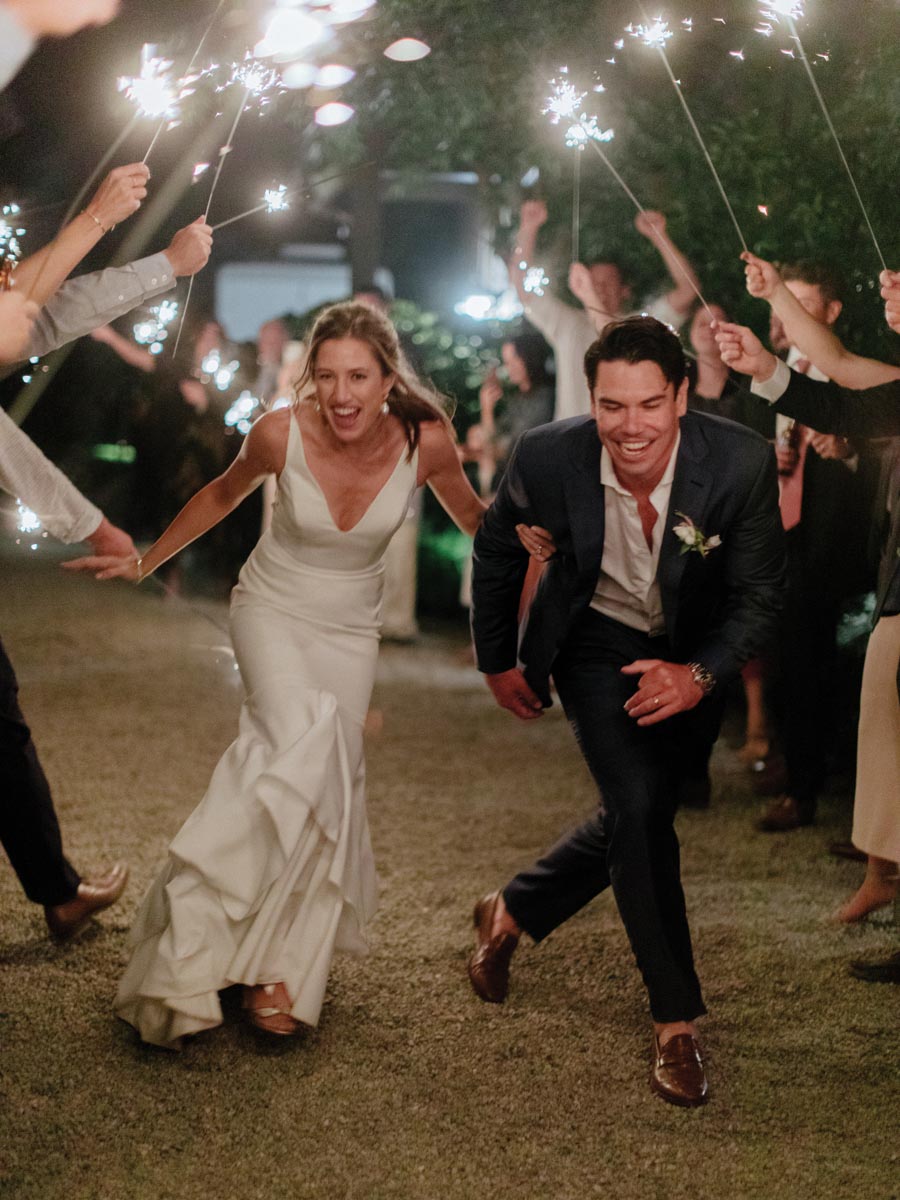
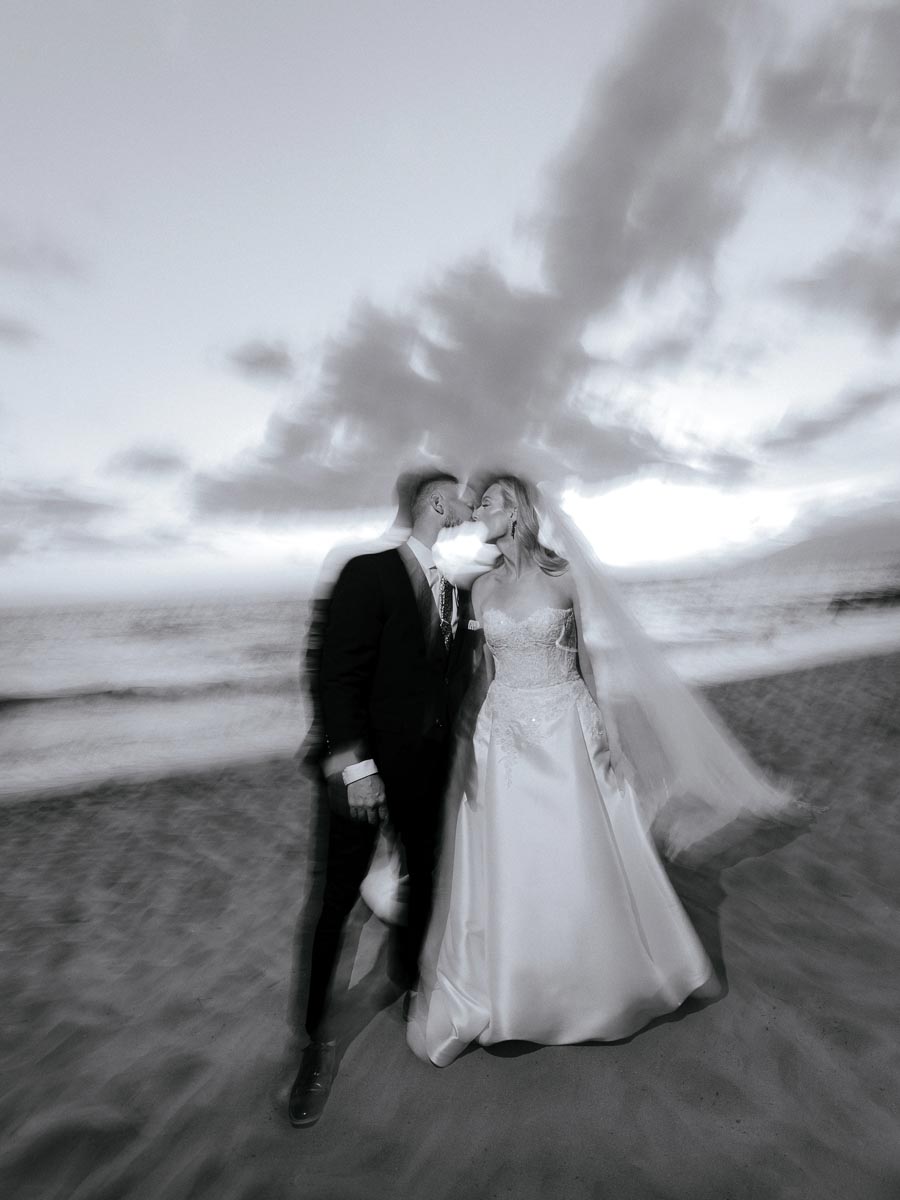
CJE: Yes, because if I’m going to do some drag-the-shutter work, I can freeze the action and get cool lighting and blur. I also sometimes use strobes for blue-hour fashion-driven portraits.
MEH: What is one of the most amazing wedding experiences on location you’ve ever had?
CJE: Last year, I did a wedding in Malta in a church that was an 18th century masterpiece. I wanted it to feel as if you were there, so I just locked in my white balance. Cameras are so amazing now. I might have been at ISO 2000 and was still getting a perfect image, especially with AI denoise in Lightroom later. I’ve shot images at 14,000 ISO and with AI denoise it’s still primo.
MEH: What’s your post-production process?
CJE: I cross-reference to make sure the 3,000 photos on the card are the 3,000 photos in the file on the hard drive. Once everything is accounted for, we bring it into Adobe Lightroom, and then I’ll do my highlight selection for the client, about 50 to 100 images. I send the rest to my post-production team in the Philippines. They know how I want my white balance and color. They match them and send back 1,000 or 1,500 of the best ones. I still give those a final run-through, but by outsourcing, I’ve taken 60 hours of post-production work down to about two hours. We typically deliver them to the client in about two to four weeks.
MEH: Did you study photography formally?
CJE: I started studying photography in 8th grade, learning how to develop black-and-white film. In high school, I was always in photo classes. I had a great photography teacher, Peter Tiner, who inspired me. I then went to music school, chased the band dream, released a bunch of records, and had a few songs on the radio. I had the modeling thing as well. I’ve lived so many crazy lives and then settled into photography at 32 when I did my first wedding. Now it’s 15 years and 500 weddings later. That’s the gift of getting older: You have so many chapters of your life to inform your opinion, your worldview, and your eye.
MEH: What experience did that time in a darkroom give you?
CJE: You realize the true magic of photography when you put the paper into the developer and an image appears. I don’t have the time, bandwidth, or patience to experience that again, but doing it then made me fall in love with the craft and artistry of photography. To this day I will sometimes select an image based on vibe rather than perfection. There are merits to a 100% technically perfect image. But there are also merits to beautiful imagery that is not perfect. I’ve started to articulate this idea in my talks: replacing the idea of perfection with excellence. When you know you gave your everything to that image, that client, that experience, that photo, that’s what it’s all about.
Mark Edward Harris is an award-winning photographer and writer based in Los Angeles.
Tags: wedding photography