
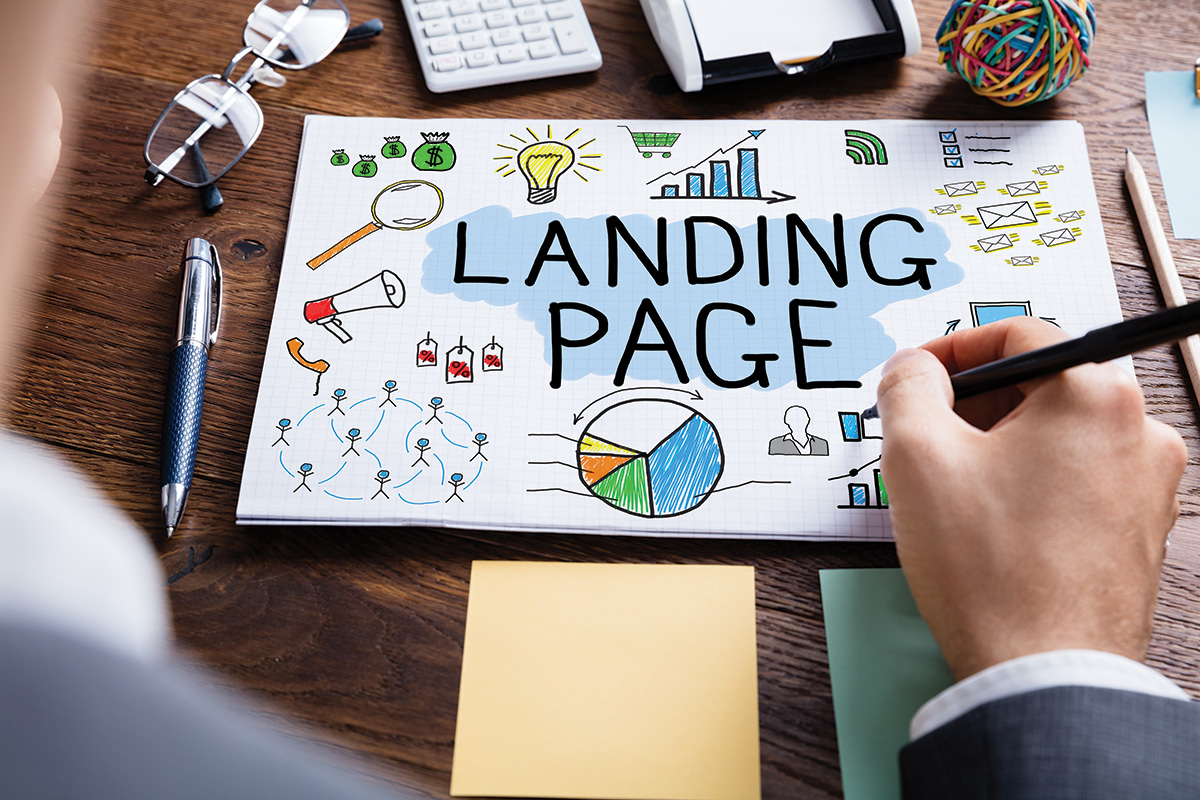
Have you tried digital advertising, social media marketing, or online promotions, and you’re just not getting the expected results? The missing link could be the experience you’re presenting on your website—specifically, whether you’re using well-optimized landing pages.
First, let’s take care of some definitions so we’re all on the same page (pun intended). A lot of people use the term “landing page” to refer to any important page on their website. In fact, a landing page is a standalone web page designed with one goal in mind: to convert visitors into clients. It’s the page where people land after clicking the link in an ad, scanning a QR code, or otherwise responding to a promotion. As such, it serves a specific lead-generation purpose.
“If you’re paying for digital ads, you want to make sure your ad dollars are spent wisely,” says Yaneck Wasiek, M.Photog.Cr., a Southern California-based photographer and owner of Wasio Digital, a marketing platform designed to help small businesses automate their customer experience and lead-generation processes. “If you’re sending people to your website, and you don’t have pages optimized for the traffic coming from those ads, you could be wasting money. You want to make sure those [potential customers] don’t leave without taking an action or providing their information.”
To accomplish these goals, Wasiek shares a few landing-page-optimization practices that can be implemented to yield better results. His session at this year’s Imaging USA on the topic had one of the highest attendance levels at the conference. Wasiek also was a guest in May on the “Professional Photographer” podcast discussing using Google Ads to grow your business.
Keep it simple. Landing pages should have a minimalist design that guides visitors directly to the intended action. A few examples of your images demonstrate the quality of your work, but don’t use a landing page as a de facto portfolio or clutter the design.
“Part of the simplicity is removing all the distractions, including the menu for your website and any clickable logos that take visitors back to your home page,” says Wasiek. It may sound counterintuitive, but you don’t want people clicking around your website from your landing page. That landing page should be a self-contained selling tool that provides everything people need to take the next step with you.
Write in short paragraphs and use bullet points wherever possible. There’s no need to explain everything about your art and your approach on your landing page; you just need to entice visitors enough to take the next step. “Your goal is to address your visitors’ pain points, offer your solution, show that you have a system, answer their questions, and describe what happens next,” Wasiek explains.

A hero above the fold. The section at the top of the page, known as the hero section (or “above the fold” for those familiar with old-school newspaper parlance), is most important. This is where most decisions are made. It should make a strong visual impression and catch the visitor’s attention. In this section, it helps to state the problem the visitor might be facing or ask a question about the result they want to achieve.
For example, one of Wasiek’s photography specialties is headshots. A landing page for his website could begin with the heading: “Do you want to make a better first impression with your professional headshot?” Then a subhead could explain how his services can help: “We specialize in creating unique headshots that elevate your professional presence and help you stand out in your industry.”
Single call to action. Landing pages should ask visitors to do just one thing, such as click a button to get a coupon code, fill out a form, or register for a consultation. The call to action should provide a solution to the visitor’s needs or the problem you’ve addressed in the hero section. Place the call to action in the hero section below the headline and subhead to encourage immediate action. You can repeat the same call to action lower down on the page as well.
Attract with a lead magnet. “People need to have a good reason to provide their information,” says Wasiek. “A lead magnet is what you offer people in exchange for their information.” Lead magnets must offer value, such as a meaningful discount or extras if they respond now. For example: “If you register for a family portrait session, we’ll design your holiday cards.” Think about how you can provide extra value or give away something for which others charge.
Follow up. If the goal of your landing page is to get prospects to register their interest in a service or sign up for a consultation, it’s imperative that you follow up. Wasiek recommends a combination of phone calls, emails, and text messages so you’re reaching people using the method they prefer. The more you can automate the process, the better. Platforms like Mailchimp, Brevo, MailerLite, and Wasiek’s Wasio all offer features for setting up automated message series that nurture leads toward eventual bookings. These follow-up messages should offer additional value without a nagging tone. Share things like guides for dressing for a portrait session, discount codes, or free product offers in exchange for timely bookings.
Is it all worth it? The numbers say yes. Statistics on landing page conversion rates (converting a visitor to a potential customer) range from almost 6% to around 10%, according to studies by HubSpot and Mailchimp. Other studies have shown rates as high as 20%-30% for pages optimized for lead generation. This compares to the average website conversion rate, in the 2%-5% range. So, if you want to convert more of your website traffic into viable leads, and spend your time and ad dollars more effectively, consider optimized landing pages as the next ingredient in your marketing mix.
Jeff Kent is editor-at-large.
Tags: marketing