
What’s in a Flash: Godox V1Pro
The Godox V1Pro allows for more full-power sequential flashes, shorter capacitor refresh times, and features a detachable fill light.
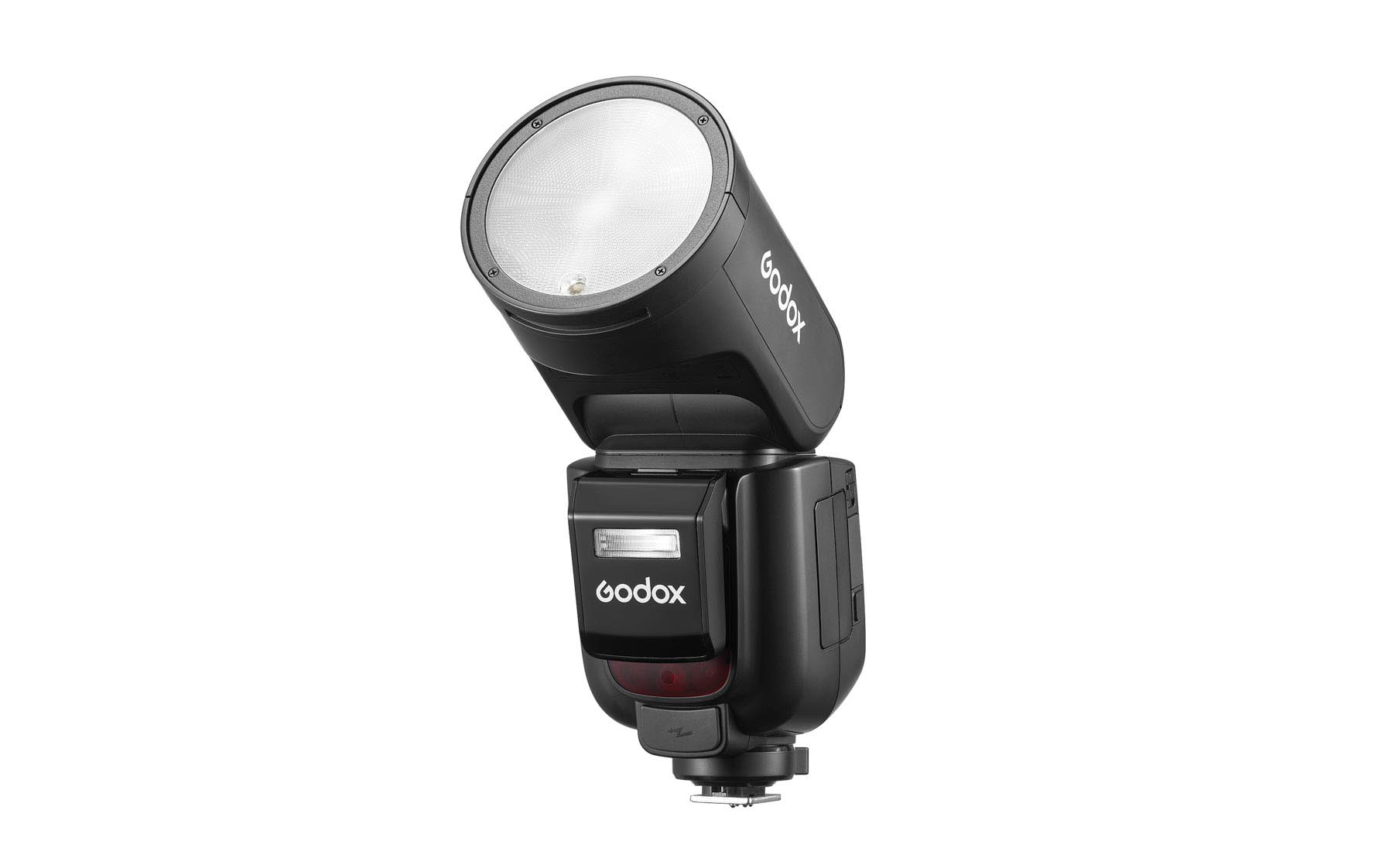
With many of the specifications of the Godox V1Pro being the same as the V1, what justifies the higher price of the pro version ($70 to $130 higher, depending on sales)? Will the Godox V1Pro make a difference in your work? Let’s review the internal changes, including power options and improved heat management, which allows for more full-power sequential flashes and shorter capacitor refresh times. Another element to consider is that the pro version also includes a detachable fill light component, the SU-1.
While the VB30 battery included with the V1Pro is the same size as older VB26 models, it has a higher output voltage, nearly 15% more capacity, and a USB-C charging port. Where VB26 series batteries deliver approximately 480 full-power flashes in a V1, the new 2,980 mAH VB30 can deliver approximately 500 full-power flashes. Combined with improved heat management around the flash tube assembly, the more energy-dense VB30 battery can produce up to 100 full-power sequential flashes and recycles 15% faster.
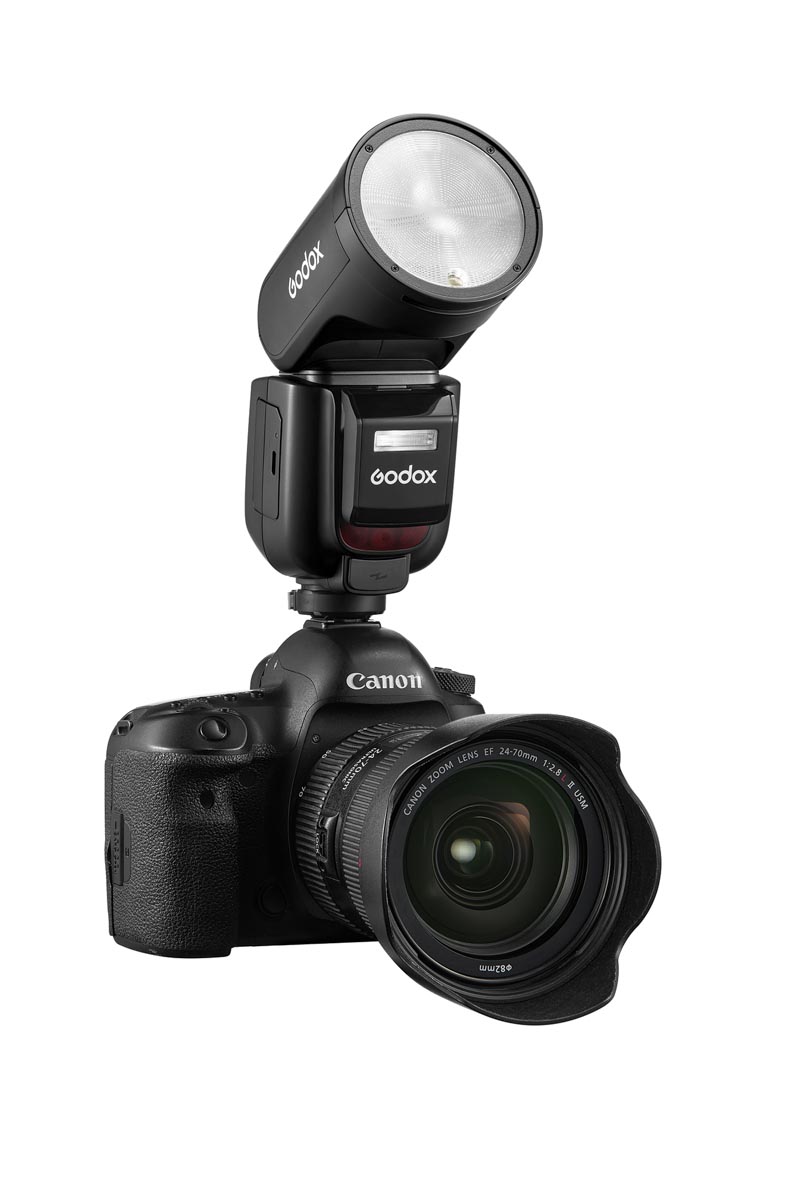
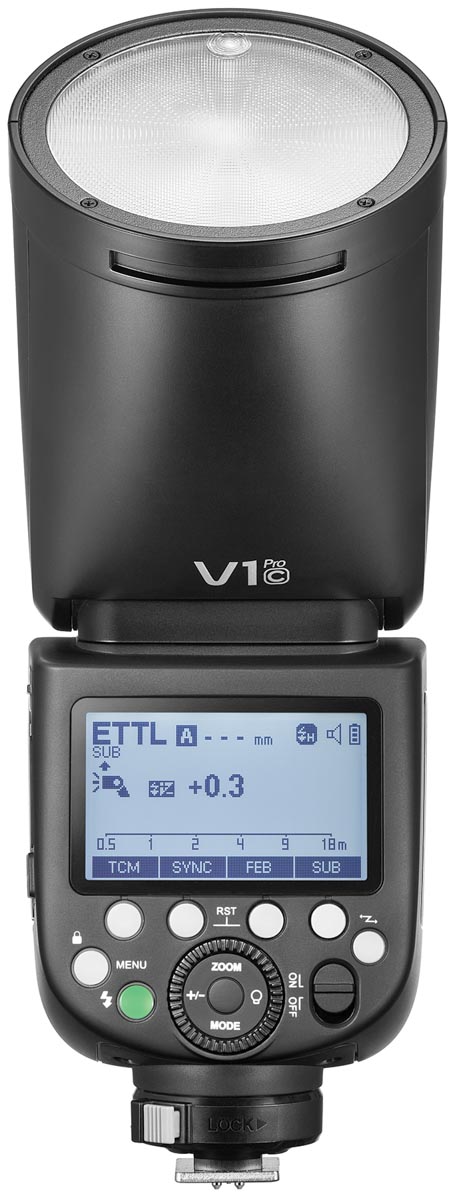
Unlike similar flashes such as the Godox V1, Profoto A10, and Westcott FJ80 II, the V1Pro sports an external power port just above the hot shoe on the front of the flash. With it, users can connect the high-voltage PB960 power pack, ideal for long, high-intensity photo sessions and events. Used with the V1Pro, the recharge time for full-power shots drops to under 1 second while delivering up to 1,800 full-power shots. The PB960 can also power two flashes and has a swappable battery. A compatible cable (like a Godox Propac Cable or B&H-recommended Bolt CZ2 HV Locking Flash Power Cable) is also required.
The Godox engineering team employed three strategies to manage the extra heat generated by pushing more watt-seconds through the flash tube: They improved the inductor and heatsink system, doubled the number of induction coils in the head, and added a layer of glass in the flash head to absorb, diffuse, and redirect heat. These features make the V1Pro 1.4 ounces heavier (excluding the VB30 battery and SU-1) and 3/8 inch longer.

For this outdoor portrait, I convinced commercial and corporate photographer Stan Kaady to step in front of the lens. I used the Godox V1Pro with a Godox AK-R21 with the projection attachment and AK-R27 65mm lens as an off-camera TTL-controlled spotlight.
To measure the V1Pro’s output, I set up a Sekonic L758DR light meter 5 feet from the flash. With the meter set to ISO 100 and a shutter speed of 1/250 second, and the V1Pro’s beam angle at 50mm, at full power, the meter read f/16+3/10 and dropped in full-stop increments to 1/8 power. At 1/16 power, the output became slightly erratic and drifted over a 4/10-stop range. At the bottom of the power range (1/256), the output was measured at f/1.0 + 7/10.
White Balance was consistent within 200K over the full to 1/16 range, averaging 7,070K. Over the lower four stops of the power range, the power range shifted upward by 200K. To me, these shifts indicate a two-stage power distribution inside the flash. In isolation, these things wouldn’t be worth mentioning, but if you are an event photographer who needs a streamlined processing workflow and consistent color from flash to flash, the color shift is worth considering.
 View Gallery
One of the more interesting features of the V1Pro is the SU-1 detachable flash. It connects to the main body of the V1Pro via a port at the top of the red translucent panel on the front of the flash. The port is protected by a spring-loaded cover. Push the SU-1 straight into the body of the flash, then push it slightly down to install. In manual and TTL modes, the rightmost of the four function buttons on the backside accesses the SU-1’s menu, and the third button is on/off. With the SU-1 active, use the control wheel to set output in 1/3-stop increments, from full to 1/128 power. At full output, it produces a 1/3 stop less light than the V1Pro main light at 1/32 power. The sub-flash was designed to act as a fill or catch light when bouncing the main light off a ceiling or pointing it up into a reflector or diffuser. Because of that, the apparent 6-stop difference between the V1Pro at full and the SU-1 at full is not as great as it seems, since bouncing, reflecting, or diffusing light always reduces the amount of light illuminating the subject.
There are hardwired limitations on which modes the SU-1 can be used in. It automatically shuts off when the V1Pro is in HSS or repeat (stroboscopic) mode, or when used as an off-camera flash (OCF) triggered by one of Godox’s X series radio transmitters. One way around the OCF limitation is to use a cable to connect the flash to the hot shoe. I tested the V1Pro with the Nikon Z 7II. I used Nikon SB-17, SB-28, and an inexpensive Pholsy i-TTL-Off-Camera Flash Sync Cord. This is an ideal way to work when the flash is mounted on a flash bracket above or to the side of the camera or on a stand 2 or 3 feet from the camera.

With the SU-1 installed, I experimented with different color gels on each light. This works surprisingly well. For the still-life example (above), I connected the V1Pro to an SB-28 cable and mounted it on a small light stand on a Platypod eXtreme and Handle. I filtered the V1Pro’s head with a blue Rogue Photographic Design (RPD) Lost at Sea gel and aimed it at the ceiling for top fill. I used the SU-1 as a hard key light and taped an orange RPD Tangerine Crush gel over it. Then I experimented with various ratios between the V1Pro and SU-1 outputs. Mixing two colors can also yield fun, creative portraits without the hassle of wrangling two separate flashes.
If you are in the market for a hot shoe mount flash, the V1Pro’s round-faced design is more than a cosmetic trick. Like the Godox V1 (and the Profoto A10 and Wescott FJ80 II), the V1Pro’s round fresnel lens produces a more even beam pattern than the rectangular head of conventional speedlights. The magnetic light modifier system makes it easy to secure snoots, grids, barndoors, gels, diffusion domes, and reflectors. You could also add the reasonably priced Godox AK-R21 projection lens and effects system. Godox is on a mission to build the deepest family of electronic flash lighting systems on the market today, with offerings from the pocket-sized iFlash Camera Flashes to the mighty P2400, a 2,400Ws pack and head system, all tied together by a 2.4GHz X transmitter system.
Ellis Vener is a commercial and portrait photographer based in Atlanta.
Tags: flash gear lighting technology