
The Stuff of Daydreams
Jenny Fine’s creativity knows no bounds
New Brockton, Alabama-based visual artist Jenny Fine admits she didn’t know what she wanted to be when she grew up. But an openness to new ideas and an opportunity on the other side of the planet put her on the path to a career in the arts. “While at the University of Alabama, I took a year off and moved to China to teach English,” she explains. “Before I left, my mom gave me a camera to document my experience.”
As philosopher Lao Tzu’s proverb goes, “A journey of a 1,000 li (a traditional Chinese unit of distance) begins with a single step,” and Fine had taken hers. “I was totally immersed in the culture, but I was also separated because of the language barrier outside of the classroom, so the camera became my closest friend and confidant,” she says.
When she returned to Alabama, she decided to pursue photography. “I felt at home in the darkroom and had a fantastic teacher, Gay Burke, who nurtured whatever direction I wanted to go in, even though I frustrated her at times,” she recalls. Gradually, her photography incorporated additional elements such as painting, sculpture, and even sound, and today, her work is shown in galleries and exhibitions across the country.
FAMILY TIES
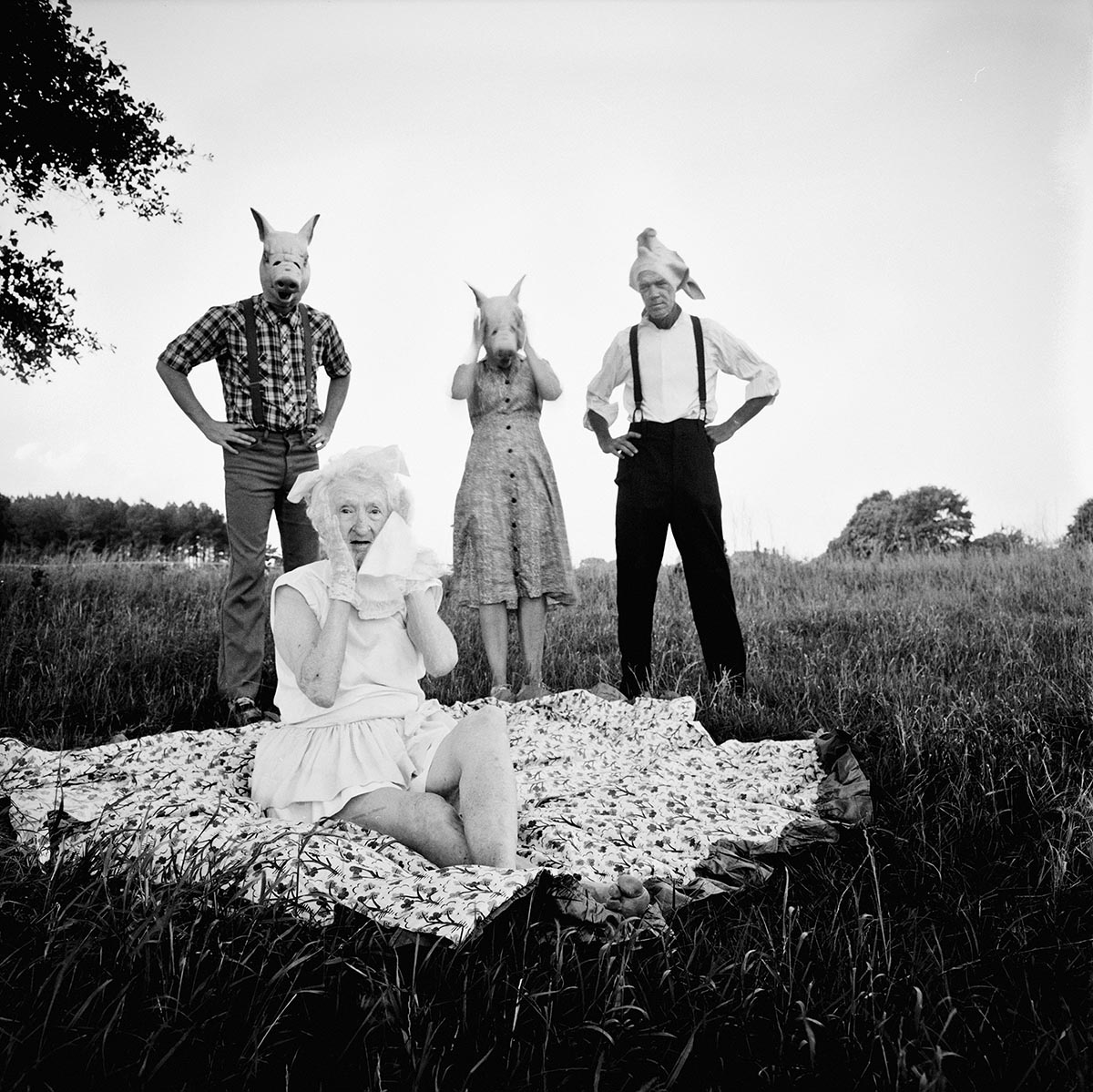
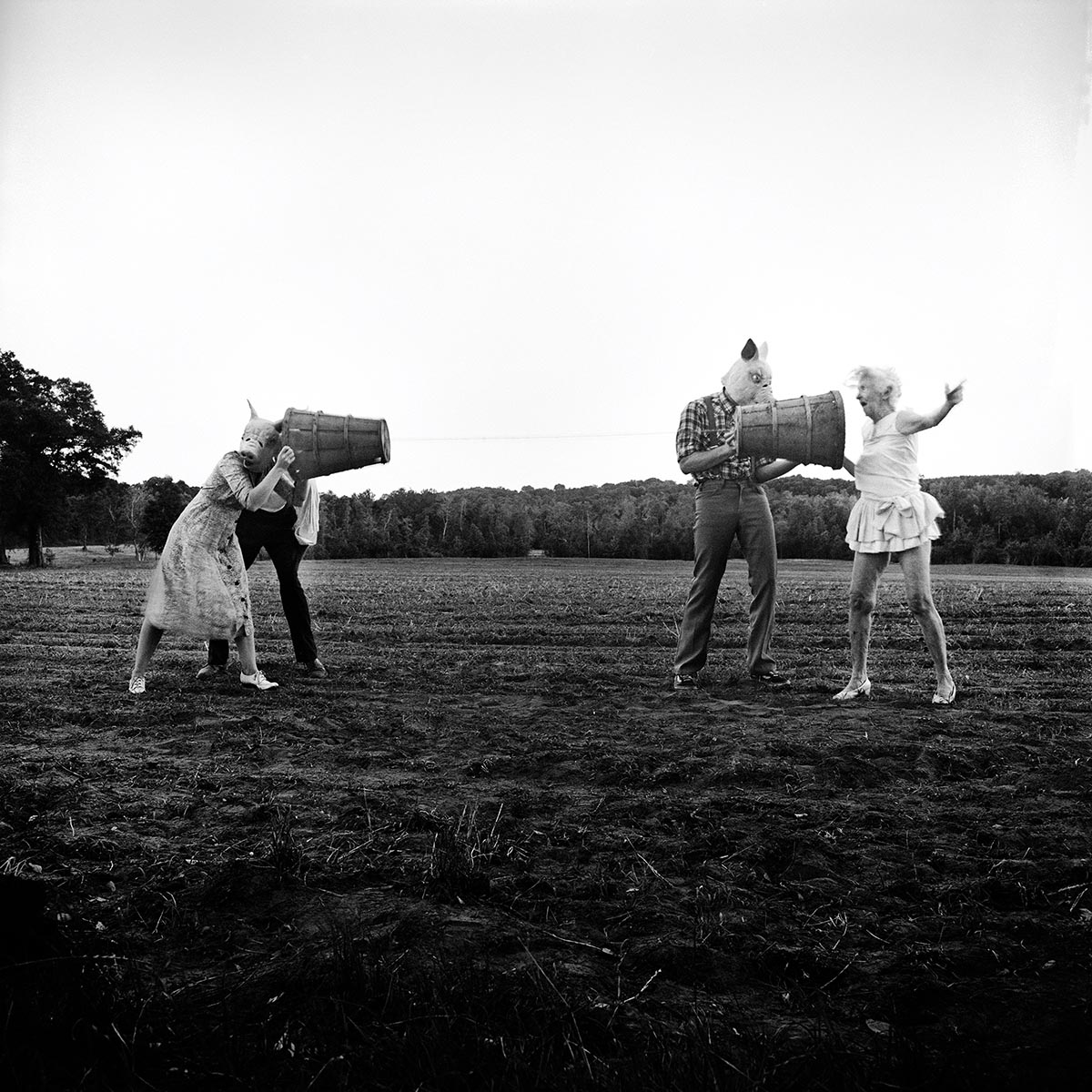
Fine’s first subjects were her family. Her paternal grandmother Sarah Fine, a retired teacher, became her muse. “She would sit there and tell me stories of her childhood, or about my parents and ancestors as I would figure out my composition, exposure, and focus, so storytelling and my photography became intertwined,” Fine says.
After graduating with a BFA from the University of Alabama in 2006, Fine taught elementary school art for two years. Knowing her time with her grandmother was finite, Fine continued photographing her and amassed a massive archive of images. “I wanted to save her stories, her voice, and continue to work with her after she passed,” she says. “But I didn’t realize that’s what I was doing at the time.” Sarah Fine passed away in 2008 and her granddaughter went on to earn an MFA from Ohio State University in 2010.
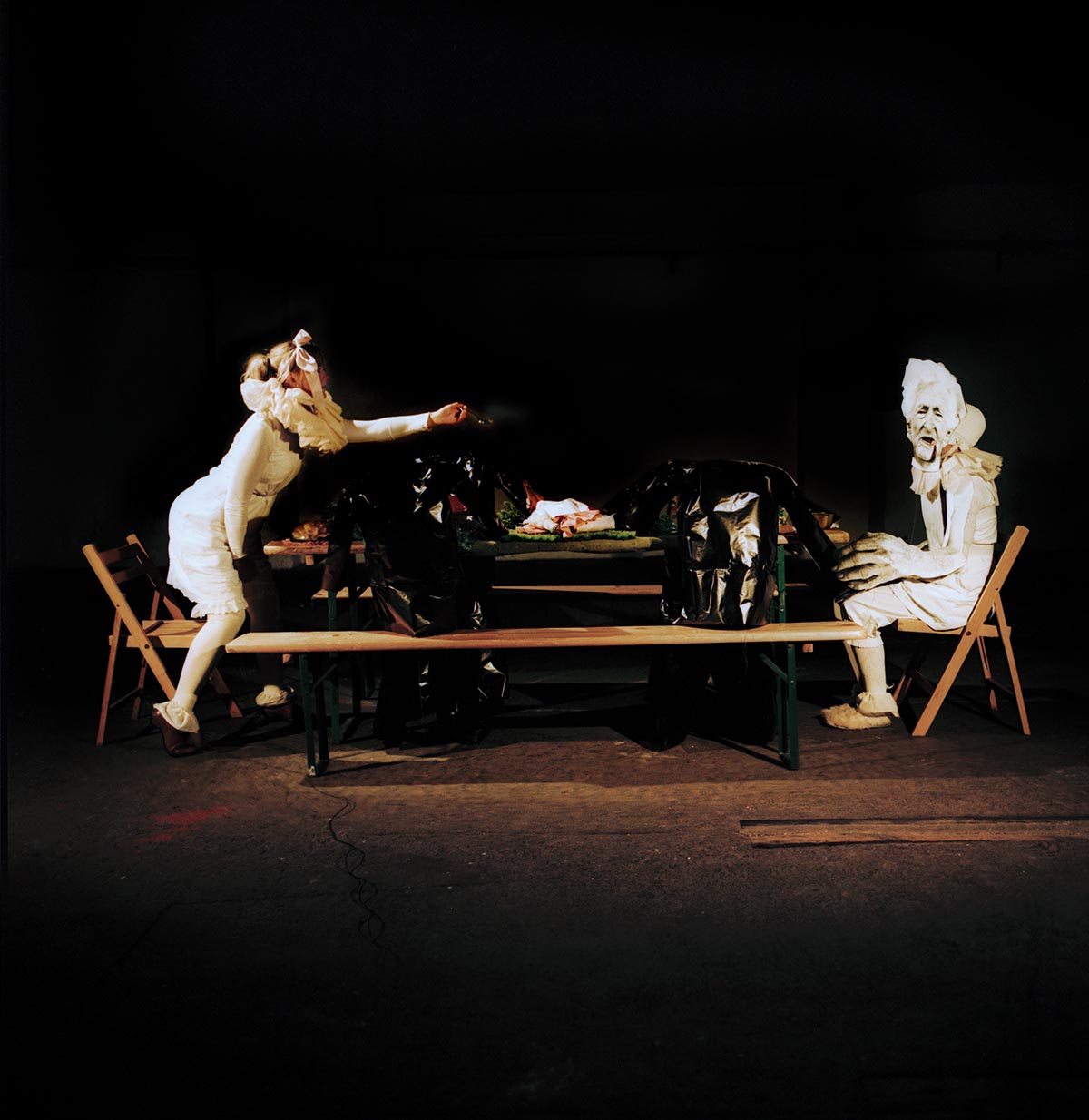
At an artist residency in Dresden, Germany, in 2012, Fine delved deeper into a series on her late grandmother. She had begun creating cardboard cutouts of the photos and enlarging them to look similar to paper dolls. But, she explains, the work seemed flat and static. “I wanted the images to be animated, and in that way, reverse the camera’s crop by returning space and time back to the photograph,” she says. “Too much of the magic that happens in front of the camera gets cropped out or flattened by the camera. My immersive installation work is an attempt to reverse that crop.”
In her photo and three-dimensional installation (below) titled, “Flat Granny as a Costume,” her grandmother’s hands are enlarged, which was initially an accident. “I was using a photo lab on the metric system, and I’m on inches, and am not the greatest at conversions,” she explains. “But when they printed out the hands really large, I was like, You know what? One aspect of her I remember were her hands. So, I decided to move forward and did a photograph of a model wearing Flat Granny as a costume for the first time.
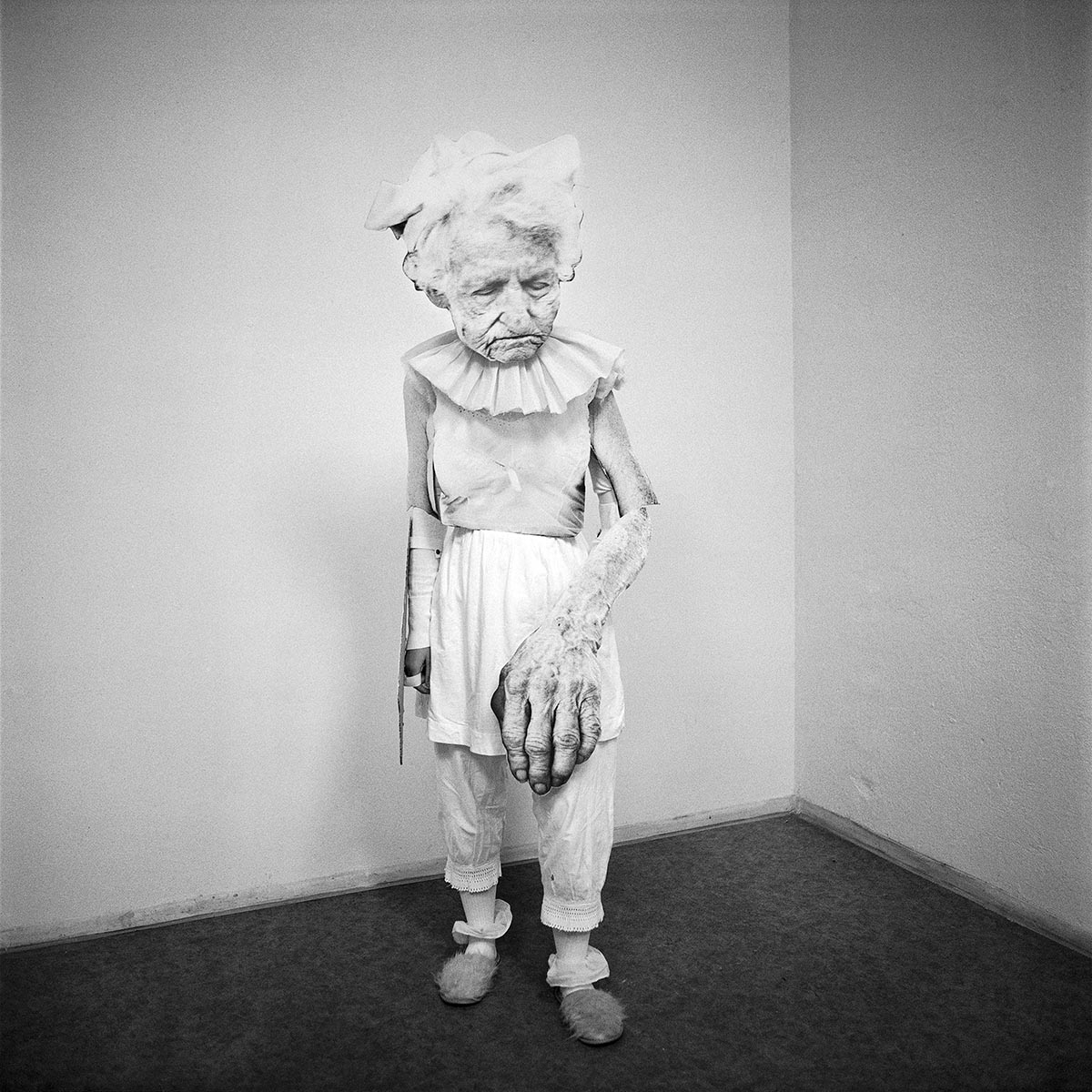
“Right outside of my studio door in Dresden was the communal art gallery,” Fine continues, “and they had all this fabric left behind by a previous artist that I could use to cobble together ‘Hello Granny,’ a performance introducing Flat Granny into this space that represented a hospital room. This is where I said goodbye to her, and this is also where I’m saying hello to her again.”
Fine is inspired by early photographic history, “where it was better to have a photograph of a deceased loved one than to not have any image at all,” she says. “That idea became the beginning point for the stand-in, and I’m very interested in how the photograph can be both presence and absence.”
MEMORY AND STORY
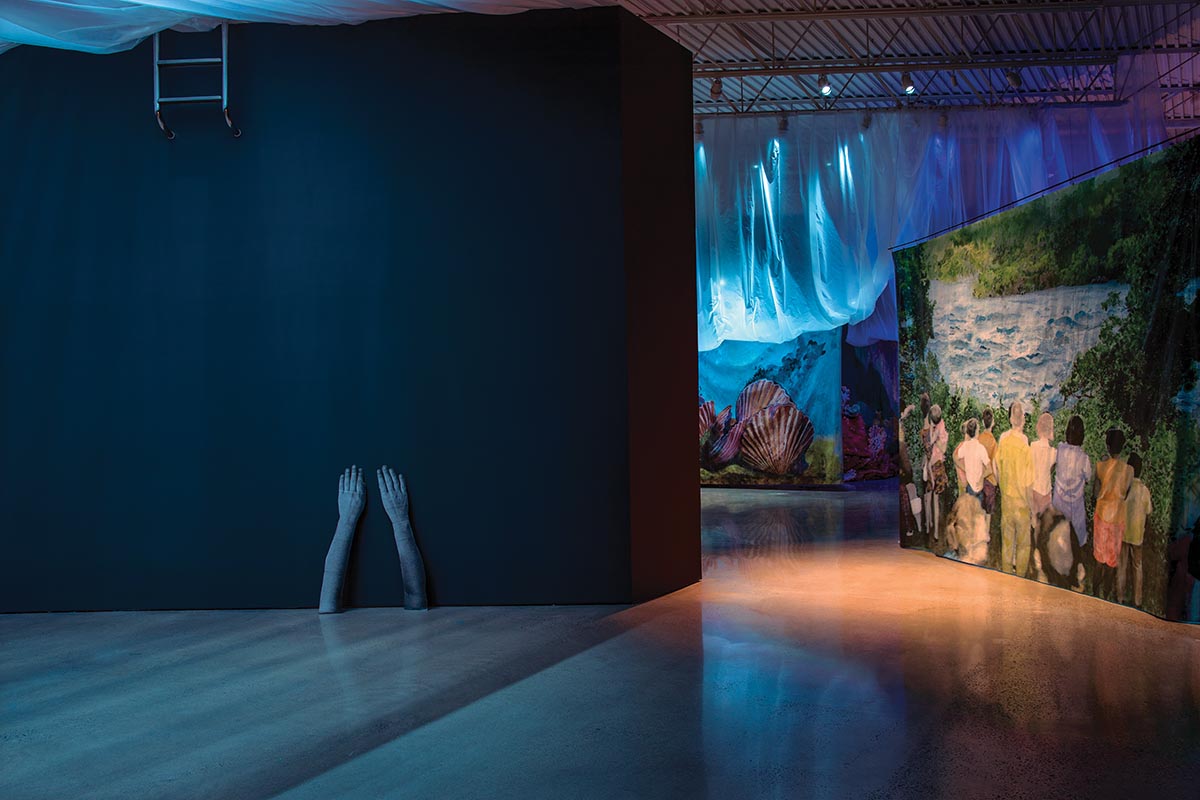
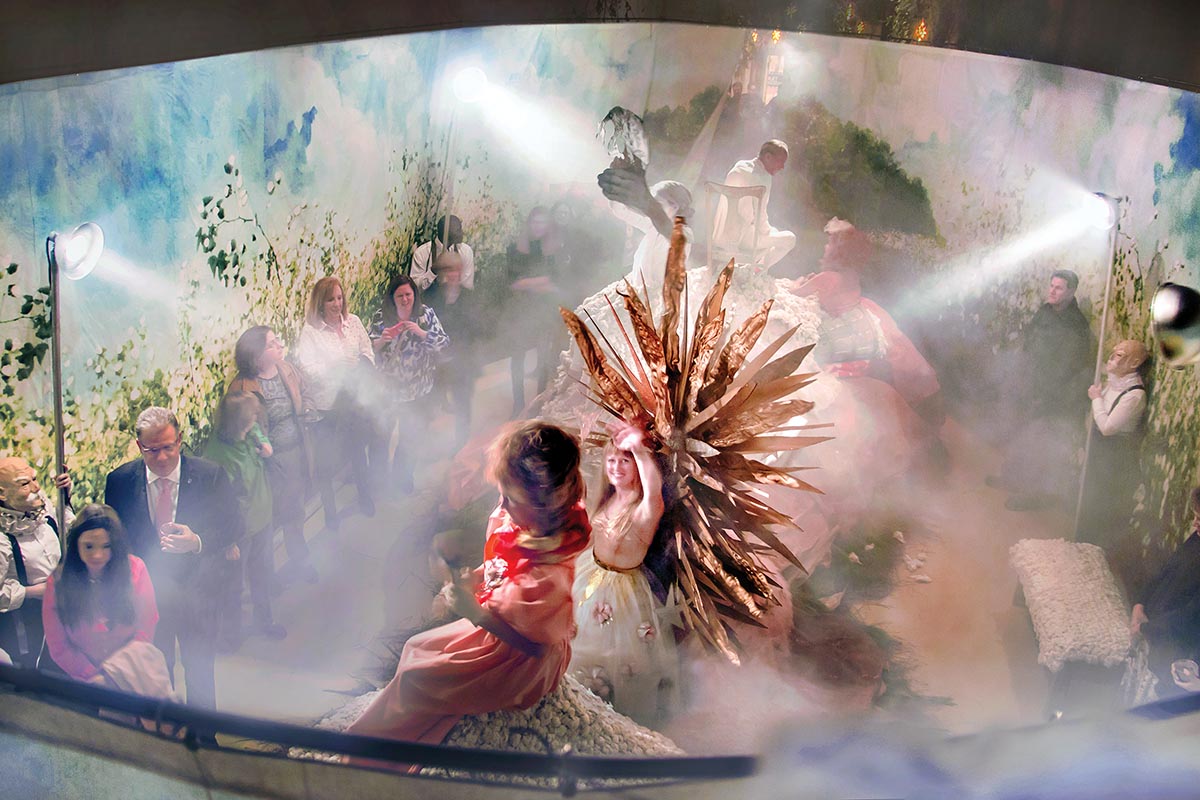
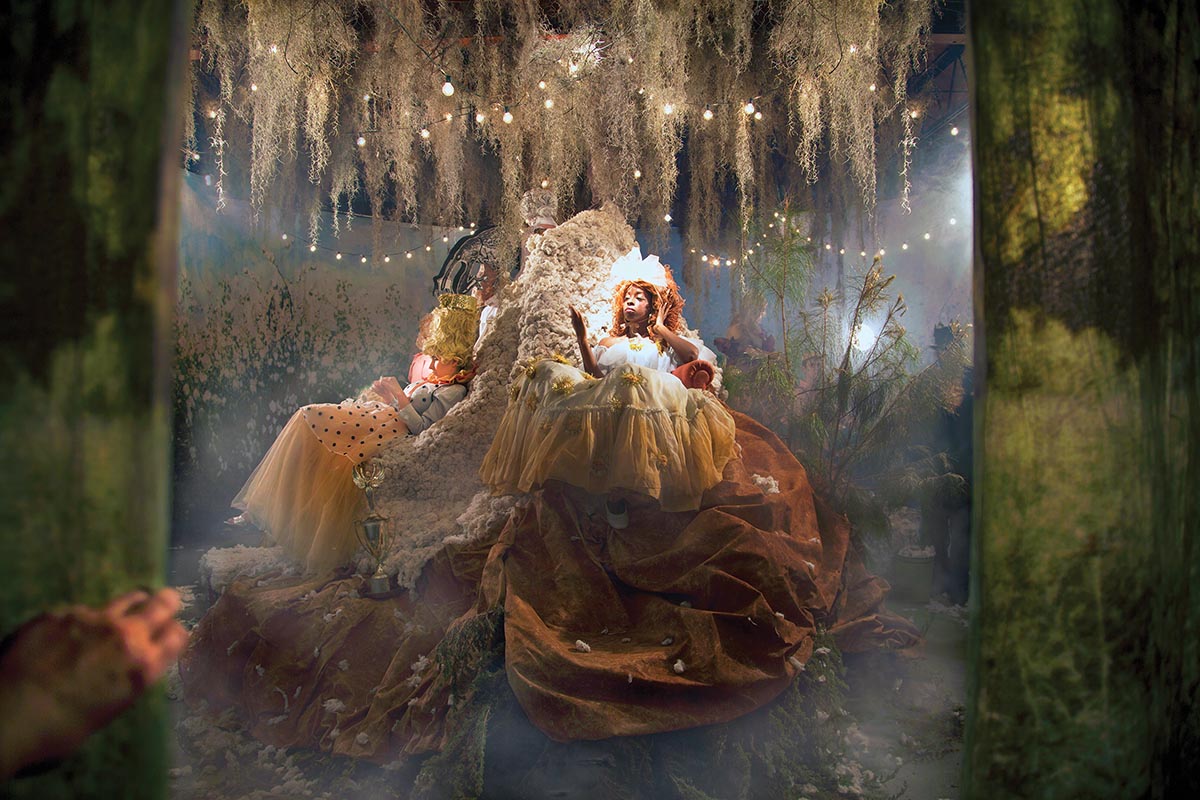
Fine’s first major mixed media and performance installation, “A Procession in my Mind,” was commissioned in 2014 by The Sculpture Center in Cleveland, Ohio. It features images of her late muse, who had been named “Woman of the Year” in 1968 in their hometown of Enterprise, Alabama and rode in a float in the city’s annual parade. The parade each year paid homage to Enterprise’s Boll Weevil Monument, which commemorates the boll weevil, a beetle that residents were told devastated the area’s cotton fields and led its farmers to take up peanut growing instead. Fine takes issue with this narrative, and calls it “an erasure of George Washington Carver’s influence on crop rotation.” Her installation is her response. “Exploring this personal narrative allowed me to investigate the nature of history,” she says, “who gets to tell the story, and whose perspective is honored as truth.”
The main piece of the installation is a cyclorama (above and below), a 10-foot-by-90-foot hand-colored photograph of her father’s farm. While creatively dressed models lounge across pieces of a set outside the cyclorama, visitors step inside the photograph to view sculptures and models dressed as characters from the parade her grandmother so regally enjoyed. “It’s like a funeral procession for my granny,” she explains, “and also the procession of a parade float.”
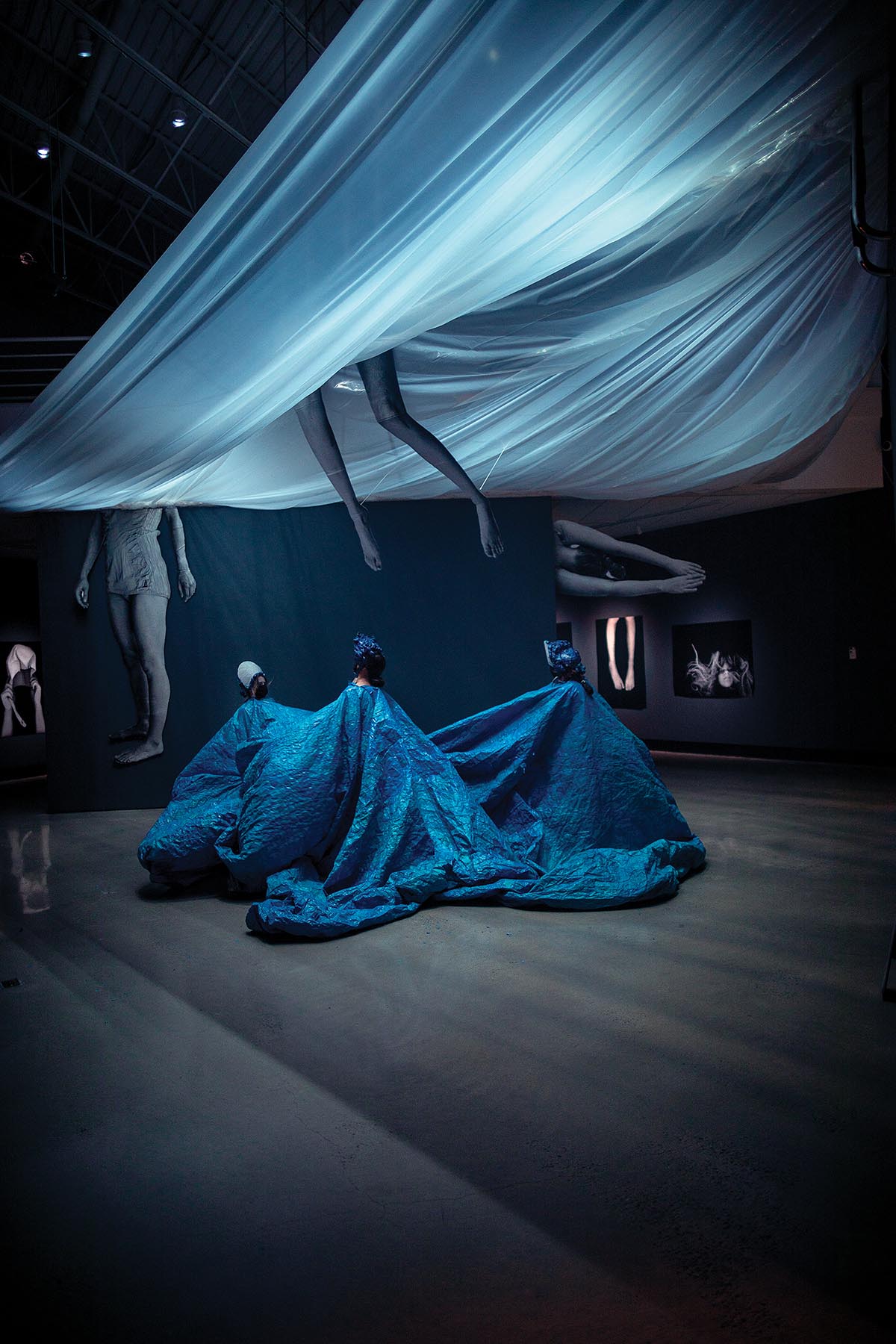
Fine’s powerful “Synchronized Swimmers” installation (see sidebar) opened in 2020 at Dothan, Alabama’s Wiregrass Museum of Art, which also funded it. “Synchronized Swimmers” has been touring since, integrating local histories and enlisting both trained and untrained performers to embody and animate the photographic space, Fine says. During its creation, Fine’s sister died “because of poverty and the lack of Medicaid expansion in Alabama,” she says. “‘Synchronized Swimmers’ became sync/swim, and the added lifesaver is supposed to represent Medicaid, and the pointing finger is about accusations. A performer flicks the finger, and the lifesaver bobs up and down. It’s all about, You’re on your own.” A cardboard image of her late grandmother appears in the work, but Fine says she may eventually add her sister to her art. “I’m going to try to go into the afterlife, find where she is, and bring her back into my work,” Fine says. “So I am thinking about the unknown, the afterlife, something present but at the same time absent, and my work incorporating that into my own personal aesthetics.”
LIVING ART
Fine’s workspace belies her state-of-the-art installations. “I make a modest income,” she says, so her studio is in a family member’s barn—no air conditioning, no heat, exposed to the elements but covered from the rain. “But it’s a place where I can start something and not have to clean up immediately,” she says. Because she works on a lean budget, she uses a Canon transmitter and Speedlites rather than studio lights, and for her medium-format camera, she uses PocketWizards so she can use those Speedlites with her Pentax.
Today, Fine teaches photography online and works on her art while living with and caring for her other grandmother, who is 94. She also helps multiple family members navigate their health issues. “I just try to put one foot in front of the other,” she says. “I live this way so that I have 100% freedom. I mostly feel overwhelmed by the reality of it, but I wouldn’t do anything else. I’m just not made for a 9-to-5 job.”
Mark Edward Harris is an award-winning writer and photographer based in Los Angeles.
Tags: fine art photography