
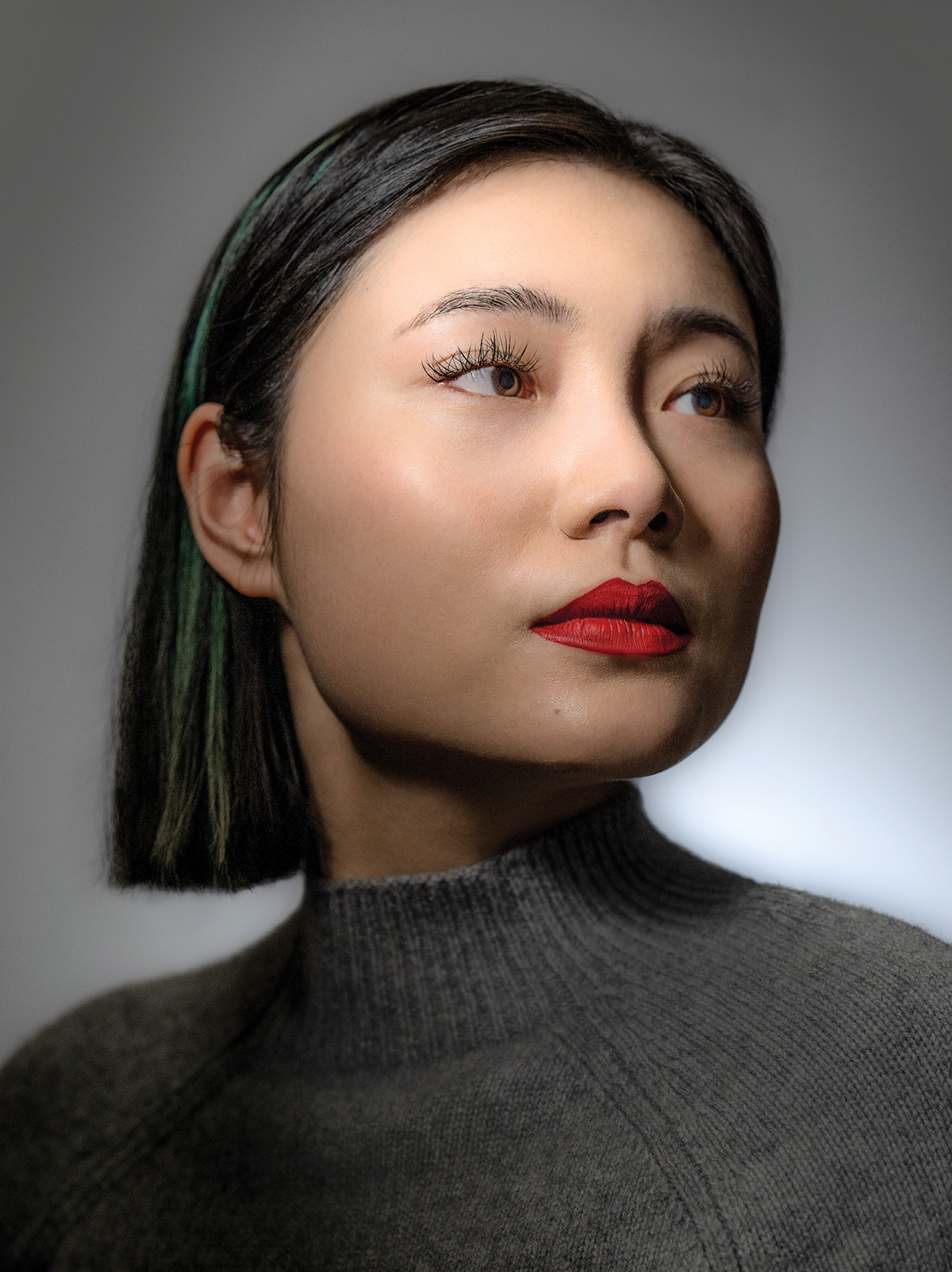
Early in my career I realized that reaching for a reflector rather than another light was often a better and more subtle solution to a given photo situation. That reflector would usually be white or silver, and, if I was in a studio, I might opt for a white foam core. As I developed a more disciplined eye and was exposed to the work of photographers such as Albert Watson (”Refined Eye,” April 2025 issue, page 58), I began to embrace shadows and see the impressive results a negative bounce could bring over whatever my lighting’s natural falloff could deliver. The latter produces arbitrary results since it’s influenced by the reflectivity of the surrounding area.
Watson’s 1992 “Love Deluxe” album cover photograph of Sade—where he used negative fill for the singer and a bright, evenly lit white background—is a perfect example of what total control of an environment and a negative bounce can bring to an image. For this type of lighting scenario, setting up foam core V-flats or some other gobo just out of frame between the bright background and the subject is vital to avoid light spill. If you have the space and a large backdrop or cyclorama, take advantage of it to distance the subject from the background.
For my sessions with gallerist Yiwei Lu (above), I used one StellaPro CLx10 in a Profoto White Softlight Beauty Dish reflector with a silk as a key light and a second CLx10 with a Dome Diffuser to partially illuminate and subtly separate her from the background (left). One of the advantages of working with constant light sources such as the StellaPro CLx10 when sculpting light is that you obtain the “what you see is what you get” factor in real time.
I first set up the portable studio for a theatrical style portrait with black fabric laid over my Westcott Eyelighter underneath the frame of my Nikon Z8 with a Nikkor Z 85mm f/1.2 lens with Westcott Illuminator QuickGrip 5-in-1 reflectors with their black sides just out of frame on the sides (below).
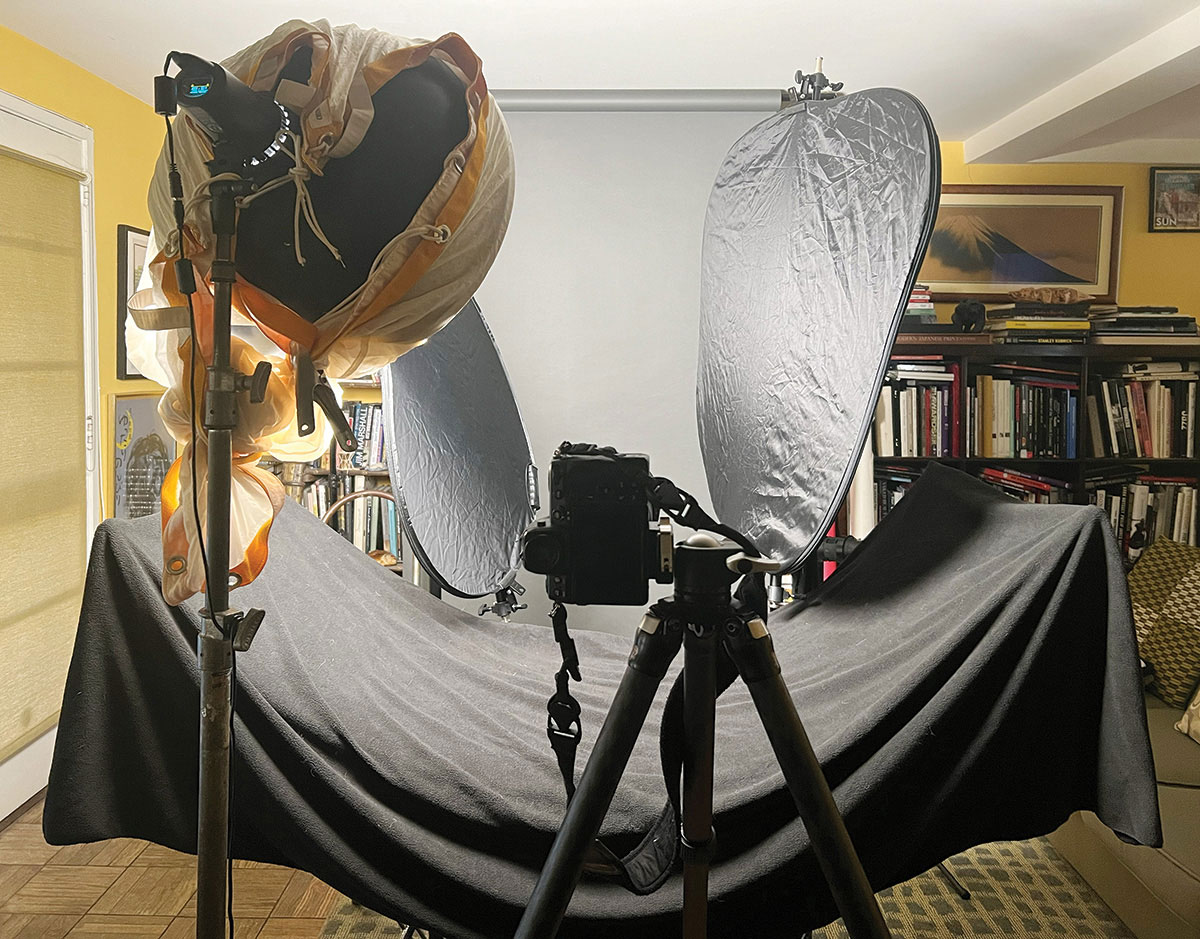
Using the black sides of Westcott Illuminator QuickGrip 5-in-1 reflectors provides negative fill for the portrait of Yiwei Lu at the top of the article.
Each size of Westcott’s 5-in-1 reflectors is made for specific photo scenarios. The 20-inch is an ideal tool for headshots, macro photography, small still lifes, and is especially useful for precise light control in tight spaces. It’s also ideal for travel photography since it can be slipped into virtually any camera backpack or roller bag. The 30-inch works well for wider portraits and small to mid-sized still lifes. The 40-inch reflector provides light control for couples’ portraits and medium-sized still lifes, and the 50-inch reflector is an ideal tool for 3/4-length portraits and small group shots. Westcott’s 48x72-inch reflector is designed for full-length portraits and family photos, and also makes a great gobo.
For outdoor sessions with an assistant or solo assignments when I have a cooperative bystander, the two handles on the Westcott Illuminator QuickGrip 5-in-1 reflectors make for easy lighting adjustments and more stability in windy situations. The 5-in-1 reflector kits include a diffusion disc to soften harsh light for smooth, even lighting; a reversible slipcover with silver for adding contrast; a gold-tinged sunlight surface for warmth; white to soften shadows; and black to block stray light or add negative fill.
The second portrait of Yiwei fits a more glamour or commercial style (below). I swapped out the gray seamless for red, increased the power on the background light, removed the black fabric I had draped over the clamshell-shaped Westcott Eyelighter, and changed the 5-in-1 reflectors to silver. I used Westcott’s Illuminator Arm Extremes to hold the reflectors, which enabled me to put them back into the same positions quickly. These telescoping arms are valuable tools for the subtle adjustments needed for intimate portraiture. Just mount them on a C-stand or light stand and use the telescoping sections and spring-loaded clips to grip and position. I often turn to the Westcott Eyelighter for headshots because its arc-shaped design matches the natural curve of the human eye, resulting in a seamless catchlight without distracting shapes or gaps. The Eyelighter sets up and breaks down in less than two minutes.

Without the reflectors changed out to use the silver side and a pop of color with the seamless red backdrop, this second portrait is a more glamour or commercial style look.
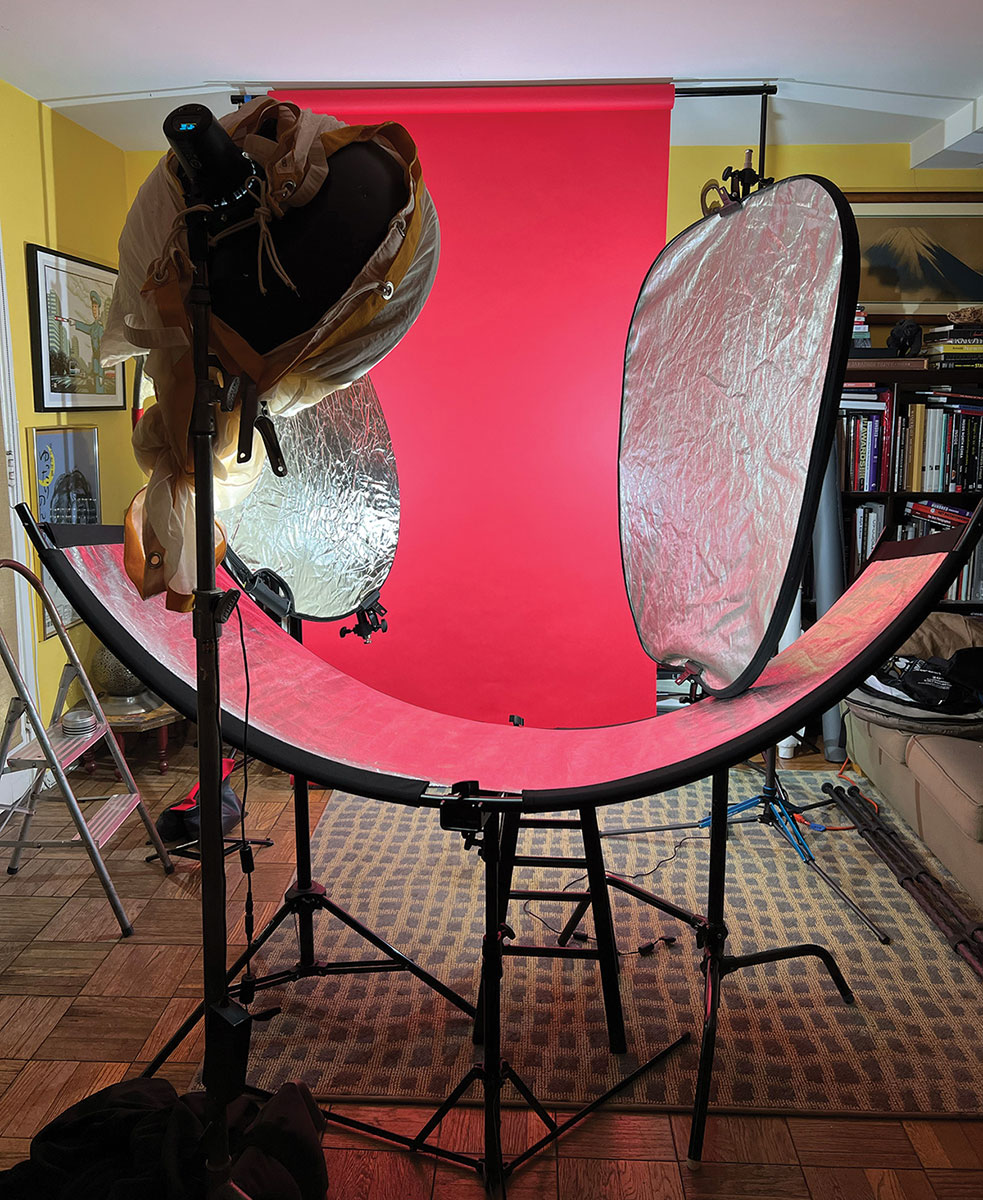
Here the black drape is removed from the Eyeligher and the reflectors are now using the silver side.
Except for my beauty dish, a large reflector, and the seamless backdrops, I can pack everything in my portable studio into Think Tank Stand Manager 52 and Production Manager 50 V2.0 roller bags. My camera equipment goes in a Think Tank backpack. This is ideal when I’m on my own for a location shoot where I need to quickly set up and break down the set. If you wanted something even more compact, you could consider Profoto’s collapsible OCF Beauty Dish and a fabric background.
No matter the assignment I’m packing for, I always include at least one Westcott 5-in-1 reflector, which gives me the option to go for more drama if a photo op calls for it. Using black surfaces to sculpt light and create rich shadows is one case where negativity is a positive thing.
Mark Edward Harris is an award-winning photographer and writer based in Los Angeles.