
Sea Change
Nautical photographer Onne van der Wal perseveres
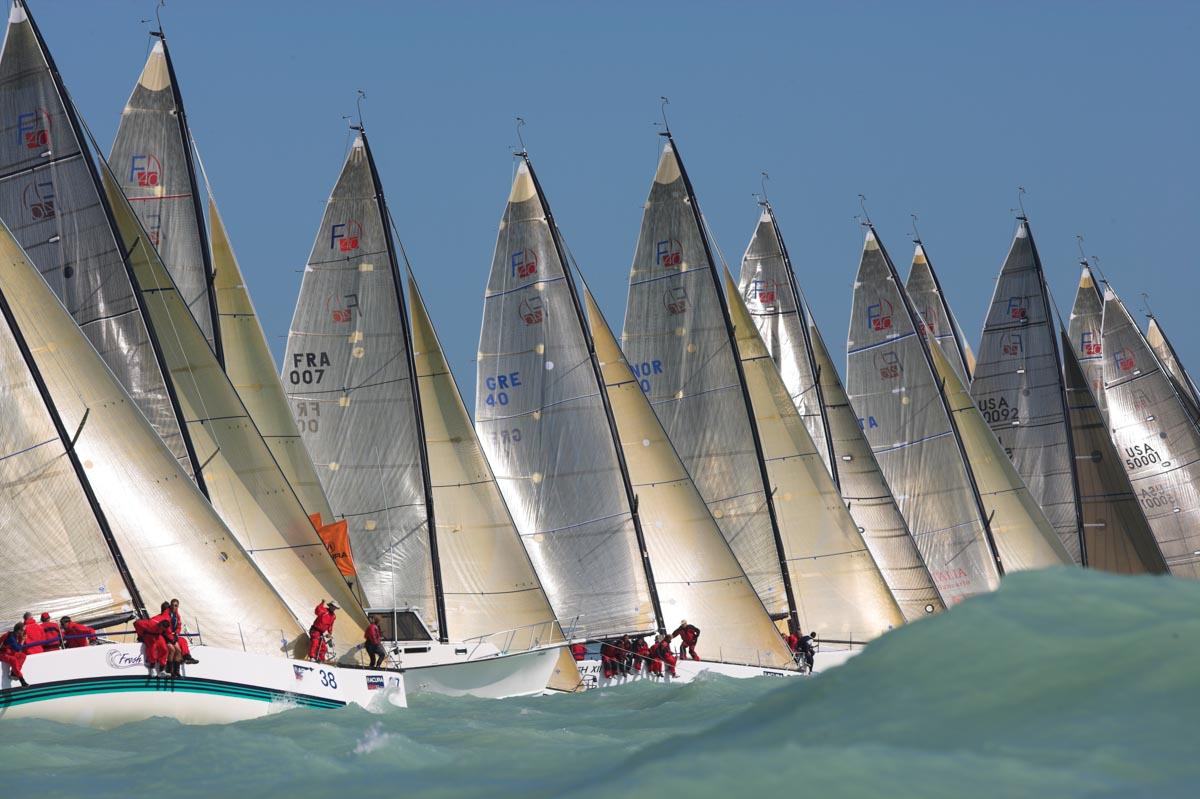
Sometimes in life you experience a sea change. For Jamestown, Rhode Island-based photographer Onne van der Wal, it was literal. When he met a man who paid him just $350 a day, the course of his life changed forever. What started as an extension of professional sailing became a thriving career in nautical photography. This interview has been edited for length and clarity.
Tyler Rickenbach: You came into photography through sailing. How did that begin?
Onne van der Wal: It really did start by accident. I had been sailing professionally for about three years when I was selected as one of the final 16 crew members for Flyer II, which was built to race the 1981-82 Whitbread Round the World Race. During crew training, we sailed from the Netherlands across the Atlantic to Newport and then up to Marblehead, Massachusetts. One day, the boat was sitting on a mooring and everyone else was ashore. I was on board doing mechanical work when I heard a knock. I looked over the side and there were three guys in suits in a little rowing boat, which immediately struck me as funny.
They turned out to be from Sail magazine: the publisher, the editor, and another staffer. They wanted a tour of the boat. At the end, I said to the editor, “I’ve been taking some pictures. Would you like to see them?” I brought up my slides and he held them up to the light on deck. He looked at them and said, “This is really good. Can I take these with me?” The next day, I got word that they wanted me to shoot for Sail magazine during the Whitbread Race. I went to the owner of the boat and he said, “That’s fantastic, and while you’re at it, why don’t you just become our official photographer? I’ll even supply the camera gear.” That’s how it started.
TR: You were still a working crew member at that time. What role were you playing on the boat?
OvdW: I was the engineer on the boat and also the bowman, which means I worked forward of the mast handling sails. It’s the wettest, bumpiest, most chaotic part of the boat. When sail changes happen, you’re in charge and you’re getting hammered by water the whole time. Photography didn’t replace my job. It was layered on top of it.
 View Gallery
During the 1981-82 Whitbread Around the World Race, van der Wal was given 20 rolls of Kodachrome film per each of the four legs of the race, 80 total rolls.
— Leg 1 was Portsmouth, England to Cape Town, South Africa.
— Leg 2 was Cape Town to Auckland, New Zealand, passing south of Australia.
— Leg 3 was Auckland to Mar del Plata, Argentina by way of Cape Horn.
— Leg 4 was from Mar del Plata back to Portsmouth on the southern coast of England.
The undeveloped film was sent by DHL from the various stopover ports to the Sail magazine office in Boston and then on to Kodak in Rochester, New York. When the magazine received his images, Onne van der Wal recalled, “They said, ‘Amazing work. Blown away. You’ve got the February cover.’”
The Flyer II won both the timed race and on handicap.
TR: When your work was published during the race, did that change how you saw yourself?
OvdW: No. I was still a sailor at heart. I still had a race to finish. I loved making photographs—especially in the Southern Ocean with icebergs, penguins, albatross, and then in the tropics with towering clouds and no wind—but I was still doing my job on deck. It didn’t change my life in any way, but it was nice to start getting published. What stuck with me was watching how other photographers behaved in port. The press would swarm the boat with no manners, no respect. I remember thinking, “I don’t want to be that guy.” That actually kept me sailing longer.
Onne van der Wal took his first photographs in 1981. It was seven years later that he began to pursue photography full-time.
TR: How did the transition to full-time photography happen?
OvdW: After the [Whitbread Round the World Race], I went back to the Netherlands, worked in a boatyard, kept sailing, kept racing. I was young and single, and people kept calling me with offers to race all over the world. Photography was still secondary. Then Sailing magazine ran a feature on me called “Sailor with a Camera.” That’s when people started asking, “Why are you still sailing?” By 1987, I was tired of living on boats. Racing boats are basically empty aluminum cans—pipe berths, freeze-dried food, bucket toilets. I’d done a lot of miles, and I was ready to move ashore. At 29, I hung up my sea boots and became a professional photographer.
TR: What gear were you using in those early years?
OvdW: My first camera was an Olympus OM-1. I bought it with a $1,000 paycheck from a captaincy job. Everything was manual focus, but the lenses were fantastic. After the Whitbread Race, Olympus sponsored me. From about 1987 to 1990, I shot entirely with Olympus—Kodachrome and Ektachrome. Then a friend in the U.K. showed me the Canon EOS-1 with autofocus. I pointed it at a duck on a pond and watched it snap into focus. I thought, This will change my life on the water. I sold all my Olympus gear and switched to Canon in 1990.
While shooting with Olympus, van der Wal had every lens he could have wanted. Canon’s autofocus inspired him to change systems, and he purchased a body and three lenses: the Canon 24-70mm, 70-200mm, and a 300mm f/2.8. He still has the 1990 receipt.
TR: That switch eventually led to you becoming a Canon Explorer of Light. How did that relationship develop?
OvdW: Very slowly. I went to Photo Expo in New York every year for 10 years and tried to talk to Canon’s marketing director. Nothing happened. Then on year 10 he said, “We want to show how tough our cameras are, but not in a war zone. What about you shooting on the ocean?” For about 15 years I worked closely with Canon: lecturing, advising, testing gear, talking with engineers in Japan about mirrorless long before it arrived. It was a great time. Eventually Canon shifted more toward video and younger creators for social media, and I thought, that’s not really where I want to go, and I quietly bowed out.
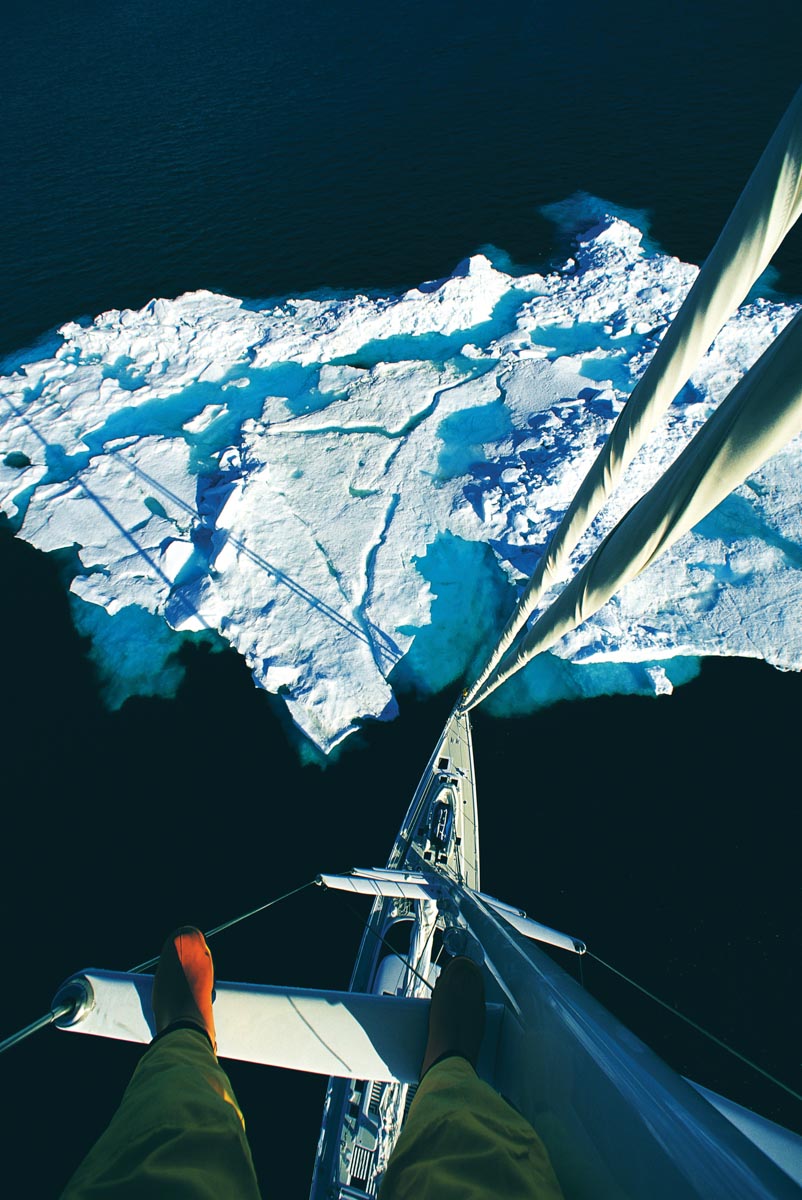
TR: Can you walk us through the iceberg mast photograph (above)?
OvdW: We were sailing through an ice field in Svalbard. It was 80 degrees north latitude, north of Norway, closer to the North Pole. No wind, sunny, beautiful. I said to Mr. Johnson, the owner of the boat, “We must stop here.” I wanted to go up the rig, go to the mast, and shoot looking down. They hoisted me up in a boatswain’s chair to about 120–130 feet. I took a radio and directed the skipper, “Turn the bow a little. Hold it there.” I was shooting with a Canon EOS 5D Mark III and a 14mm rectilinear lens. I climbed out onto the spreaders and shot looking down. I even took a picture of my boots for Patagonia. That image became a cover. That picture never sold much in the gallery, but it stopped people. They would often question how I got the image, and then they’d buy something else.
TR: You’ve talked about risk and isolation. Were there moments you chose not to shoot?
OvdW: I was always happy to take the risk to go out there, but sometimes the conditions would be too extreme to physically shoot—70-mile-an-hour winds, spray everywhere. But suddenly the sun poked out. It was a dramatic scene, and there are albatross flying around and all that, but I could not shoot in the direction I wanted, which was towards the iceberg and sort of backlit because there was so much spray in the air. I ended up shooting through the windows from inside the cabin.
I also wish I had photographed more when I was young. I worked on fishing boats in South Africa in the 1970s. If I had a Q3 then, I would have made incredible documentary work. I’m actually going back there in January, and I’m just going to take a Q3.
TR: After 40 years, what advice do you give younger photographers?
OvdW: When I was lecturing for Canon at all the various colleges, camera clubs, and high schools, I remember a kid once stood up and said, “Mr. van der Wal, how long does it take to get the ball rolling? Is it one or two years?” The kid was 18 or 19.
I said, “You’re not going to want to hear this, but it’s going to take you 10 years.” Now you start working at your photography career, and you do it for 10 years. You’re 28 and now you have something that is really working for you, and you can make a living with it. What’s wrong with that? If you’ve got a passion and you figure out what you want to do, just know it’s not going to be easy. If it was, everybody would do it. But every once in a while you’ll see little streaks of light coming through … and you keep going. You persevere. And suddenly, the phone rings and you’re given another assignment.
SIX MONTHS
As our conversation began to wrap up, I asked van der Wal, “What continues to inspire you after 40 years of shooting?”
In a rather quiet voice he said, “I’ve got to let you in on one little thing here. I’m dealing with pancreatic cancer … I was diagnosed three years ago. Most people don’t last six months.”
“I’m still here,” he said with a smile. “Radiation, surgery. More chemo with its ups and downs. One minute you weigh 165, the next minute you weigh 90 pounds.” This part of our conversation wasn’t planned, but van der Wal’s enthusiasm for life, and love for photography is contagious, and I could feel it. People would often ask him, “Why are you working on a book when you feel like this?” His answer was, “Because I love doing it.”
“When the Leica Q3 came along, there was another huge sort of drug that helped me so much mentally ….”
Between open water swimming, his Q3, and his boats, they’ve kept van der Wal going through the trials of pancreatic cancer. He isn’t sure how long he’ll last. “I could be kicking this thing for a while … but in the meantime, the photography and the Q3 … keeps me positive, loving life, staying fit, eating well, and exercising.”
Through it all, photography with the Leica Q3, and side projects like a coffee table book and calendar have given van der Wal a mission and a meaning just like the expeditions with Johnson did years ago.
Tyler Rickenbach is a filmmaker and photographer based in Idaho.