
Pitch Fever
Mark Edward Harris shares his World Cup experience and game day tips other types of photographers could take away for their own work.
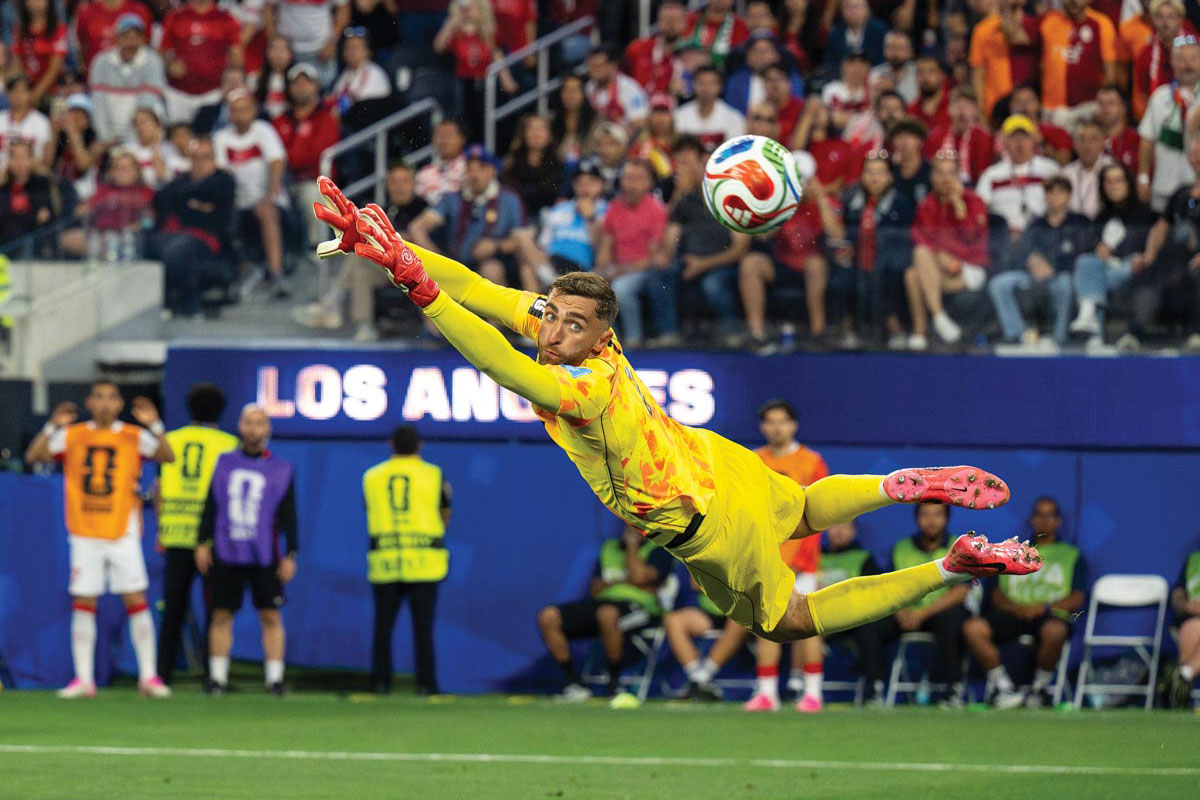
Soccer (or football/fútbol) is one of the most difficult sports to cover for several reasons. The first is the amount of real estate to cover. Though the size can vary, a soccer pitch is typically 105x68 meters, roughly 115x74 yards. For comparison, an American football field, including the end zones, is 120 yards long and 53 yards wide, and photographers have more freedom to move with the action than they do covering soccer. The second issue is the lack of scoring. Two of the eight FIFA World Cup 2026 matches I covered in Los Angeles ended 0-0 and 1-0. Field-credentialed photographers can choose a fixed position on three sides of the pitch: one along the sidelines opposite the team benches or on either side of the two goals. This means that in a 1-0 match, you have a one in five chance of being in the right location to capture the match-determining goal. If I’m on the right side of the goal and the goalkeeper jumps to his left to block the shot, I will be out of position.
The lessons I learned covering the 2026 FIFA World Cup can be applied to many sports, as well as other photographic genres.
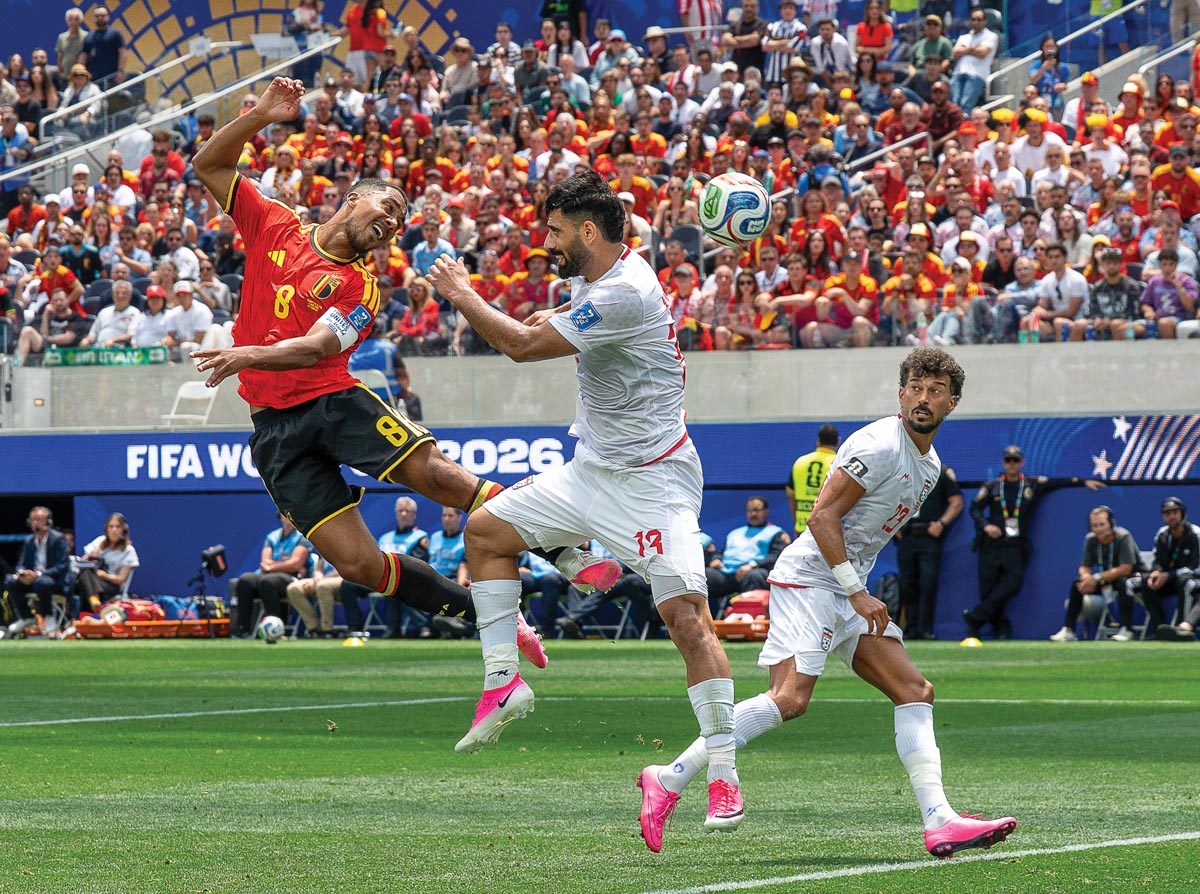
With my Nikkor Z 70-200mm f/2.8 VR S lens, I captured Belgium’s Youri Tielemans attempting a shot in a match that ended in a 0-0 draw with Iran.
Remote Cameras
For example, using a remote camera greatly increases the odds of capturing a goal. At a wedding, a remote camera can offer unique angle positions, such as above the altar.
PocketWizards are the industry standard when it comes to triggering remote cameras. Their latest version, the PocketWizard Plus Ve, works with an internal lithium-ion battery that lasts approximately 35 hours per charge. During the games, I slipped one of the paired transceivers in receiver mode onto a Nikon Z 9 hot shoe then plugged a N10-ACC remote camera cable into the camera’s 10-pin remote port. I placed the camera with a Nikkor Z 14-24mm f/2.8 lens on a base plate with a Benro ballhead behind the net and pre-focused on the goal line in manual mode. I set the shutter to 1/2,500 second, the sweet spot for action on the pitch. Part of the magic of photography is its ability to freeze a moment in time, and I like to go the full distance with that concept. I set my f/stop to f/5.6 and ISO to auto with +.3 exposure compensation since I was photographing up into a brighter translucent dome-topped stadium with supplemented bright lights. On top of my Nikon Z 8 with a Z 70-200mm f/2.8 lens, I set the PocketWizard Plus Ve to transmitter mode with a remote camera cable going into the camera’s remote port. With my behind-the-net setup complete and remotes paired, I settled into my assigned folding chair with the Z 8 and my other Nikon Z 9 with a Z 400mm f/2.8 lens attached to a Benro SupaDupa72 Carbon Fiber Monopod.
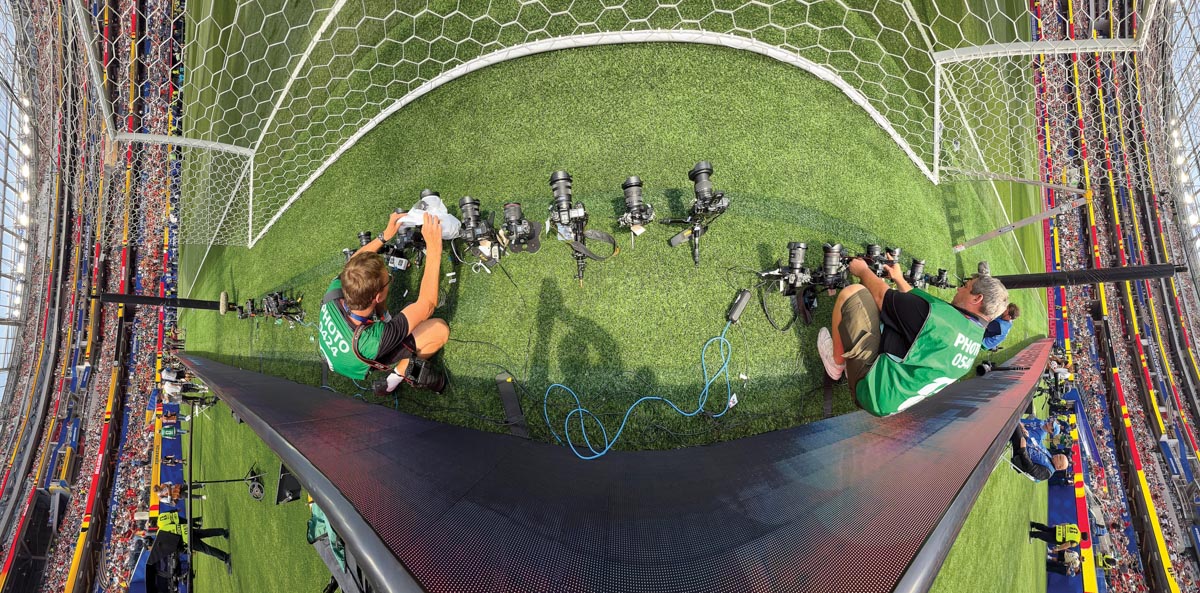
Credentialed photographers set up their remote cameras behind the net before the Spain vs. Belgium quarter final World Cup match in Los Angeles Stadium.
The Plus Ve has 112 channels and 6 zones for less interference in crowded, multi-photographer settings such as the World Cup, Olympics, or other major sporting events. For photographers working in less crowded venues, a pair of easy-to-use 10-channel PocketWizard PlusX Transceivers is a less expensive option. Either way, when working with remotes, it’s vital to turn the sleep mode off on the camera body. If not, by the time the camera wakes up, you may have missed the peak moment of action.
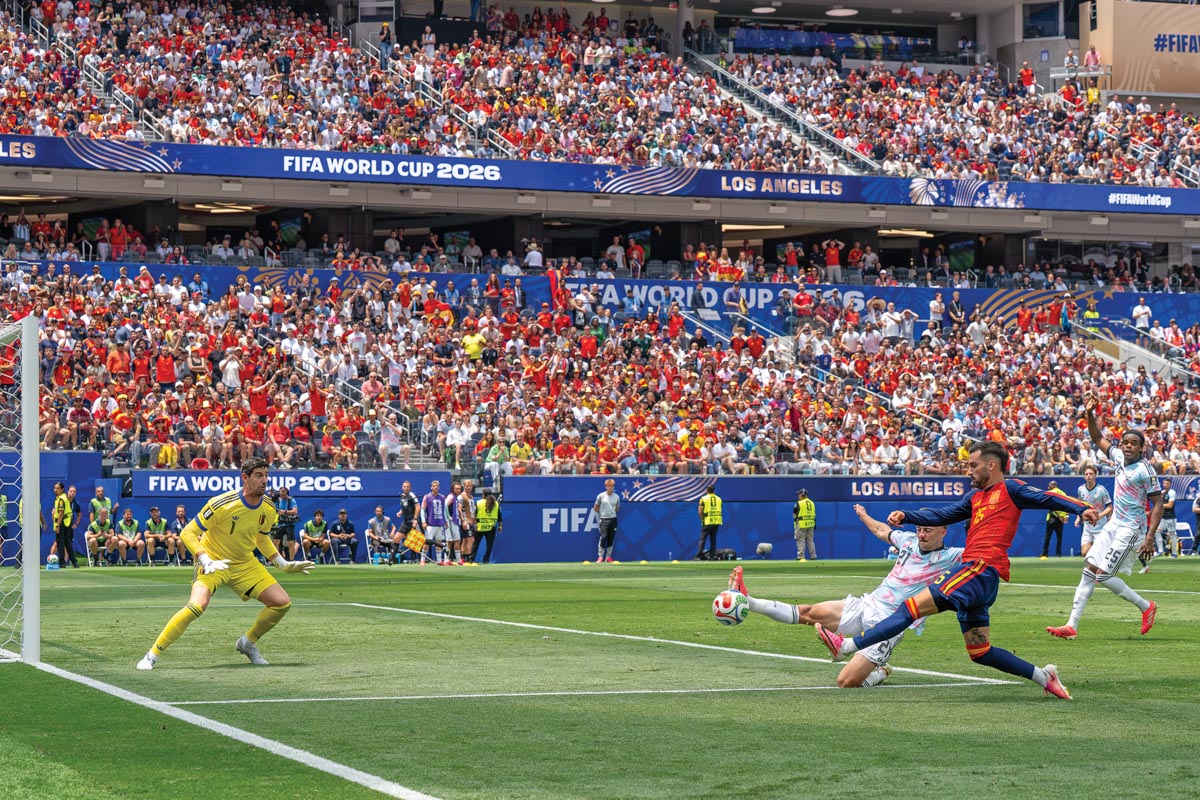
Spain’s Álex Baena attempts a shot that was deflected by Belgian Timothy Castagne in their quarter final World Cup 2026 match.
Position Flexibility
For FIFA World Cup soccer, credentialed photographers are packed tightly together, especially on the goal sides of the pitch, so cooperation is a must. The first step to coexistence is removing or reversing lens hoods on longer lenses. While I’m a strong advocate of using a lens hood to avoid lens flare and ensure rich colors, there’s simply no choice.
In other sports, there are varying levels of position flexibility. Golf is on the opposite side of the spectrum from soccer because of the nature of the game. With “inside-the-ropes” credentials, we can move around the golf course to get the most dramatic angles of the players. The one restriction, up until the advent of the mirrorless camera, was that we could only depress the shutter after ball impact to avoid disturbing the players on their backswings. That rule is being updated. Shooting in silent mode on a Nikon Z 9 does not reduce image quality, since the camera uses an ultra-fast electronic shutter. But banding can become an issue under arena and stadium lighting because of the flicker in LED lights. The Z 9 has a High-Frequency Flicker Reduction feature to eliminate banding with micro-adjustments to the shutter speed.
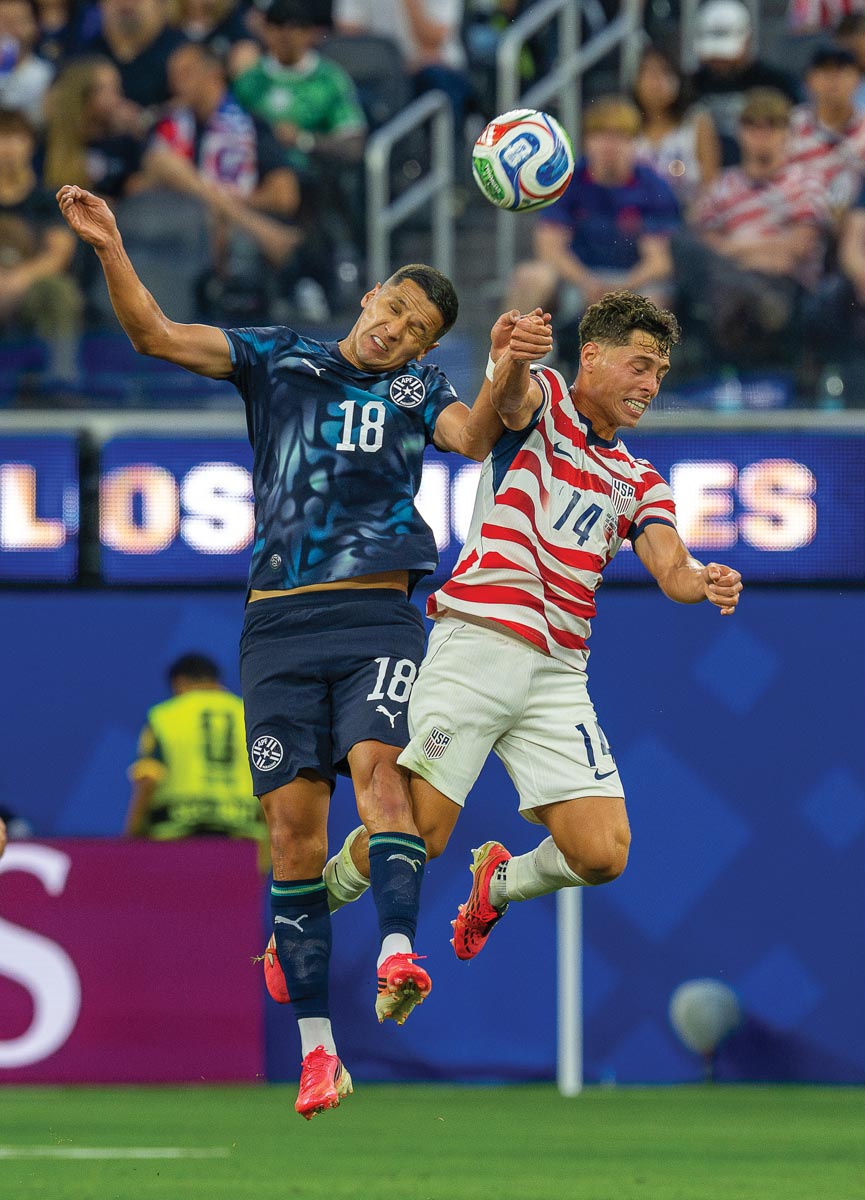
Players going for a header makes a great photo op. Paraguay’s Álex Arce and USA’s Sebastian Berhalter go after the ball during a Group D match in Los Angeles Stadium.
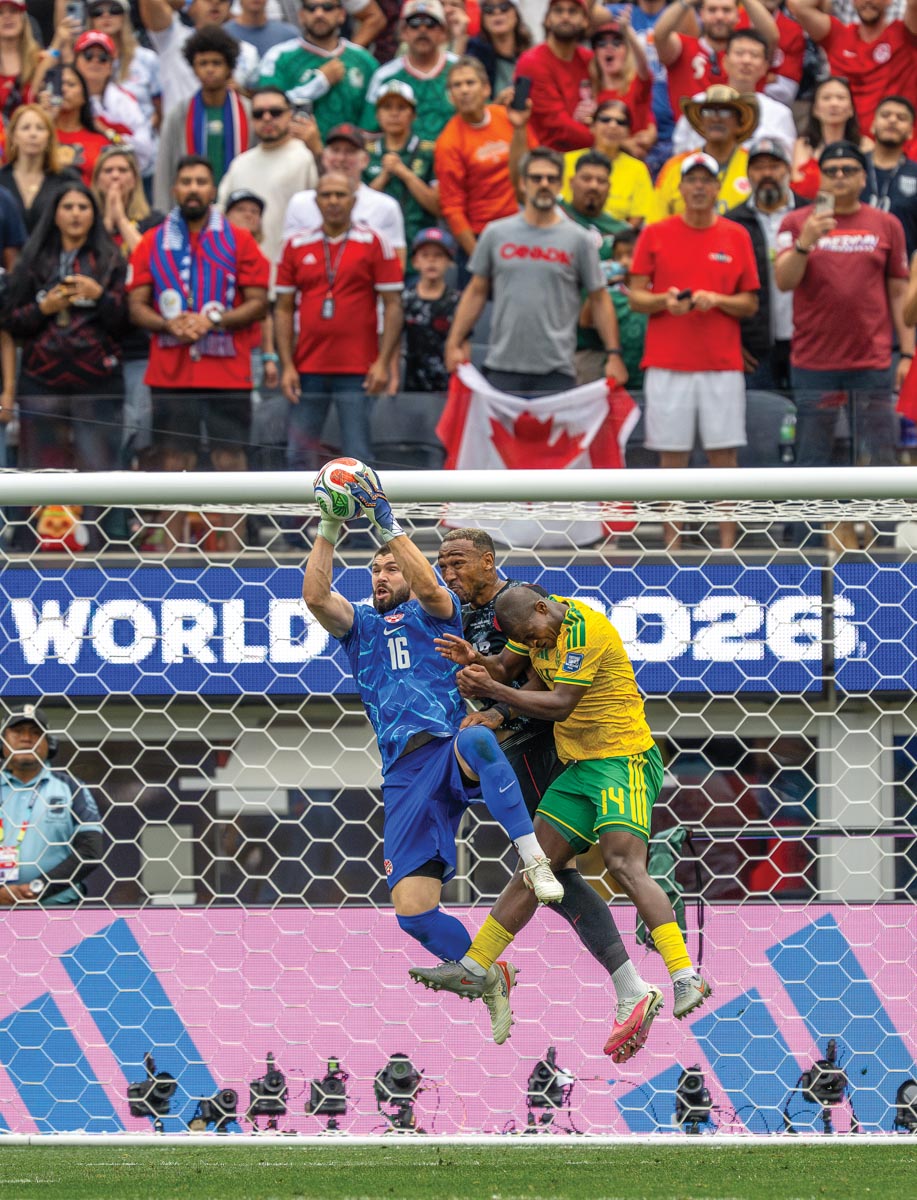
With the Nikkor Z 400mm f/2.8 TC VR S lens with a built-in 1.4x teleconverter, I have the equivalent of a 560mm lens and captured Canadian goalkeeper Maxime Crépeau from the other side of the pitch as he stopped a South African goal attempt.
In terms of getting the images you want, a bit of homework can go a long way. While it’s a photographer’s goal to capture the perfect images of World Cup soccer stars like Argentina’s Lionel Messi, Norway’s Erling Haaland, or Spain’s Lamine Yamal, knowing the names and jersey numbers of other players, and how and where they play, will pay off. When you visit the online portal the day before the match to pick a position for photographing, you can use this knowledge to select the best angle to follow those you would most like to document. I use a photo-essay-style approach to expand my coverage by documenting spectators with their signs, flags, and painted faces, as well as making establishing shots of the stadium. I also pull my Nikkor Z 24-70mm f/2.8 out for team photos near the normally off-limits team bench areas just before kick-off.
To further extend the scope of my on-the-pitch coverage, I often engage the built-in 1.4x teleconverter on my Nikkor Z 400mm f/2.8 for midfield and backfield action. Players jumping for a header is a good photo op. Typically it’s more interesting if they’re facing toward my camera. I can anticipate the action by watching the goalkeeper and pointing my camera downfield in continuous focus. To capture the action in front of the goal on the far side of the pitch, I switch to single focus, aim at the goalkeeper, and press and hold the shutter button halfway down so that I maintain that focus when other players move in front of him. I use the same technique when covering golf, when the player is going to hit out of the rough or sand in my direction. In continuous focus, the sand or grass can pull the focus away from the player even if I have subject “people” selected.
For those without press credentials, stadiums have varying rules about what type of photo equipment is allowed. MLB teams, for instance, do not have identical photography rules, and restrictions on lens sizes and support gear vary between venues.
There are pathways to enter the professional sports photography arena. Covering high school, college, and minor league sports for local papers or news organizations, for instance, is great training to get a shot at covering major league teams.
Mark Edward Harris is an award-winning photographer and writer based in Los Angeles.
Tags: gear sports photography