
Match Ready
Tapping into the fast-paced world of women’s soccer
Kevin Gilligan started his career as a prosecutor in Los Angeles, a job that involved a “steady diet of crime and nuisance.” For his own mental health, he needed an artistic outlet. So, he picked up a camera and started photographing landscapes, then portraiture, and eventually sports. He assisted established photographers and traded his labor for lessons in lighting, composition, and technical details.
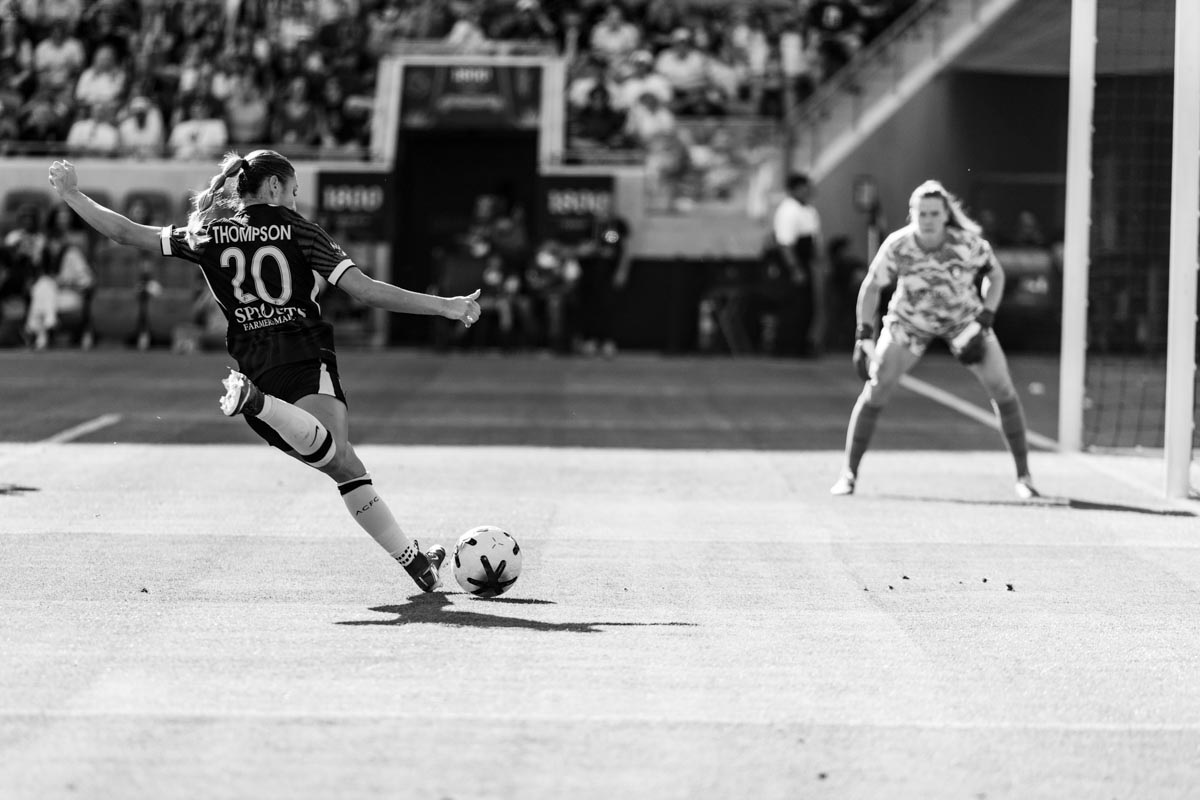
A former high-level soccer player with a daughter currently playing Division I soccer in college, Torrance, California-based Gilligan was intrigued by women’s soccer. He worked his way onto photographing the sidelines at college soccer matches and local tournaments before eventually earning credentials to photograph Angel City FC, L.A.’s National Women’s Soccer League (NWSL) team. Today, Gilligan is a regular fixture on the Angel City sidelines, and he offers a playbook for other photographers who want to break into one of America’s fastest-growing professional sports.
GETTING ACCESS
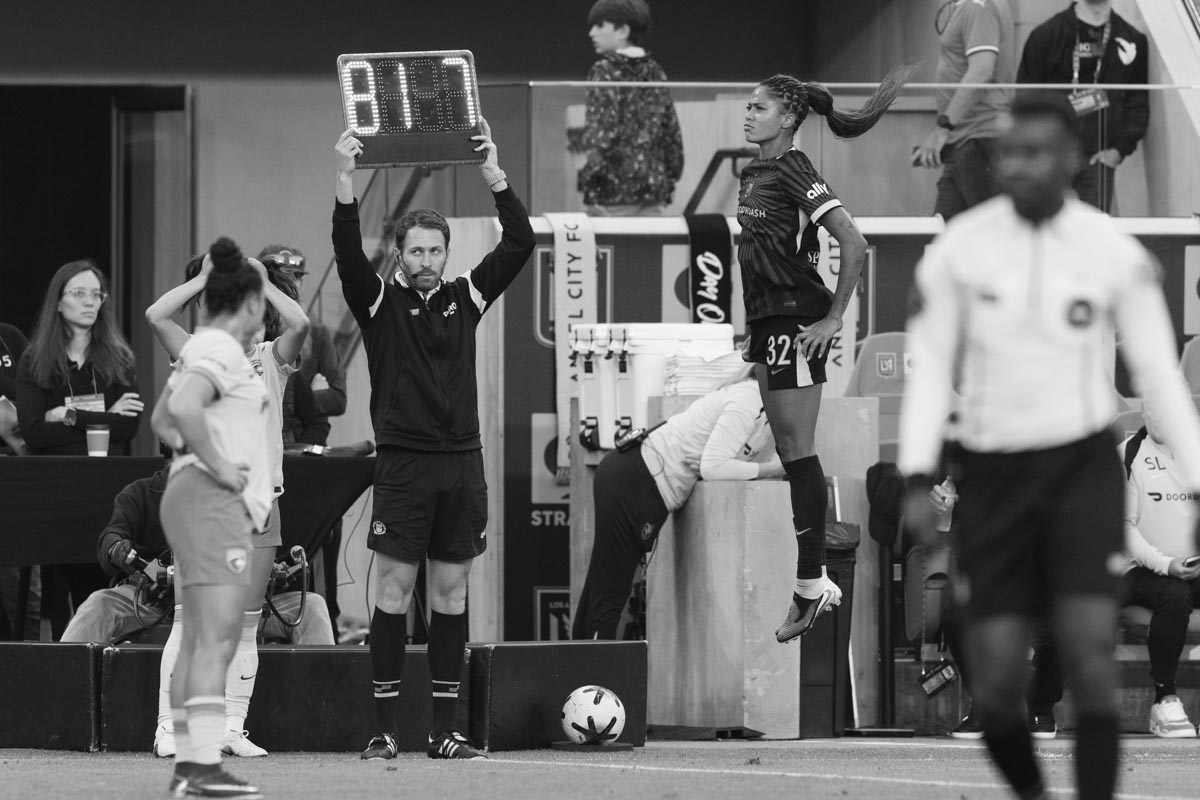
Before Gilligan could capture a play on the pitch, he had to get into the stadium, which is no easy feat. Gilligan’s first application to shoot NWSL was rejected outright, “but I’m not someone who’s bothered by the word ‘no,’” he says. “So, I kept trying different angles to get credentials.”
The fix, he found, is understanding that credentialing runs through editorial access. Most professional soccer organizations publish media policies, and nearly all of them require a sponsoring news outlet or publication, because access is granted primarily for reporting purposes. Gilligan eventually found a magazine willing to sponsor him; an editor wrote the letter that got him his first credentials. From there, he worked hard to become a valuable contributor to the publication and continue making connections for access to future games.
Gilligan’s advice for photographers navigating that same maze:
Read the media policy first. Every professional club and governing body posts one, and requirements vary by organization.
Find an editorial sponsor. Approach local papers, magazines, or online outlets and pitch a specific story idea, not just a request for access.
Expect rejection, but don’t let it stop you. “It’s important to keep looking and not quit,” Gilligan says. “Take no as a suggestion. Understand that’s going to happen. Treat it as a learning process and keep trying.”
Consider a smaller market. Competition for credentials is fierce in major cities with deep benches of photographers. A club in a smaller city may offer an easier entry point, as do some college teams and youth clubs. Build your portfolio photographing at those levels and use those images to validate your claims for access to top-tier professional games.
THE ROAD TO MONETIZATION
Aside from getting paid assignments from media outlets or public relations companies, Gilligan notes there’s no single path to monetizing sports photography. In his experience, once you have a viable portfolio, you can pursue multiple pathways, including stock sales, gallery exhibitions, teaching workshops, and private photography coaching. However, using game images for anything beyond the original editorial purpose usually requires separate permissions from the sponsoring organization, so understand the terms of your credential and maintain a good relationship with the team’s media department.
PREPARATION IS KEY
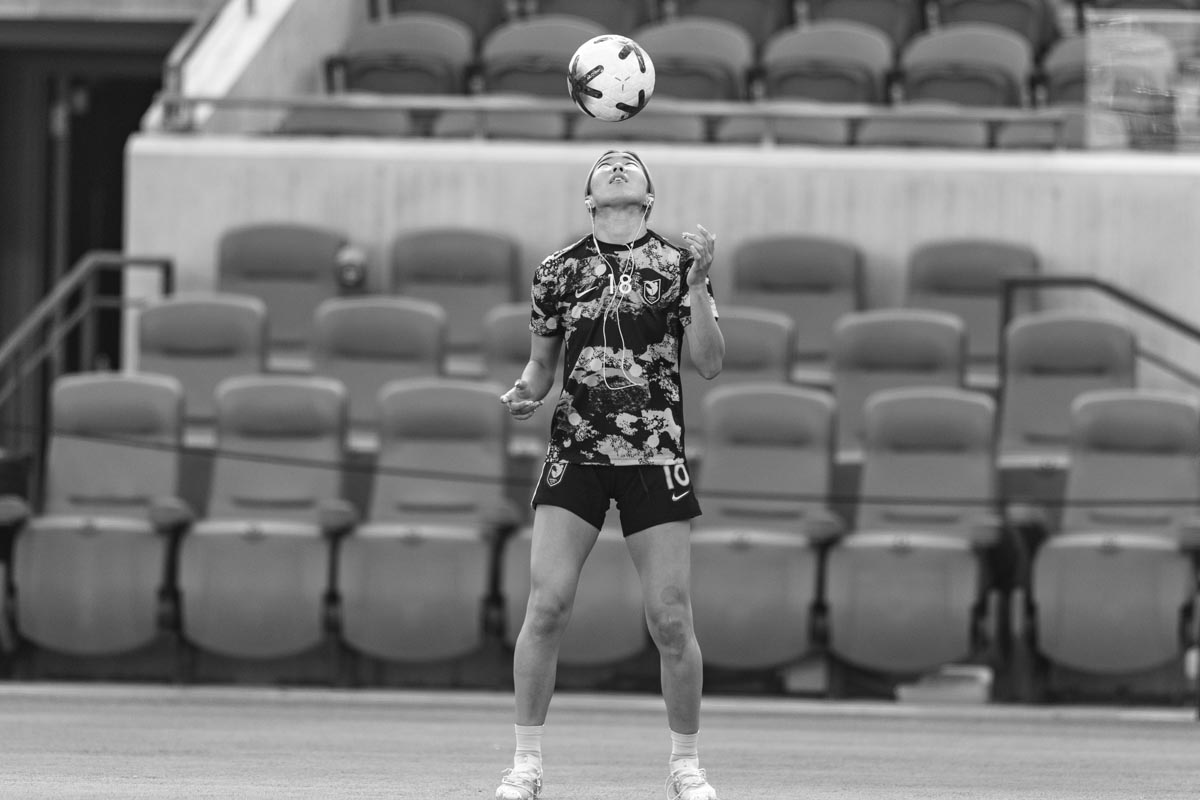
“My work actually starts at least the day before the game, if not two days before,” he says. He cleans and charges gear, clears memory cards, and packs backups of everything ahead of a match. He also arrives at the stadium at least two hours early, partly for logistics, but also because the quietest moments, before other photographers show up, often produce some of the most unexpectedly poignant images. “I’ve taken some really cool shots when no other photographers were there,” says Gilligan. “Just the players on the field meditating, or spending time juggling or doing something that you wouldn’t otherwise see.”
FIND THE NARRATIVE
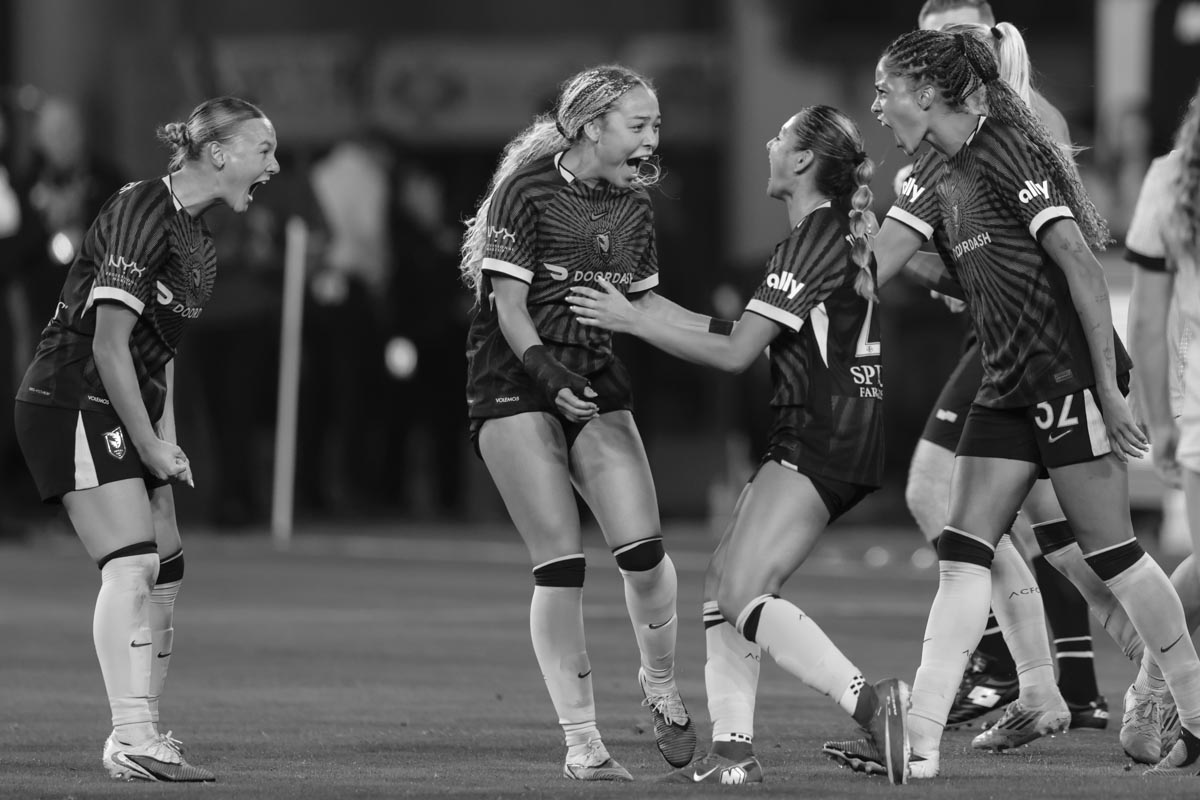
“As photographers, we’re storytellers,” says Gilligan. “So, it’s important to find the story behind the images. Do we have a great rivalry? Is a certain player returning from a long injury or a pregnancy? Do we have old teammates that are now competitors fighting each other? Is this a battle for the playoffs? Finding those storylines gives the images context and meaning.”
It also helps Gilligan know where to point his lens before the action even starts. For example, he recalls tracking Angel City star Jun Endo’s return from injury. He knew the crowd would erupt when her name was announced during her first game back, and he was ready to capture some images of her basking in that excitement.
Beyond the action shots, Gilligan recommends keeping a shot list for every game. His standard list includes:
A wide, establishing image of the stadium: Bonus if he can frame the L.A. skyline in the distance.
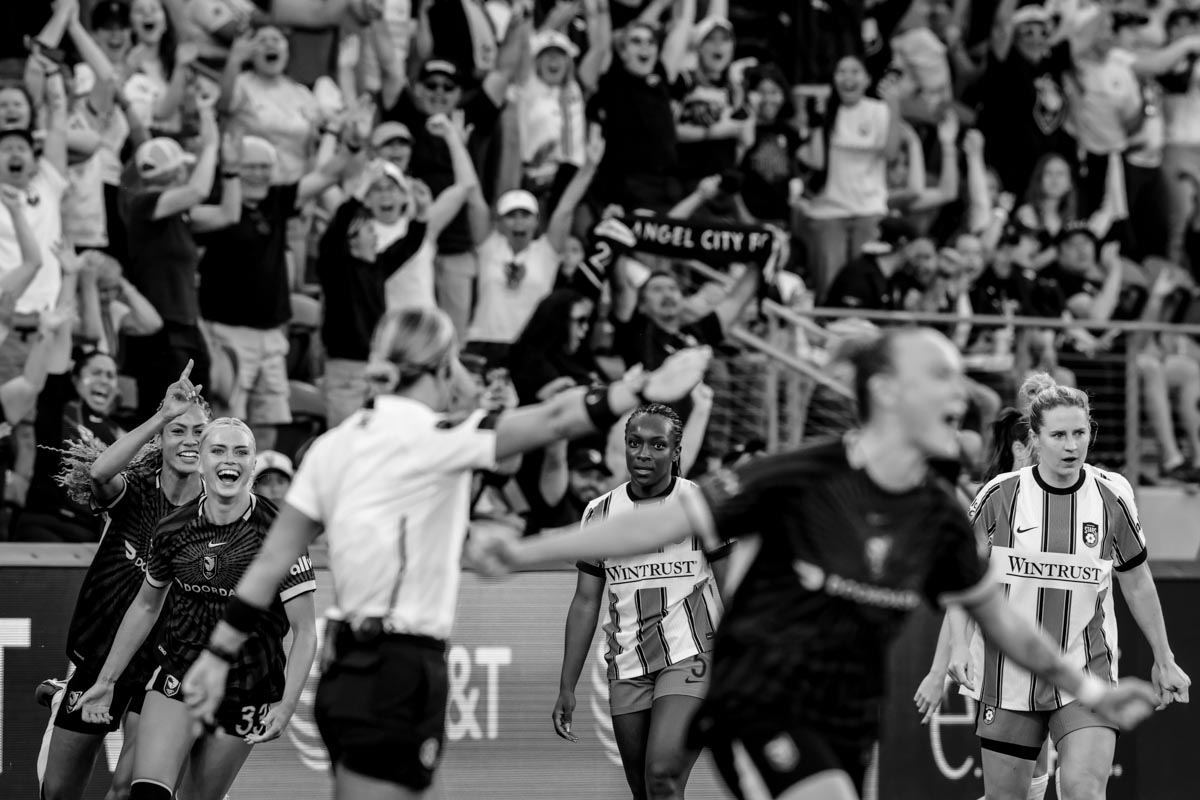
Crowd reactions after a goal: In L.A., these celebrations typically include pink smoke and a “GOAL” scoreboard graphic.
The team’s pregame walkout: Capturing multiple angles can help set the scene.
Candid crowd moments: The supporter section, often located behind one of the goals, usually provides the most enthusiastic fan moments.
Faces in the crowd: Add some personality to the coverage by photographing compelling faces in the crowd during breaks in the action.
SIDELINE ETIQUETTE GETS YOU INVITED BACK
Gilligan emphasizes that the way photographers treat each other and the stadium staff will determine their access to future games. The same core group of photographers tends to show up at every game, and reputations travel fast. His standards for himself:
Follow the rules. Adhere to the seating and movement protocols the venue sets.
Stay off the pitch. Never venture onto the playing surface while the game is happening.
Be polite. Be respectful and courteous to other photographers, the team’s staff, and the security personnel.
Ask for guidance. If you’re unsure of local customs or club protocols, seek advice from more veteran photographers.
Show gratitude. “I make a point of always saying thank you,” says Gilligan. “I also send handwritten thank-you notes to those who help me. You would be amazed at the doors a handwritten thank-you note opens for you.”
A GROWING OPPORTUNITY
With the NWSL roughly doubling in size over the past decade and the FIFA Women’s World Cup coming up in Brazil in 2027, Gilligan sees opportunity ahead for photographers to ride a wave of enthusiasm for women’s professional soccer. His advice to other photographers is to make your own market. “Don’t wait to be assigned the work you want to do,” he says. “If you have an interest in a particular sport, do a self assignment. Go out and make it happen.”
Once you’ve assigned yourself the inspiration, consider the kinds of images that will set your work apart and open doors for your sports photography. “Strive to create images with feeling,” he says. “The best images, the ones that really resonate, demonstrate real emotion. They show you what it feels like to be there in the moment. You want your viewers to feel like they’re not just witnessing something from afar but feel like they’re actually there.”
Jeff Kent is editor-at-large.