
High Quality, Great Price
Tamron 70-180mm f/2.8 Di III VC VXD G2 review
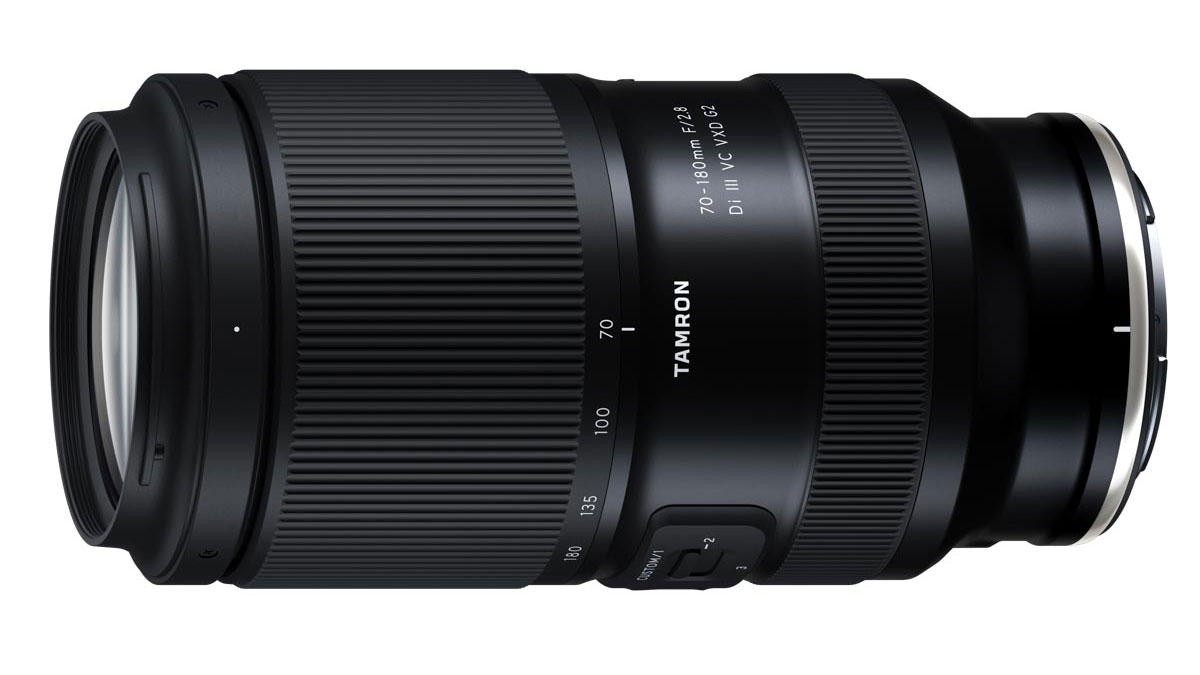
If you are a Nikon Z or Sony E-mount camera user in the market for a 70-200mm f/2.8 lens, you have a not-so-easy choice to make. The Tamron 70-180mm f/2.8 Di III VC VXD G2, optically and mechanically, delivers excellent performance while being substantially smaller and lighter than the Nikon and Sony 70-200mm f/2.8 lenses. That’s great, but there are compromises. For photographers watching their bottom line, the extremely competitive price—$1,099 and $1,149, about one-third the MSRP of either the Sony or Nikkor Z competition—might make choosing a no-brainer. The pool is deep, so let’s dive in.
You may not have thought about the letter designations in a lens model name, but they tell you more about the lens. Di III is Tamron’s designation for lenses made exclusively for full-frame mirrorless cameras. VC is short for Vibration Canceling technology. It works well; I was able to reliably make acceptably sharp photos at 180mm when handholding down to shutter speeds as low as 1/15 second. Voice-Coil Extreme-Torque Drive, Tamron’s name for a linear focus motor, has mercifully been abbreviated to VXD. Both auto and manual focus are as fast and precise as your camera allows, and with the Nikon Z6III, subjects snap into focus with near-instantaneous speed. Finally, the G2 tag indicates that this is not only a second-generation lens but also one of Tamron’s “Daisangen” lenses. Daisangen translates as “Big Three Dragons,” a reference to a highly valued hand in Japanese Riichi Mahjong. The other two dragons of the VXD G2 triad are a wide-angle zoom, the 16-30mm f/2.8 G2, and a mid-range zoom, a 28-75mm f/2.8.

With the Daisangen trinity, Tamron set out to make smaller, lighter, and less expensive alternatives to Nikon and Sony’s trinity of f/2.8 full-frame zooms. By comparison, you can purchase all three lenses in Tamron’s trinity for less than the price of either the current Sony or Nikon 70-200mm f/2.8 lenses. The Tamron lenses do not have the physical bulk of the rival OEM versions, and all three G2 lenses take 67mm filters. As all lenses in this class are known for their superb image quality, you need to pair them with equally good filters, which are not cheap. Since the G2s use the relatively small 67mm filter size, going with the Tamrons can save you even more money.


You also must measure cost and weight savings against what you give up. With the Tamron 70-180mm f/2.8 G2, the three most obvious things you’ll find missing compared to the Nikkor Z 70-200mm f/2.8 VR S II are: the extra 20mm at the long end, a rotating tripod mount, and the lens not needing to physically extend to zoom. On a full-frame 45-megapixel Nikon or a 60- or 68-megapixel Sony camera, you have enough resolution to crop to make up for the less-than-10% focal length difference for all but the most demanding needs, and even fully extended, the Tamron is roughly an inch shorter than the Nikkor and a half-inch shorter than the current Sony FE 70-200mm f/2.8. There are also accessory solutions for supporting the barrel of the lens if that is critical for you.


The Tamron 70-180mm f/2.8 G2 is a pleasure to use. The length of the main barrel makes hand-held photography a breeze. With my left hand cradling the lens, my thumb and index finger control the wide zoom ring, allowing me to go from 70 to 180mm with a short (about 60 degrees) twist of the ring, and my ring and little finger fall on the narrower focus ring. For this class of lens, its low weight and small size make it easier to handhold and travel with than the Nikon or Sony 70-200mm f/2.8. Because the lens extends as the focal length increases, using the optional lock switch at the 70mm position is a nice feature for keeping the lens compact when it is packed up or when you are walking with it. When manually focusing, rotating the focusing ring clockwise takes you toward infinity.
Image quality, even in difficult lighting, is superb. When stopped down, the curved edges of the aperture blades give out-of-focus areas, particularly highlights, a pleasingly soft-edged quality. Flare is not quite as well suppressed as it is with a Nikkor Z 70-200mm f/2.8 VR S II, but unless there is a light source just outside the field of view, the difference between the two lenses is minimal. Overall sharpness and definition are best at f/5.6, but these qualities hold up surprisingly well across the entire f/2.8 to f/16 range. Center-to-corner brightness falloff is close to nonexistent at all focal lengths and f/stops. Its optical and mechanical qualities make it excellent for portraits, and as a great general-purpose out-and-about lens.
Tamron has made a great lens at an extremely competitive price.
Ellis Vener is a commercial and portrait photographer based in Atlanta.