
Growing up I was glued to the TV watching “ABC’s Wide World of Sports” and will never forget the opening credits narrated by Jim McKay: “Spanning the globe to bring you the constant variety of sports... the thrill of victory... and the agony of defeat... the human drama of athletic competition... .” When we enter the arena of sports photography, being prepared mentally and equipment-wise exponentially increases our odds of capturing decisive moments, whether they’re during a Little League game, a Super Bowl, or anything in between.
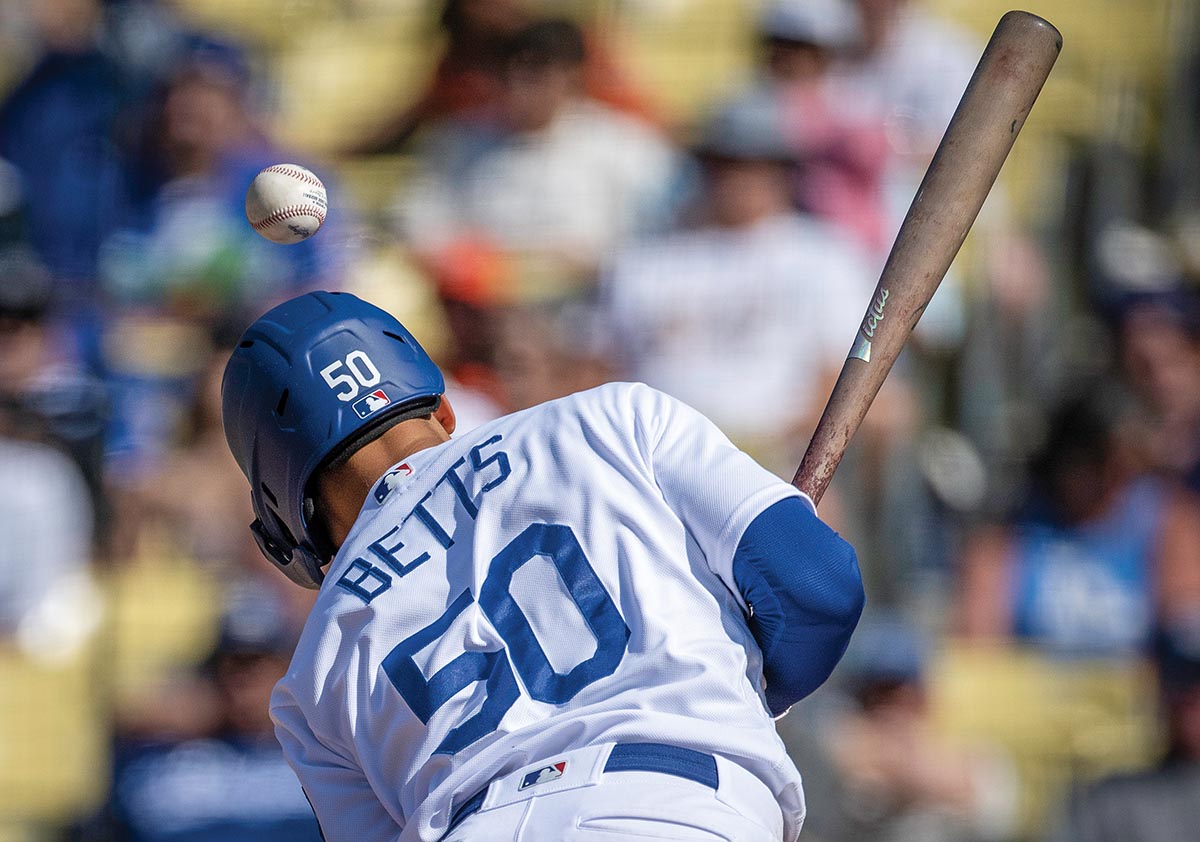
In sports photography, speed is the name of the game, but the speed depends on the action in front of the lens and the desired outcome. Typically my goal is to freeze moments in sports that the eye and brain cannot fully register. That’s part of the magic of photography. Catching Olympians and Paralympians suspended in mid-air as they perform dives and gymnastic feats typically requires a shutter speed of at least 1/2,000 second, while somewhere around 1/2,500 or faster is a safer setting. Stopping a MotoGP motorcyclist leaning into a tight turn (below) and freezing a baseball, with its seams visible, sailing over the helmet of Los Angeles Dodgers superstar Mookie Betts (top), required a 1/5,000 second exposure.
Cameras with higher shutter speeds and sensors with lower digital grain in high ISOs allow for possibilities unattainable to previous generations of sports photographers, yet they still captured remarkable, iconic images. Neil Leifer and Walter Iooss are two of many photographers who photographed dramatic moments in sports in the film era with their far lower ASA chromes and negatives. Look at their striking work for inspiration.
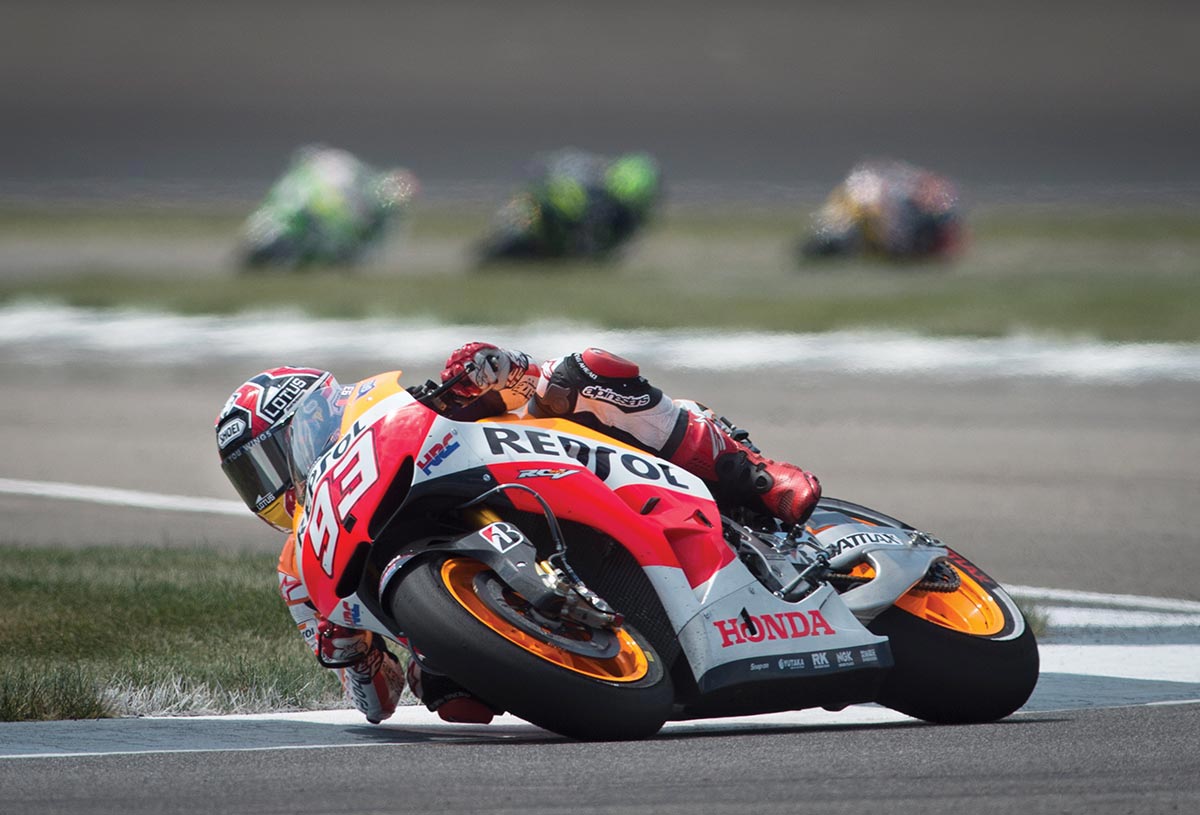
To freeze high-speed action to the degree where you can see the stitches on a baseball hurtling over the head of Los Angeles Dodger Mookie Betts (top), or a MotoGP racer (above), you’ll need a shutter speed at 1/5,000 second or faster.
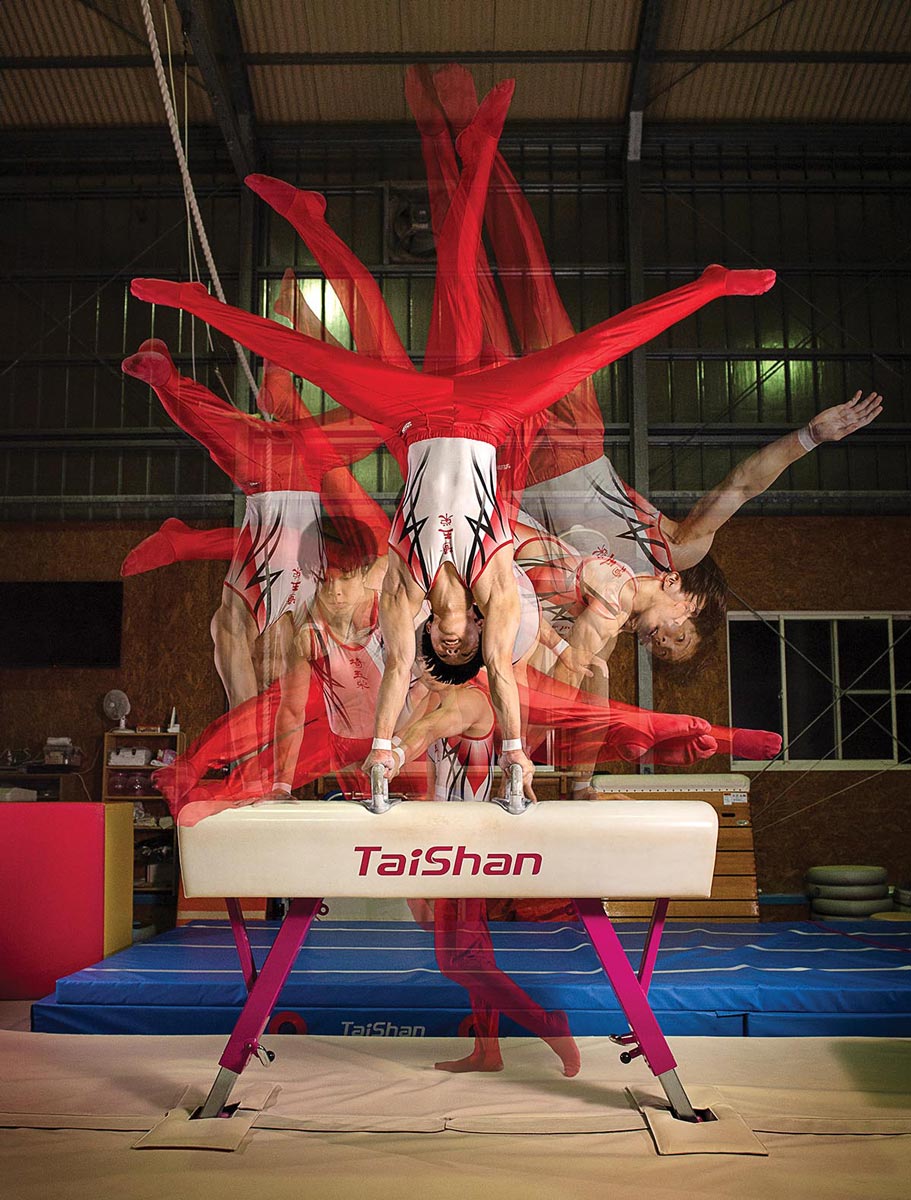
A stroboscopic study requires a flash like the StellaPro Reflex S that can light 30fps at full power.
WHEN STROBES COME INTO PLAY
Harold Edgerton, inventor of the strobe flash in the early 1930s, used extremely short durations to freeze footballs being kicked, tennis balls being served, and golf balls being hit in controlled environments as part of his fascinating motion studies.
For my own stroboscopic study of an athlete during the break between the Olympic and Paralympic Games in Tokyo, I used StellaPro Reflex lights fired by an Elinchrom trigger attached with a hot shoe. The latest version of the StellaPro Reflex S is capable of lighting 30 frames per second at full power. Godox triggers can also be used.
For the most part, still photographers covering sporting events cannot use strobes or continuous lights to record the action on the field of play, though there are a few exceptions. At NBA games, for example, several photographers are allowed to fire off strobes placed high in the rafters while most work with ambient light.
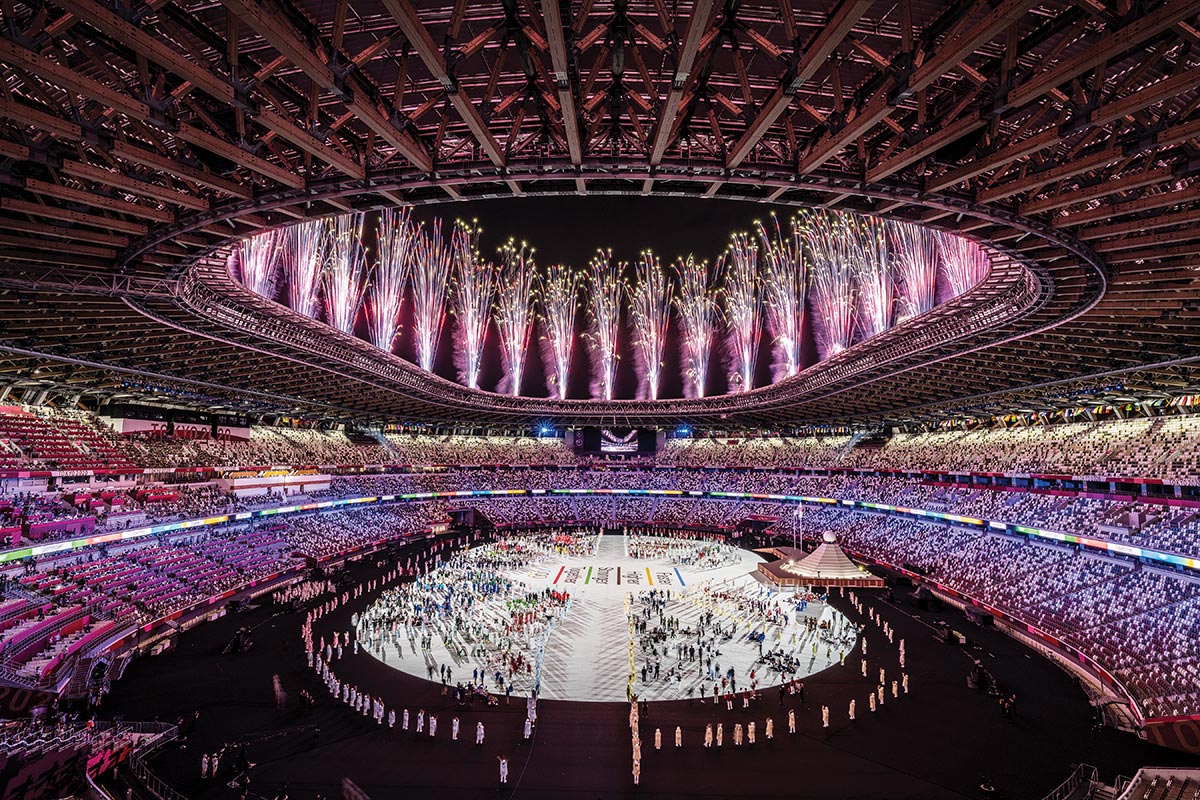
I was allowed to use a tripod for the opening ceremony and captured fireworks using a 2-second exposure at f/11, ISO 200.
WHEN TO GO SLOW
Tripods are typically not allowed at sporting events except for accredited videography and television use. That said, I was given permission to use a mini-tripod at a non-competition event, the opening ceremonies of the 2020 Summer Olympics, to capture the fireworks over Tokyo’s National Stadium using a Nikon Z 7II with a Nikkor Z 14-24mm f/2.8 set to 2 seconds at f/11, ISO 200. Other photographers going for similar shots, or wanting to trigger several cameras from different angles simultaneously, clamped their equipment to the stadium’s railings.
Panning can easily be done handheld with the shutter speed being dependent on the speed of the subject matter and the desired blurred effect on the surrounding area. In general, a good starting point is 1/15 or 1/30 second. The faster the action, the faster the shutter speed and the pan. To keep pace with the moving object and ensure a smooth pan, I start with my feet facing the end position and unwind my upper body in pace with the subject. This technique is extremely helpful for smartphone panoramas and videos as well.
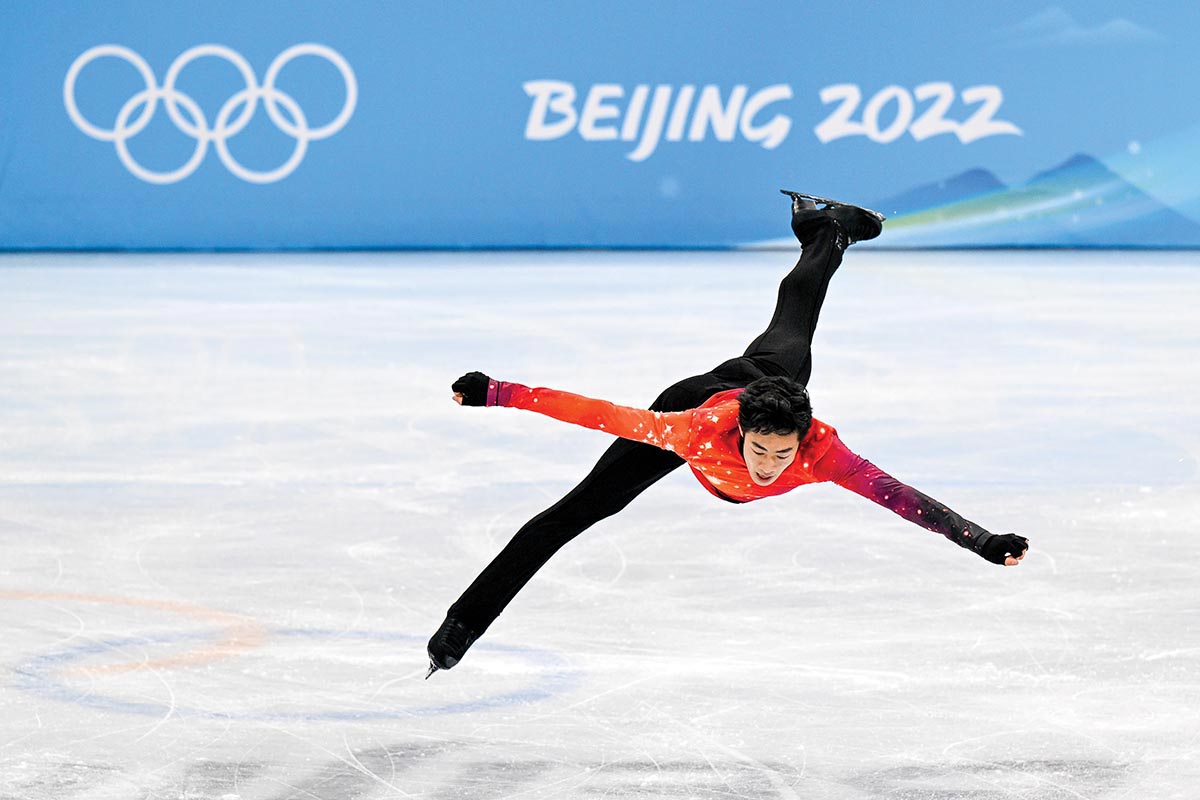
I use 3D tracking in continuous focus mode for sports where you can see the athlete for the entire routine or run, such as figure skating.
GEARING UP
The Olympics and Paralympics offer a wide range of photo ops requiring an equally broad focal length range, so for both the Summer and Winter Games I pack lenses that give me coverage from 14mm to 560mm. The longest focal length is achieved with a Nikkor Z 400mm f/2.8 with its built-in 1.4X teleconverter engaged. All venues have lockers for photographers, so we can just carry what we need in our hands, around our necks and waists, and in supplied photo vests and small backpacks. If I need even wider or longer glass, I check a lens out from Nikon Professional Services at the International Media Center. The same goes for credentialed Canon and Sony photographers at their brand’s respective booth. Regardless of the camera system, a monopod is helpful with longer lenses.
At the Beijing 2022 Winter Olympics I started using the Nikon Z 9. Because of its advanced technology, I made several technical adjustments to my usual practices, including the use of the Auto ISO on occasion. At outdoor venues under fluctuating light conditions, I set my shutter speed and f/stop manually and let the camera choose the ISO. In snowy conditions when there is a lot of white, I use exposure compensation to add +.03 to +1 stop to get the correct amount of light to the sensor.
I find 3D tracking in the continuous focus mode a particularly great tool for photographing sports in situations where I can see the athlete for the entire run or routine, such as figure skating and skiing. For ski jumping and Big Air snowboarding, where the athletes temporarily disappear from sight before launching off a slope, I find it best to focus on the ramp and then pick them up in the sky and track them in the Dynamic Area AF mode.
For the downhill slalom, one of my favorite competitions to cover, in the past I would have prefocused on an area such as the gates and let the athlete pass through the plane of my focus, pressing the shutter a moment before and having the motor drive continue firing until after the skier had left the frame. Now, with incredibly fast modern focus and tracking capabilities, I’m following the skiers on the slalom course rather than going the prefocus route. And since I’m now able to shoot at 20 frames per second in raw, the odds are increased for getting the crucial moment of action.
Continuous shooting at high frame rates creates the need for high-capacity yet compact external hard drives. It also requires a filing system that prevents ending up with files with the same names. I set the file naming for my primary camera body to use OL for Olympics and then a letter, so OLA, OLB, OLC and so on for each day, and kept the original file number. For my second camera body, these days a Nikon Z 8, I use OL for Olympics and then a number, so OL1, OL2, OL3. So my first processed file from each camera would look like: China_Beijing_Olympics_OLA_001.tif and China_Beijing_Olympics_OL1_001.tif. After processing a high-res TIFF for my archives I save a JPEG for distribution. If I have a tight deadline for a particular event, I’ll capture in TIFF plus JPEG. Photographers can shoot tethered at many venues, and their editors receive images for immediate distribution.
Photographing the Winter Games means trying to freeze dramatic moments in sports while not freezing your body in the process. Battery-heated gloves, wool socks, and waterproof boots are vital, as are crampons for photographers who want to make it to higher vantage points at skiing competitions. Understanding the sport and previsualizing the action makes it easier to pick the best angle. I keep an emergency rain cover for the camera and lens and spare batteries in an inside pocket to keep them warm. Batteries drain faster in colder weather.
If you’re ready for sports photography, go out prepared for the expected and unexpected. Seek your own thrill of victory, and push through the agony of defeat to gain the experience and skills that will keep assignments coming your way.
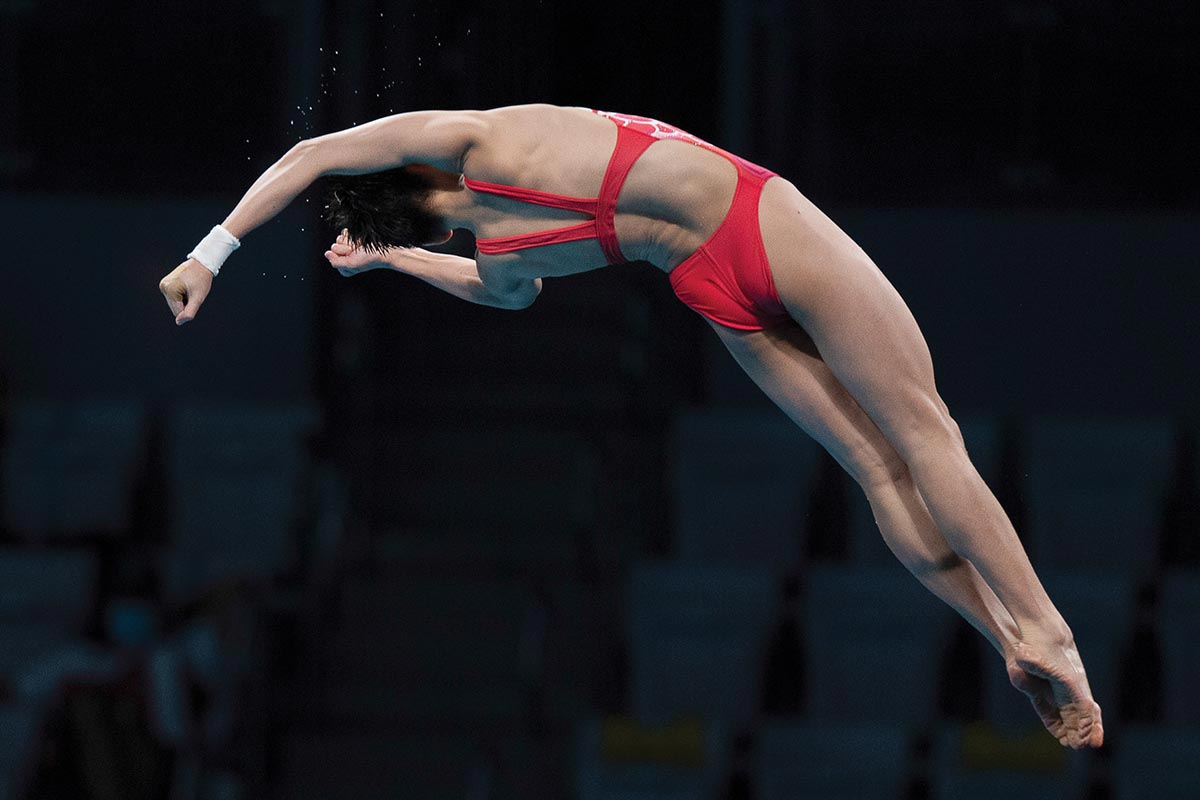
To freeze the twists of China’s gold medalist diver Quan Hongchan at the Tokyo 2020 Summer Olympics, I exposed for 1/2,500 second at f/5.6, ISO 4000.
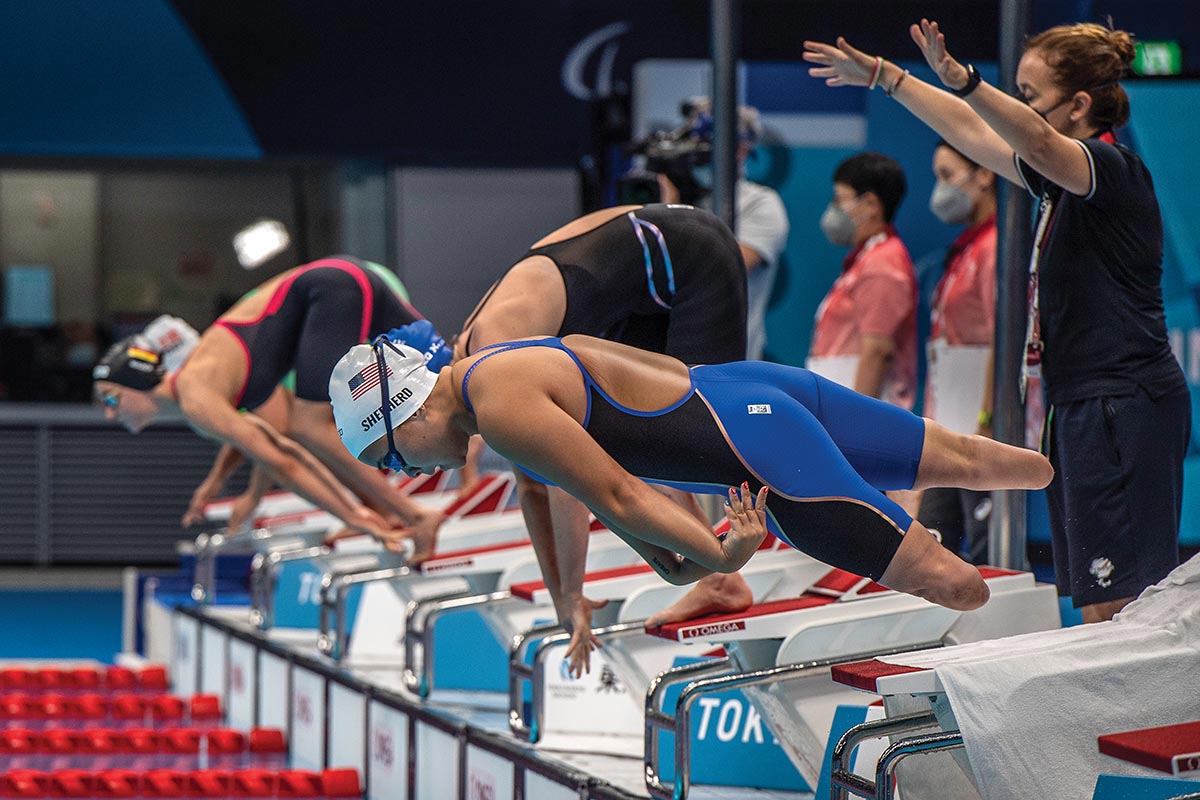
I captured Team USA swimmer Haven Shephard at the start of the 200m individual medley heat at the Tokyo 2020 Paralympic Games with an exposure for 1/1,600 second at f/5, ISO 1600.
GEARING UP FOR THE SUMMER OLYMPICS
For the summer Olympics and Paralympics in Paris this year, I’ll pack my Think Tank Airport International V3.0 rolling camera bag with Nikon Z 8 and Z 9 camera bodies and Z 14-24mm f/2.8, 24-70mm f/2.8, 70-200mm f/2.8 lenses along with a Nikkor Z 400mm f/2.8 with its built-in 1.4X teleconverter engaged. The Z 400mm is supported by a Manfrotto Monopod. At venues, roller bags and backpacks need to stay in the press rooms, so the Think Tank PressPass Sling bag is tasked with carrying one of the shorter lenses and backup batteries.
For athlete portraits off the field of play I’ll use StellaPro Reflex S and CLx10 lights. When I’m allowed an opportunity to use flash to capture athletic movement, I’ll take advantage of the full power bursts at 30 frames per second that the StellaPro Reflex S can fire in Digital Burst mode.
Mark Edward Harris is an award-winning photographer based in Los Angeles.
Tags: nikon sports photography technique