
Big League Ambitions: Nikon Z5II Test Review
The Nikon Z5II fits the tighter budget and needs of emerging pros
• January 2026 Issue

Nikon recently released the new Z5II with a 24.5-megapixel full-frame BSI-CMOS sensor that is 50% larger than most APS-C models but still demure in size. That means there’s no crop factor with Nikon’s Nikkor Z lenses. I took it for a spin to test its capabilities and get a feel for it.
Since I teach many photo workshops around the globe, I’m frequently asked, “What kind of camera should I get?” Too often, this question is based on the student thinking they need a camera upgrade to get the world-class photos they envision. The reality is that often, the camera and lenses they currently have are capable of producing those images if they put more artistic thought and technical prowess into their creation. But, in the ever-evolving world of photographic equipment, there are times to consider an upgrade.
Moving from DSLRs to mirrorless is one of those inflection points. The advantages include more compact cameras because of the removal of the mirror and prism, and the “what you see is what you get” factor in terms of depth of field.


To narrow down my answer to which model to get, I always ask, “What is the usage in terms of subject matter, as well as the end usage?” If the plan is to print the images large, cameras like the Nikon Z5II are a good starting point. If the images will stay on a computer screen or the web, then the more compact APS systems might be the way to go. The Z5II dimensions are 5.3x4x2.9 inches and it weighs 24.7 ounces.
The Z5II also has 3D-tracking autofocus and nine subject-detection subjects: people (eye, face, head, upper body), birds, dogs, cats, cars, bicycles, motorcycles, trains, and airplanes. These features are two huge technical steps forward from DSLRs.
At fellow photographer Joyce Charat’s Tulum-inspired pool house in Southern California, I photographed model Danielle Okia (top) using Nikon’s new Nikkor Z 24-70mm f/2.8 S II lens on the Z5II body in the Auto ISO mode with manual shutter speed and aperture settings and exposure compensation. It was not until I entered the mirrorless world that I felt confident trusting Auto ISO. The camera’s exposure compensation ranges from -5 to +5 EV in 1/3 and 1/2 increments. I keep my aperture set to 1/3 stop increments, though it’s not a bad idea for photography students to set their cameras to 1/2 stop increments so they will both memorize their f/stops and see the subtle differences in every aperture adjustment.
I tested the Z5II’s low light capabilities with a Nikkor Z 24-50mm f/4-6.3 lens attached at the Los Angeles County Museum of Arts Urban Light artwork by Chris Burden (above). The vertical here is at ISO 2200 with the horizontal being exposed at ISO 11,400. Even at the latter’s high ISO there was relatively low digital noise.
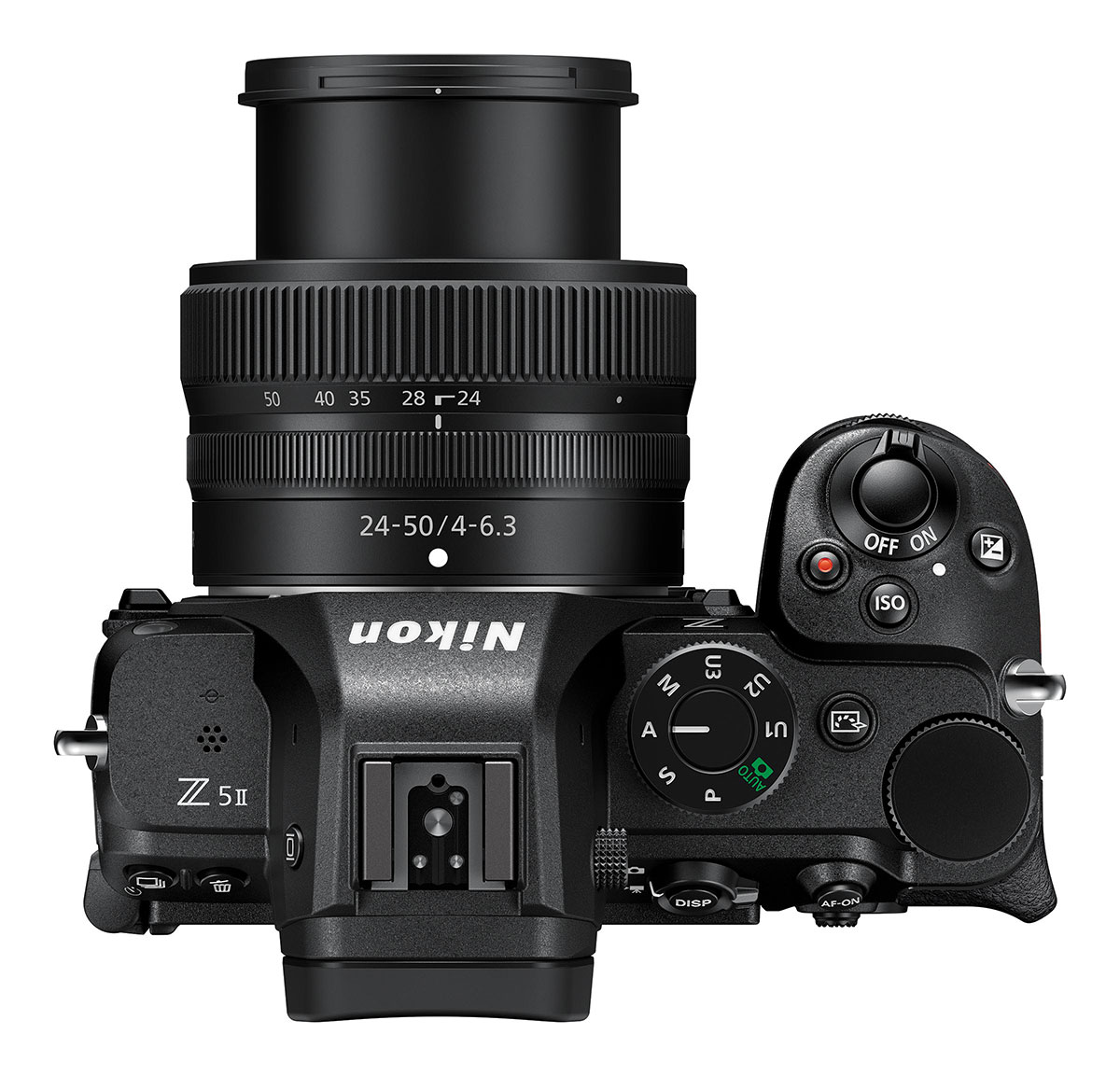
For those shooting in JPEG, a top deck (pictured above) Picture Control button (to the right of the exposure mode dial) sets built-in signature looks. Included settings are Auto, Standard, Neutral, Vivid, Monochrome, Flat Monochrome, Deep Tone Monochrome, Portrait, Rich Tone Portrait, Landscape, and Flat. Creative picture controls are combinations of hue, tone, saturation, and other settings to create styled looks and have 20 options to choose from, including Dream, Morning, Pop, Sunday, Somber, and Dramatic. Selected picture controls can also be modified and stored as custom picture controls and shared with others, and you can download customized Picture Controls from Nikon Imaging Cloud.
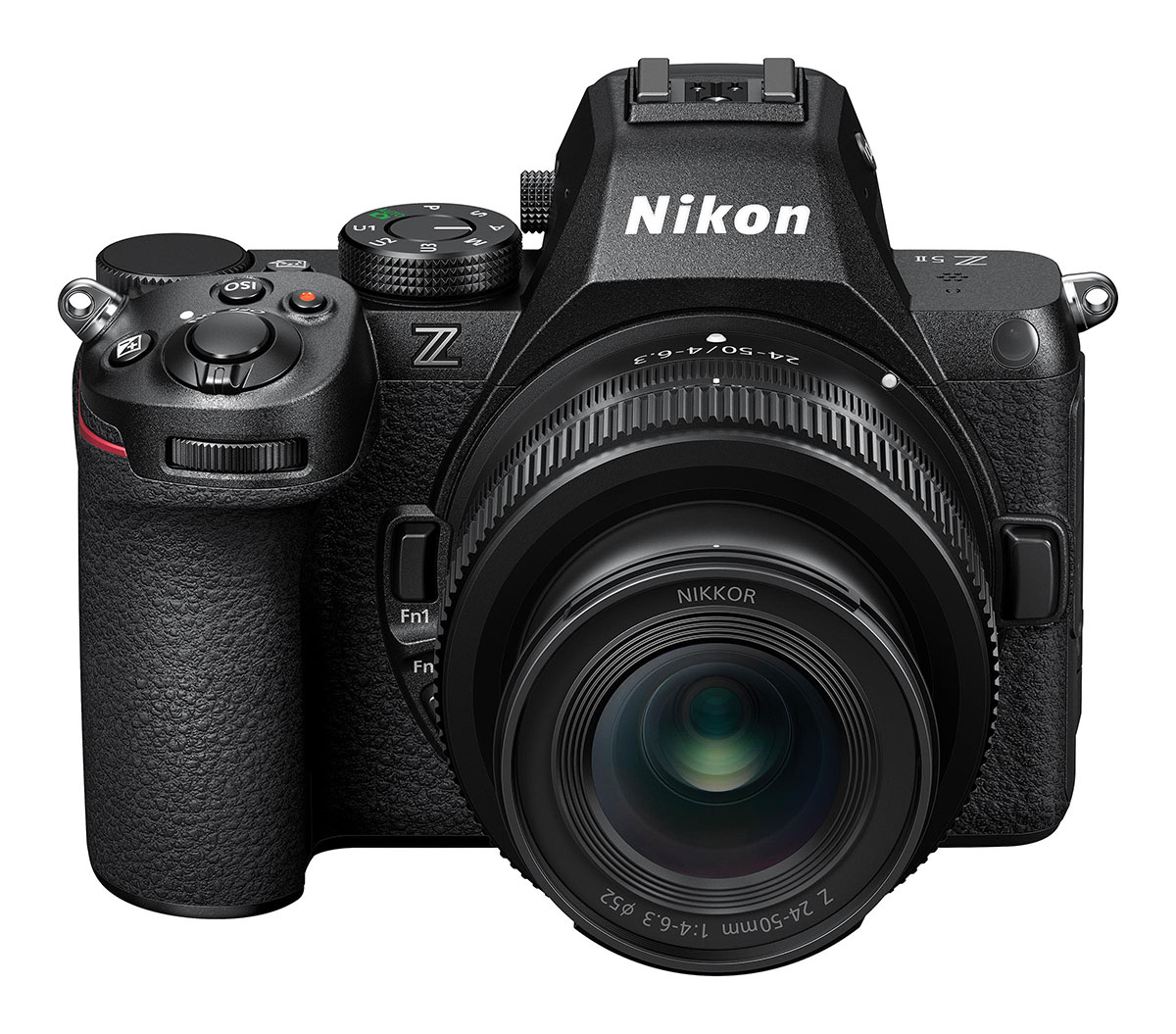
For sports, the Z5II’s Expeed 7 processing engine enables high-speed shooting up to 30fps. Sports photographers can also take advantage of the 1/8,000 second mechanical shutter. Flashes can keep up with that shutter speed in the FP High Speed Sync mode for applications off the field of play.
Astronomical and landscape photographers can slow things down and set shutter speeds as slow as 900 seconds—in other words, 15-minute exposures—before having to work in the Bulb setting.
Photographers working on film sets and in performance halls with mirrorless cameras can take advantage of the silent shooting mode and avoid the cumbersome foam-lined boxes, known as “blimps,” that act as giant silencers.
The Z5II has an impressive array of AF-Area Modes, which determine how the camera selects the focus point for autofocus: Pinpoint, Single-point, Dynamic-area (S, M, L; photo mode only, AF-A or AF-C), Wide-area (S, L, C1, C2), Auto-area, 3D-tracking (photo mode only, AF-A or AF-C), and Subject-tracking (video mode only). The user manual includes examples of when to use which type of autofocus based on subject and types of movement anticipated.
The Z5II also has TTL metering and autofocus in the video mode and 4K Ultra High Definition (UHD) recording. Video file types N-RAW 12-bit (NEV), H.265 10-bit (MOV), H.265 8-bit (MOV), and H.264 8-bit (MP4) are available for capture. Audio recording can be done through a built-in stereo microphone (with sensitivity adjustment, attenuator, frequency response, and wind noise reduction functions) or external microphones. Continuous recording is possible for as long as two hours and five minutes.
With the SnapBridge app you can pair or connect to the camera via Bluetooth or Wi-Fi to transfer stills and video off the camera and into the world.
The Z5II is available as body only with an MSRP of $1,849.95 or as kits with the economical Nikkor Z 24-50mm f/4-6.3 lens ($2,149.95) or the Nikkor Z 24-200mm f/4-6.3 VR ($2,649.95). The Z5II seems to be well placed for photographers on a tighter budget who are interested in moving up into the big leagues of photography.
Mark Edward Harris is an award-winning photographer and writer based in Los Angeles.