
Above It All
On location with landscape photographer Caleb Kenna
It’s early October, and I’m in Brandon, a picture-perfect town in central Vermont. The area’s celebrated fall foliage is at peak, and the town is packed with camera-toting leaf peepers. It’s 5 p.m., the beginning of the golden hour; the sky is cloudless, and everything is cast in a soft, warm light. To make things even more ideal, I’m with much-praised, Vermont-based photographer Caleb Kenna, high atop a hill overlooking Brandon (his hometown) as he’s about to launch his DJI Mavic 3 drone and fill me in on how he captures his award-winning, fine art aerial images.
Kenna holds the DJI Mavic remote controller in both hands, taps the screen, and the three-lensed drone, which is sitting on the grass lawn about 50 feet in front of us, responds with a gentle whir as its four propellers lift it straight up into the air. As it soars above the nearby treetops, Kenna tells me, “Remember I told you that when I first began using drones, some eight years ago, I used to fly my drone about as high as it could go, about 400 feet in the sky, then I’d make landscape images, complete with a horizon line?”
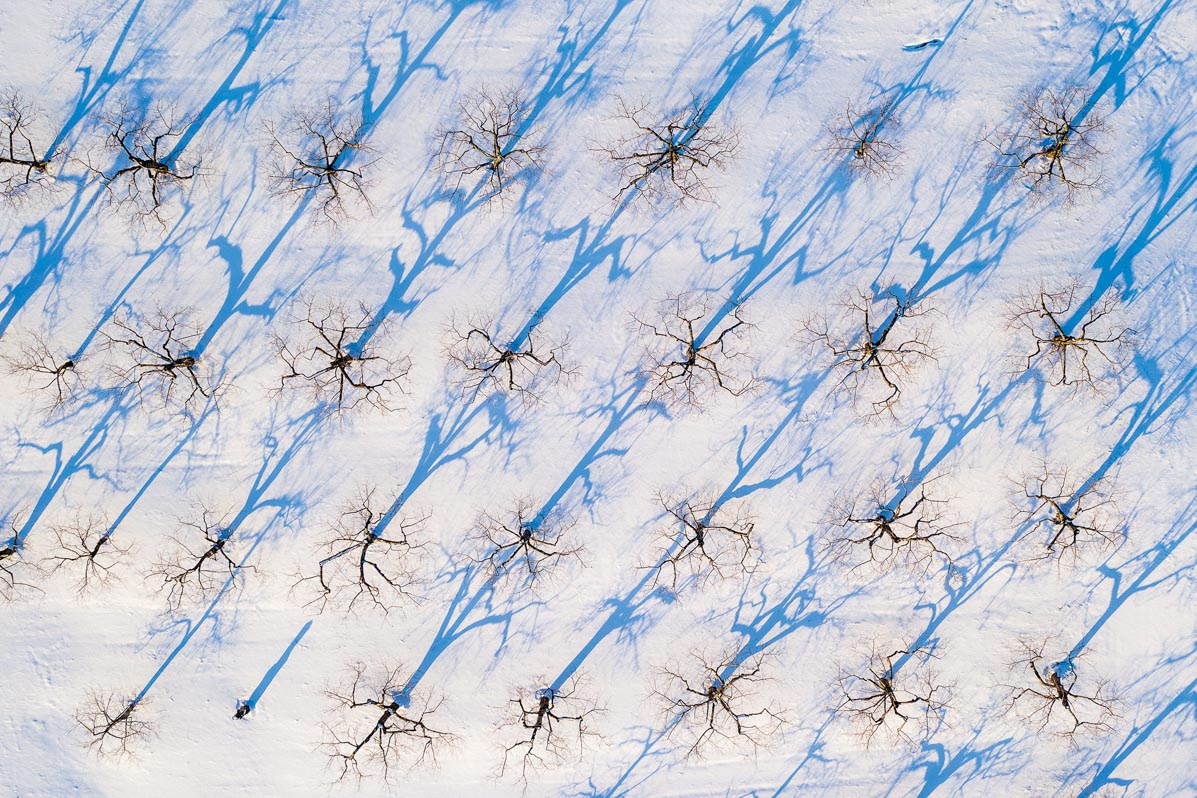
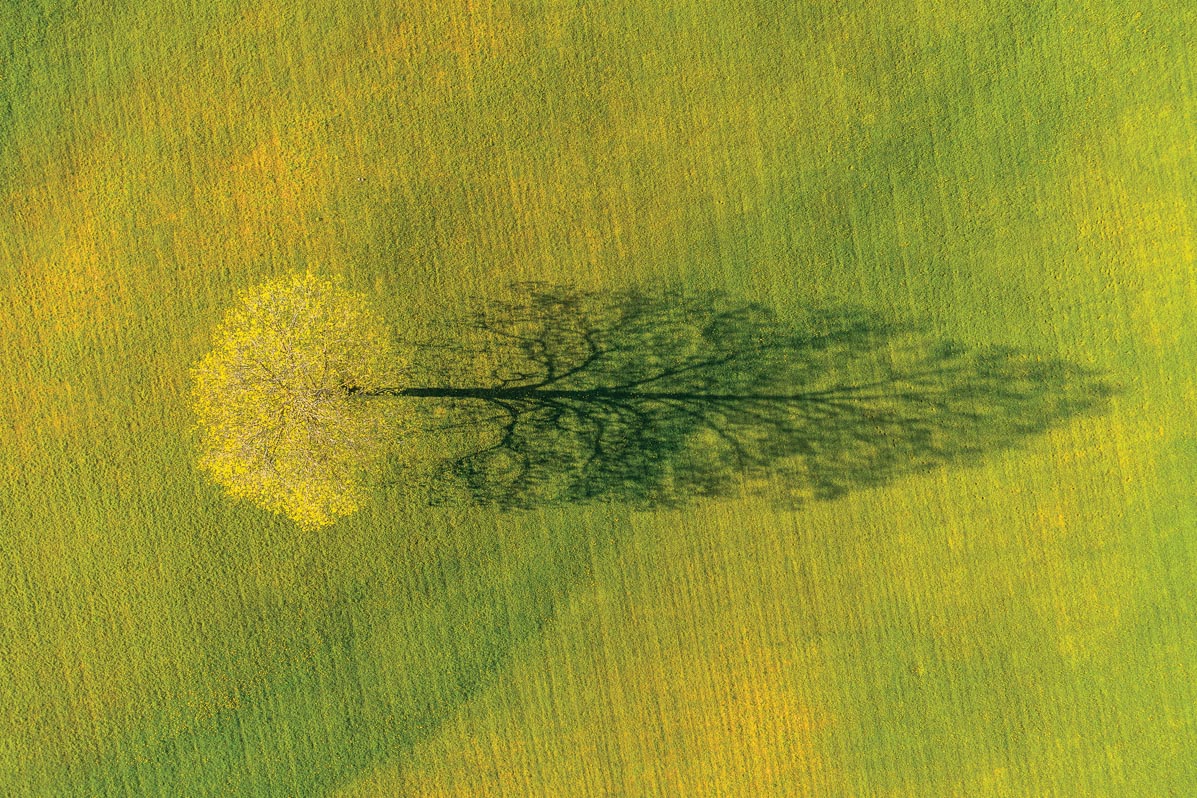
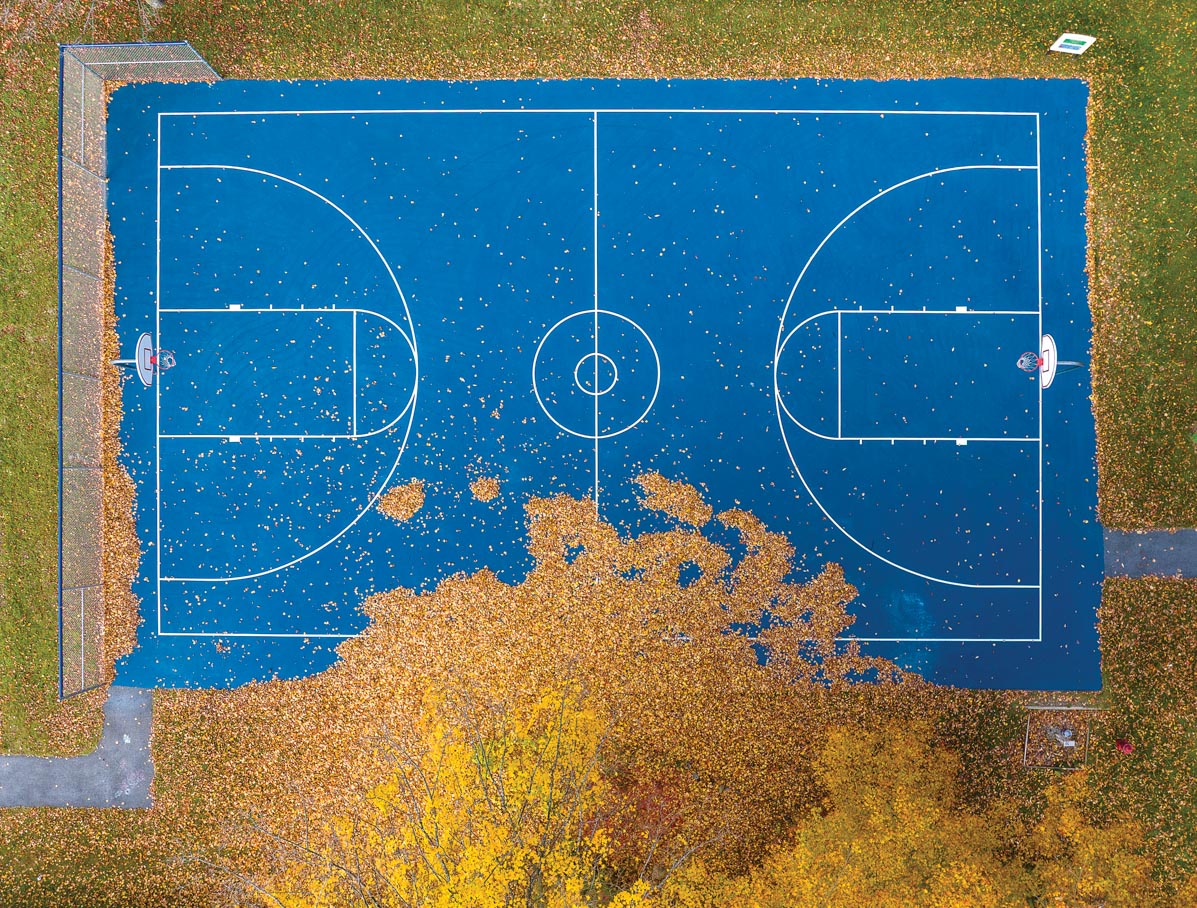
As the drone soars overhead and Kenna expertly uses the joysticks to move the drone’s gimbal, or motorized stabilizer, to adjust the lenses, he continues. “I realized that, while my long-range landscape-type pictures were good, I was too high. I was missing so much. So, I started lowering the drone to 200 feet, then 100, then even lower and shot straight down. I was thrilled with what I was discovering. I started capturing details, many of which I hadn’t expected or seen before that blew me away. Without framing the shot by including the horizon, hovering lower and shooting straight down, landscapes became more about patterns, abstractions, and visual mystery.”
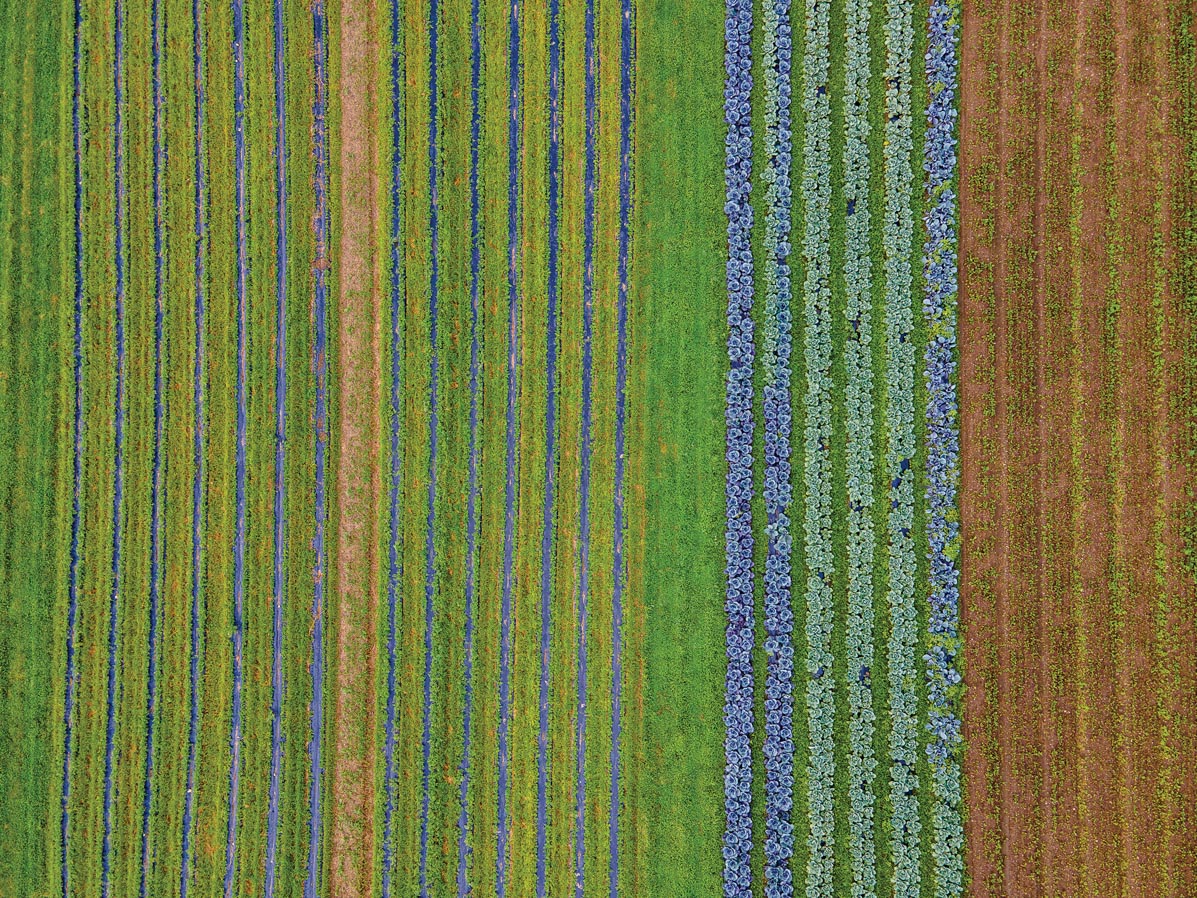
He invites me to look over his shoulder as he lowers the drone to some 100 feet over a nearby cornfield. Suddenly, the digital screen on the remote control is filled with an artistic, geometric, almost abstract image of the lush, thick cornfield and its neat rows. “See, with this bird’s eye view you really start to see patterns of the land. There’s beauty everywhere.”
He makes a few adjustments with the joystick to frame the composition and then clicks the shutter release. “Got it,” he tells me. “That’ll be a keeper.”
 View Gallery
AERIAL DISCOVERY
Kenna, 55, graduated from San Francisco State University in 1993 and worked as a newspaper photographer in his home state of Vermont as well as the U.S. Virgin Islands and New Mexico before turning to freelance photography some two decades ago.
While he created a wide variety of work (“Whatever helped pay the bills,” he notes), he always had a special interest in landscape photography. “I’d long been interested in aerial photography and I would hire a plane a couple of times a year to shoot in Vermont,” he explains. “But I wasn’t too happy with the results.” Hiring a plane was expensive, he notes, and there were no guarantees that the weather and light would cooperate. “It was always a risky proposition. You were always pretty high above the ground so there was often a sameness—a distance—to the images.”
Experimenting with his first drone camera in 2017 was liberating. Released from the restrictions of standard cameras, he felt “free as a bird,” he says. “Suddenly I was soaring above the landscape and making new discoveries in places I’d covered many times on the ground.”
He remembers driving near the tiny town of Rupert in southern Vermont and spotting the roof of an old barn rising in a cornfield. “It wasn’t until I flew my drone over the barn that I saw—and photographed—the wonderful patterns of the barn’s slate roof and the swirling rows of corn nearby. It was a moment of aerial discovery. Without the drone, I would have missed the picture.” He was hooked.
While Kenna kept freelancing for clients including occasional assignments for The New York Times, The Boston Globe, The Wall Street Journal, commercial and nonprofit organizations, and others, he continued to work with drones. He laughs when he remembers how long it took him to feel comfortable operating a joystick and keeping track of his new airborne gear. “I was never a big gamer, so operating a joystick was a challenge. I admit I lost a couple of drones. One got away from me and smashed into a stand of trees; another crash-landed into a creek.”
He kept practicing and improving, and in 2018 qualified as a FAA-certified drone pilot. What he calls his “big break” came in 2020 when The New York Times published a 17-image photo essay of his Vermont aerial work in its series called, “The World Through a Lens.” “That really gave me national exposure and brought me both work and recognition,” he explains. Indeed, after seeing his photo essay in The New York Times, Schiffer Publishing reached out to him and published a 144-page, hardback collection of 130 of his aerial images, “Art From Above: Vermont,” in 2022.
While discussing The New York Times photo essay, he admits that he is, like so many other accomplished photographers, always “hustling.” “For example, The New York Times didn’t call me and ask to run my images. I put a package together myself and pitched them. I’ve learned that if assignments don’t come to you, you need to make your own assignments. Being a freelancer is exciting, but it’s also challenging.”
Although Kenna has earned national praise as an aerial photographer, he is quick to explain that he prefers the simple label of photographer. “I still love shooting people, places, and things with my Nikon, and I don’t want to be pigeon-holed as only a drone photographer.”
CATCHING THE UNEXPECTED
After Kenna retrieves his DJI Mavic 3 from the grass atop the hill overlooking Brandon, we flip through the various images he’s made over the last 20 minutes. As he looks through photos of farmland; colorful, tight shots of lush foliage; and a few faraway landscapes that feature the Green Mountains and the Taconic Range, he reminds me that much of the drone’s appeal is its ability to catch the unexpected.
He flies his drone almost every day, often near his home in Middlebury, Vermont—a region known as “the land of milk and honey” for its abundance of beekeepers and dairy farms. “I’ve often said that these aerial chance discoveries, when you’re putting up your drone to shoot one thing and you see something else, are the most fun,” he explains.
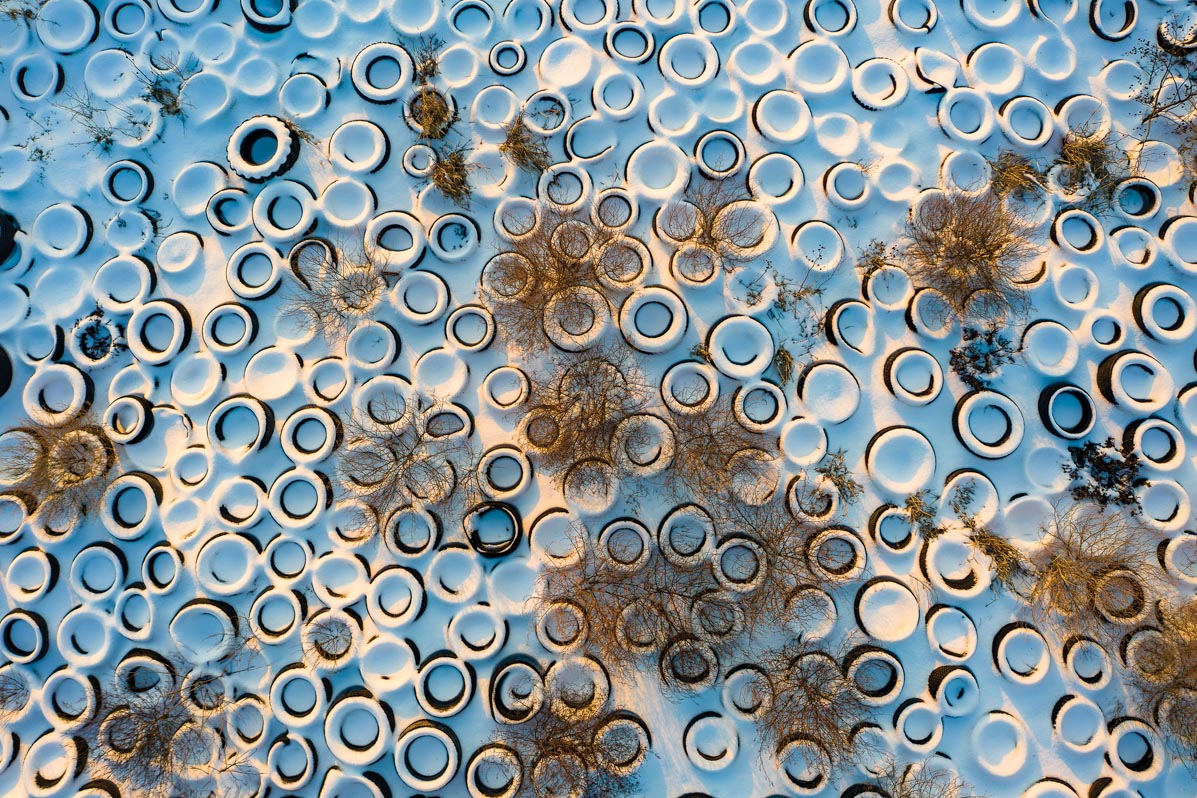
In his nearby studio, Kenna shows me a few aerial images that prove his point. One is a compelling, almost abstract composition, featuring the unlikeliest of subjects: a farm’s massive silage pile, or bunk, that is covered with plastic sheeting held in place by scores of snow-covered used tires. Another is an image of a smattering of hay bales in a colorful, just-plowed farmer’s field. And a photo of solar panels next to a meandering, half-harvested field is an artful study in abstract expressionism. Another eye-catching composition is an overhead view of a scrap metal lot.
“I had no idea that I’d capture these images after I launched my drone,” he says. “But that’s part of the magic of this process. You never know what you’ll discover. Some of my subjects may be trees, hay bales, and even discarded tires, but I hope they become something more—a metaphor of sorts.”
Clearly, Kenna has an eye for that, as The New York Times has noted that he can “isolate and elevate mundane objects and present them as if on display.” Kenna has a simpler, perhaps humbler, explanation: “I am so lucky because I live and work in a location where there is beauty everywhere. You just need to go looking for it.”
Robert Kiener is a writer in Vermont.
Tags: drone photography