
A Sense of Mystery
Daniel Sackheim’s enigmatic cityscapes evoke film noir
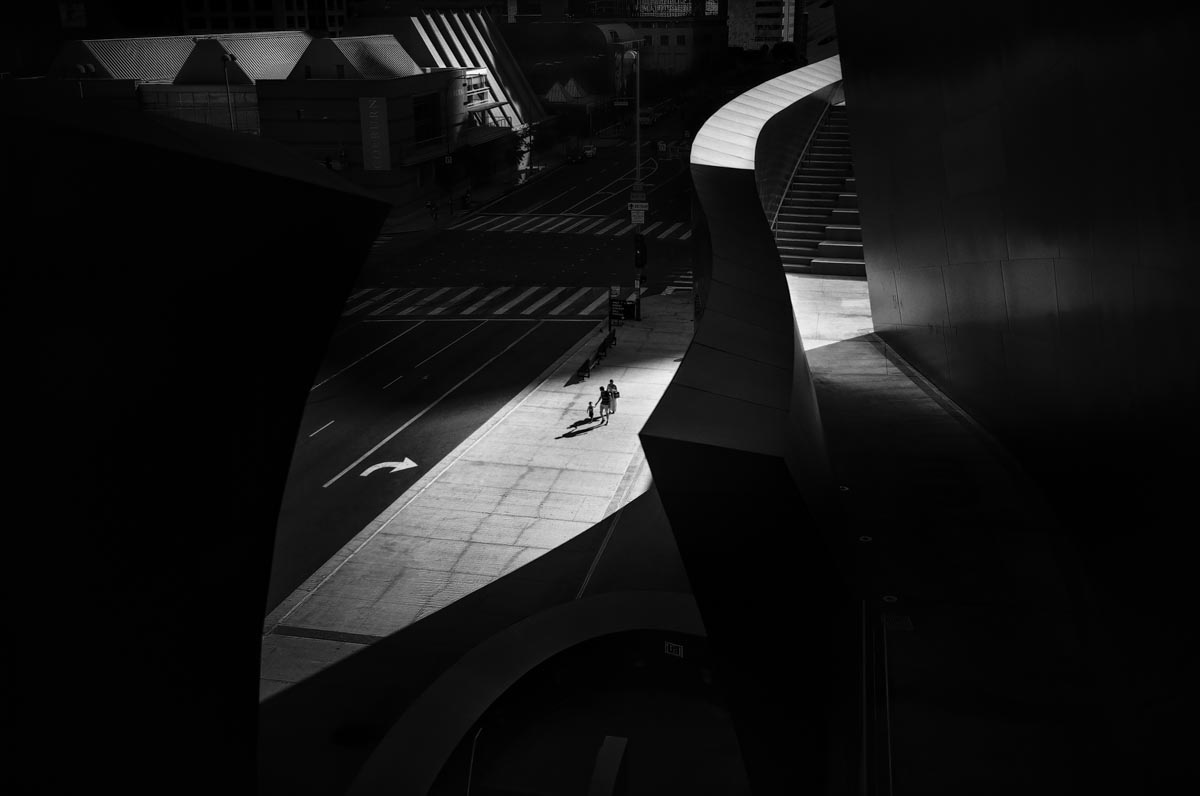
“I was a shy kid,” says film noir street photographer Daniel Sackheim. Each day after school, he hung around his father’s New York office doing his homework as his father, a writer and producer in the film industry, tapped away on his Smith Corona manual typewriter. The office, a large suite shared with many typing writers, was on the 12th floor of a high rise with panoramic views of the city. When Sackheim finished his homework, he’d position himself by the window to watch the drama unfold at the apartment building across the street. When it was warm, “The windows would be open, and you would see people in their apartments—a woman vacuuming, someone practicing the piano, two people having an argument,” he says. “You couldn’t hear them from that distance,” of course, which only fueled young Sackheim’s imagination. “I would watch the comings and goings and hear the sound of the typewriters in the background, and I would build my own story.”
It follows that Sackheim would go on to a successful career in film and photography. He’s an Emmy-award-winning director and producer for TV series such as “Game of Thrones” and “True Detective” as well as an award-winning still photographer. “I think there is this connection between being a visual storyteller and having an interest in observing the human condition,” says Sackheim, who is in the process of putting together a monograph of 50 of his film noir photographs from his acclaimed series “City Unseen.”
 View Gallery
“I guess I’ve always been fascinated with this idea of voyeurism,” says Sackheim—not a “transgressive” kind of voyeurism, he notes, but “seeing people in their more naturalistic and unguarded states, without that performative mask that we all put on when we’re in polite society.” The film noir style of photography drew him in not just because of his background in film, but also because it delivers the “tension and mystery” he desires for his works and allows him to explore this idea of witnessing things from a distance, as he did in his youth.
“There’s a double meaning to ‘City Unseen,’” Sackheim explains. The photos in this series, which were made in various cities, including Los Angeles, New York, San Francisco, and Tokyo, are intended to represent what it’s like to live in a metropolis where one can feel “unseen and diminished around these large façades of buildings, and almost sort of captive in this environment,” he explains. Meanwhile, Sackheim is also unseen, as the person observing and capturing these scenes on camera.
A MOMENT OF VULNERABILITY
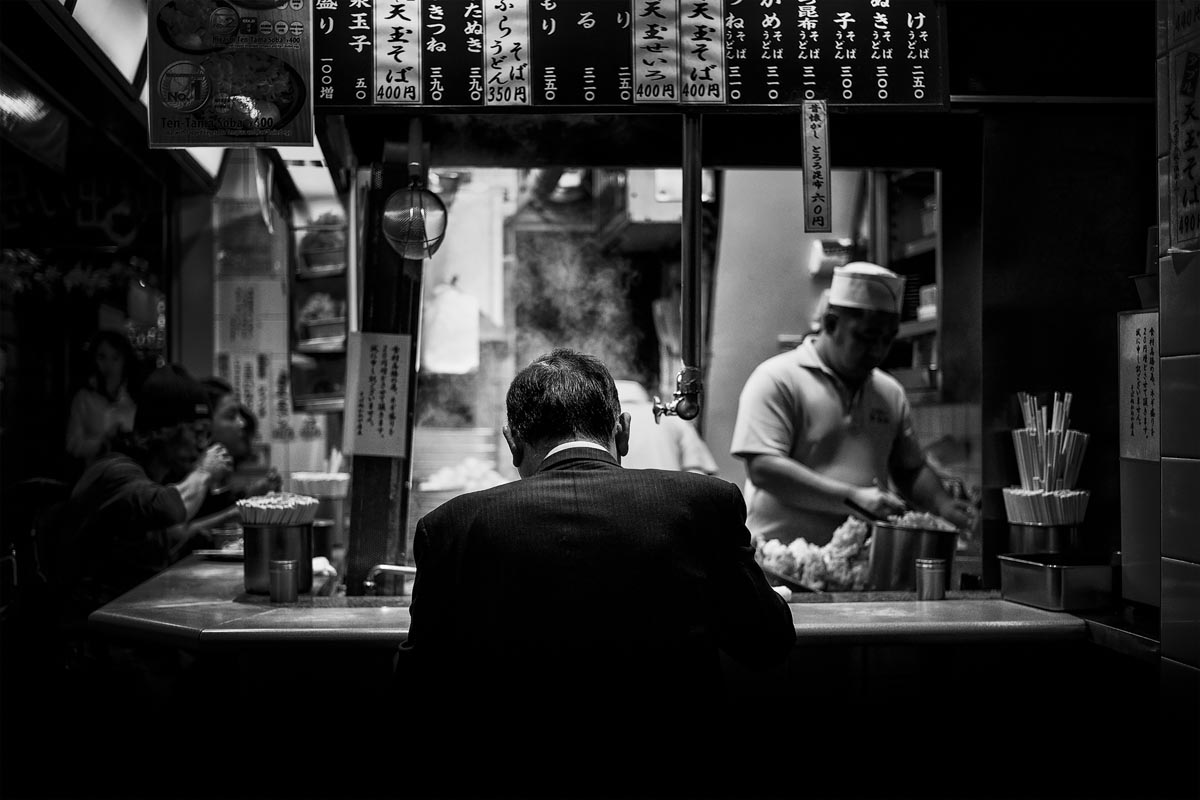
The first film noir image Sackheim made was in Tokyo. Suffering from insomnia, he wandered the streets at night with his camera. One night, taking a winding course through the back alleys of the city, “I stumbled upon this little noodle stand where there was this one solitary figure of a salaryman—these kind of ubiquitous, dark-suited men with slicked-back hair and briefcases that were really prominent at that time in Japan,” he explains. “I saw him sitting there, his back to me, this mysterious figure with steam rising up around him, and I took this photo” (above). It dawned on Sackheim at that moment that the photo reminded him of his early days in film, working on a retrospective of the work of film director John Huston. “Part of that job involved sitting in a screening room for a week watching three John Huston movies a day,” he explains. He’d really connected with Huston’s work, he says, which includes the films “The Asphalt Jungle” and “The Maltese Falcon.” Sackheim’s photo, which he wound up titling “A Salaryman’s Night Out,” got him thinking about “photography as a way of telling stories rooted in a different genre … approaching it from a cinematic purview.”
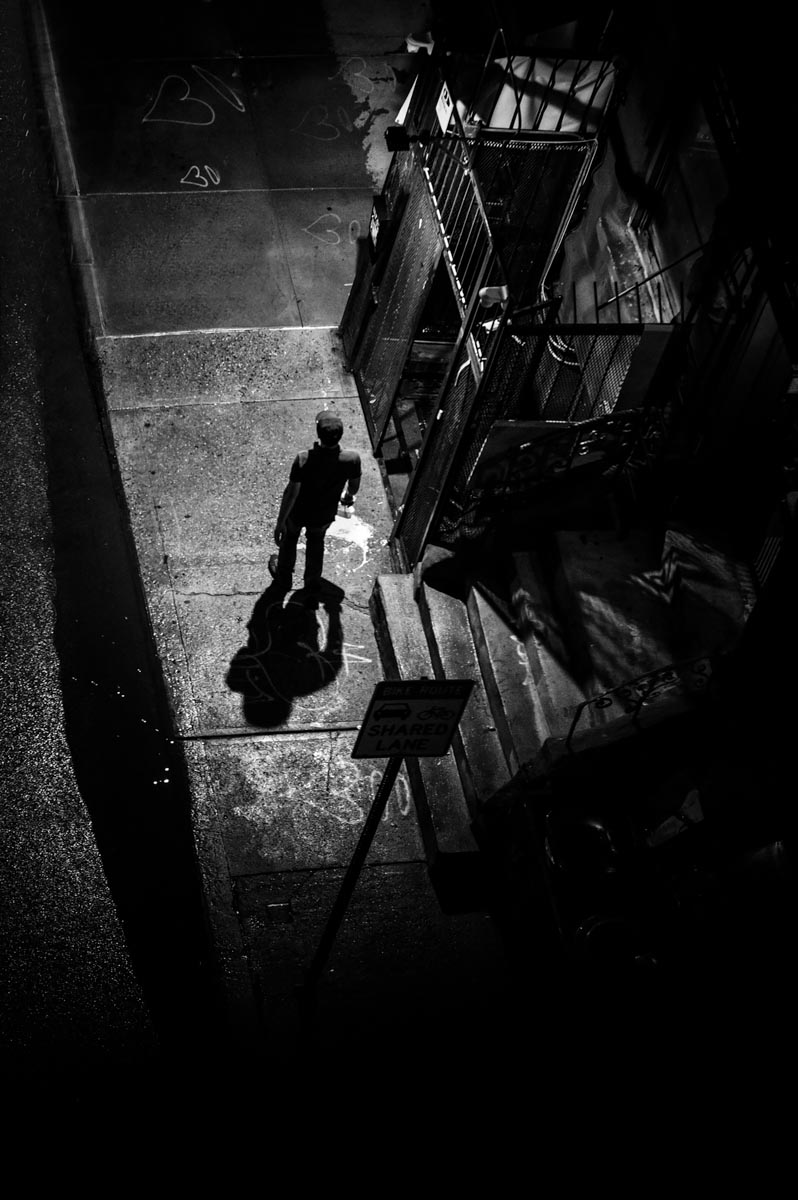
What makes a photo film noir? For one, there’s a narrative that involves what Sackheim dubs a “curiosity gap.” “The thing about film, television, motion pictures, is that you’re privy to the moments before, during, and after,” he explains. “It’s all encapsulated in a scene.” A still image is a miniscule slice of time, captured “hopefully just after something has happened or just before something else happens.” A film noir image prompts the viewer to ask questions: What’s going on in this scene? What’s just happened? Who’s this person and why do they look frightened? Why are they alone? Why are they walking into the shadows or out of the shadows? “I think as human beings we naturally want to know what’s missing,” says Sackheim. “When we’re presented with a void, we want to fill that void. So, I guess I would say that’s the thing that speaks to me as to why I should take a photo.”
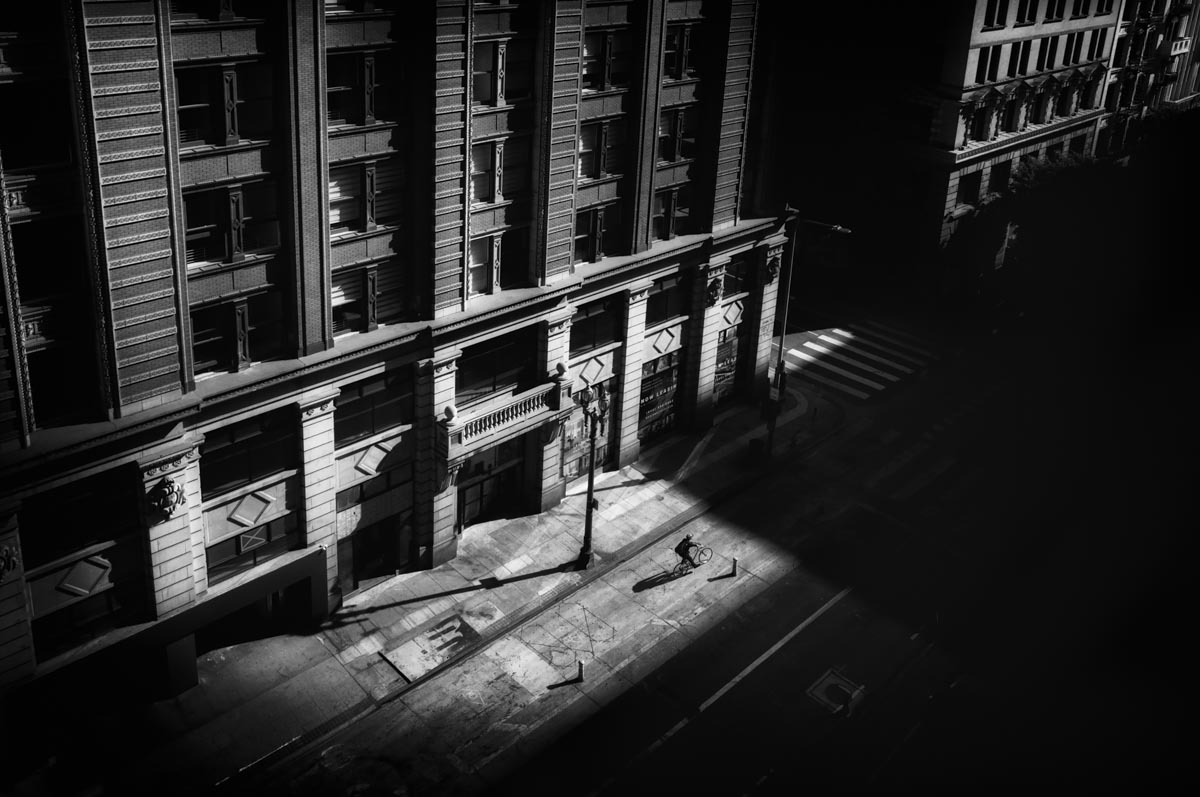
For his film noir works, Sackheim often photographs from above, which “naturally diminishes the subject,” he says. “It makes them [appear] as if they’re being watched, that they’re vulnerable, that there are powerful things around them that are dominant. It helps illuminate, I think, both literally and figuratively, the standpoint of a moment of vulnerability.” That, in combination with the narrative element of curiosity, work together to create a photo that “speaks in that film noir grammar,” he says.
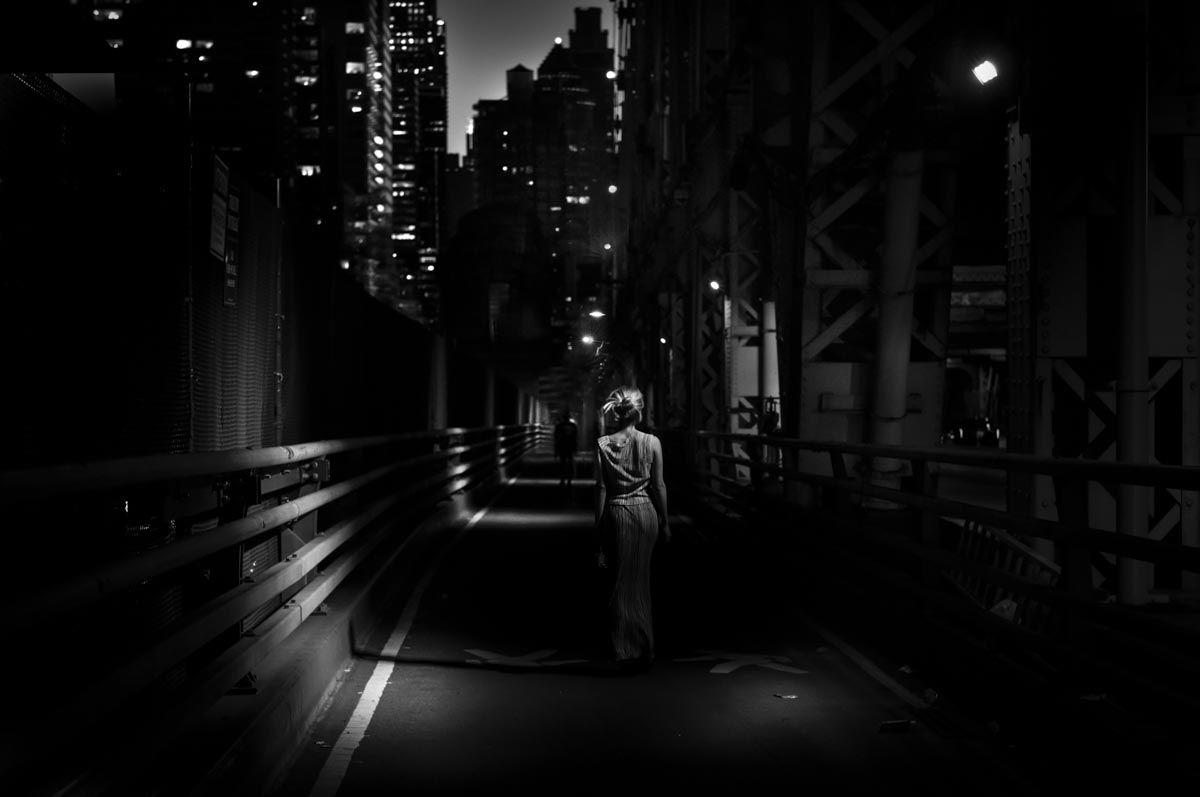
INTO AND OUT OF THE LIGHT
Sackheim’s photo “A Woman on the Bridge” (above) prompts just the questions Sackheim brings up, despite the simple circumstances behind its making, which he prefers to keep to himself to ensure the image retains its mystery. Why is this stylishly dressed woman walking alone on the bridge? the viewer wonders. The story behind the image isn’t particularly daring, he notes, but that speaks to the power of imagery and the power of the curiosity gap. “The lack of information is what makes something compelling,” he says.
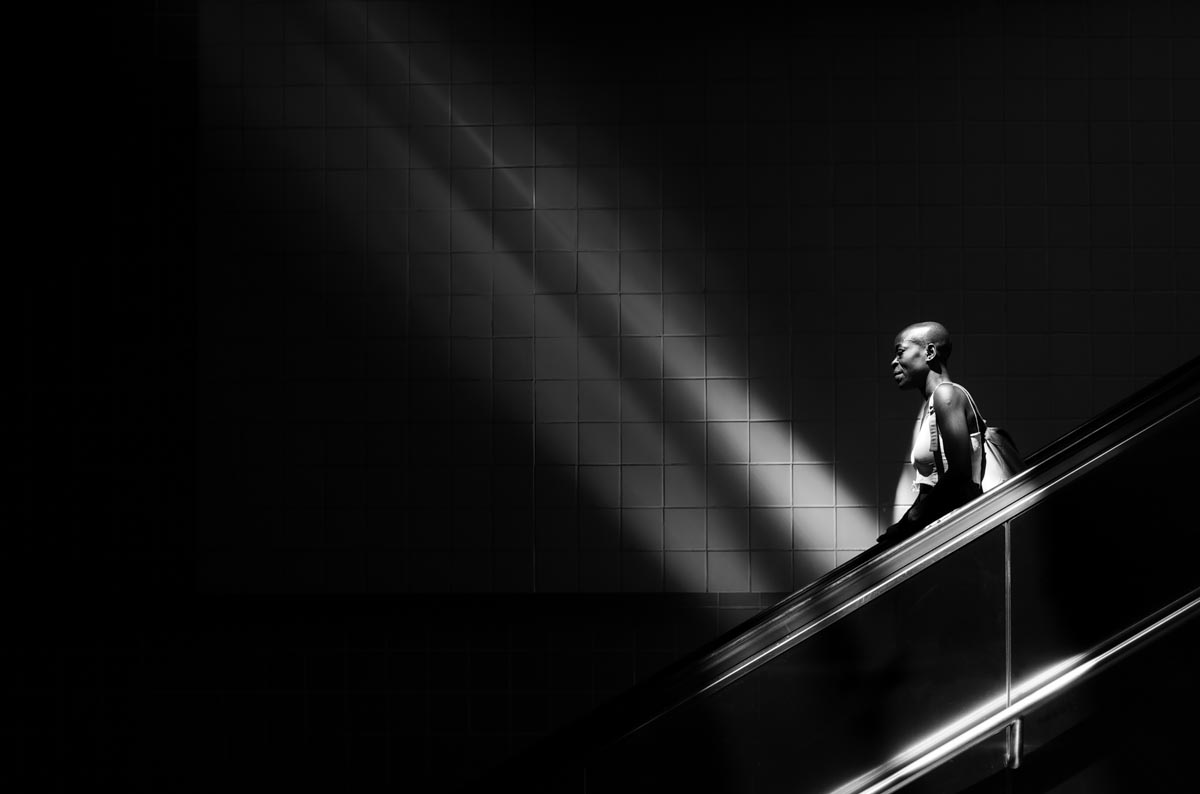
The shaping and bending of light and shadow is another important element of film noir photography, Sackheim notes, and it was an important aspect of his image “Guided by the Light” (above). He was scouting locations at a Los Angeles subway station when he spotted a narrow beam of light hitting an escalator that delivered passengers down to the platform. “Day after day I would go back and do light studies of it,” he explains, checking at different times of day to evaluate when the light was ideal for a photograph. Once he decided on a time of day, he returned more than once, photographing within the 15-minute window when the light was ideal, searching for just the right subject to come down the escalator at just the right moment.
On the third try, “this woman came through, and she just kind of had this radiance about her,” he says, “and she was hit with the light in this perfect way.” Sackheim did some dodging and burning to the sides of the image in post-production but says it was 80% caught in camera. As with “City Unseen,” he notes there’s a double meaning in the title “Guided by the Light.”
The subject was guided to that light by the escalator, he says. And he was guided to that light as well, “just waiting for a subject that was inspired.”
Amanda Arnold is a senior editor.