
A Budget-Friendly Prime
You might be surprised by the optical performance of the TTArtisan AF 75mm F2 lens, an affordable prime lens.
• December 2025 Issue

The TTArtisan AF 75mm F2 lens is an affordable alternative to OEM and other third-party lenses for Sony, L-mount, Fujifilm APS-C, and Nikon Z mirrorless cameras. As a high-performance, short telephoto autofocus prime lens, it is sharp and well-built while also being small and light. Best of all, it costs less than $200 ($199 for the Nikon Z-mount, $179 for the others). For the past few months, I have been using one on my 45.5-megapixel Nikon Z 7II for portrait, concert, architectural, and product photography, and it has surpassed my initial expectations.
When wide open, sharpness and contrast are better in the center half of the frame than in the corners, improving to excellent in the f/4 to f/5.6 range. At f/8, the amount of diffraction becomes evident and increases when stopped down further. Oddly, sharpness is excellent at all distances except the minimum focusing distance of 29.5 inches. Wide open, vignetting is visible but negligible at f/4, and practically disappears at f/5.6 and below. The transition from in- to out-of-focus areas is pleasingly smooth. The simple 10-element, seven-group optical formula features four high-index elements and one extra-low-dispersion element.
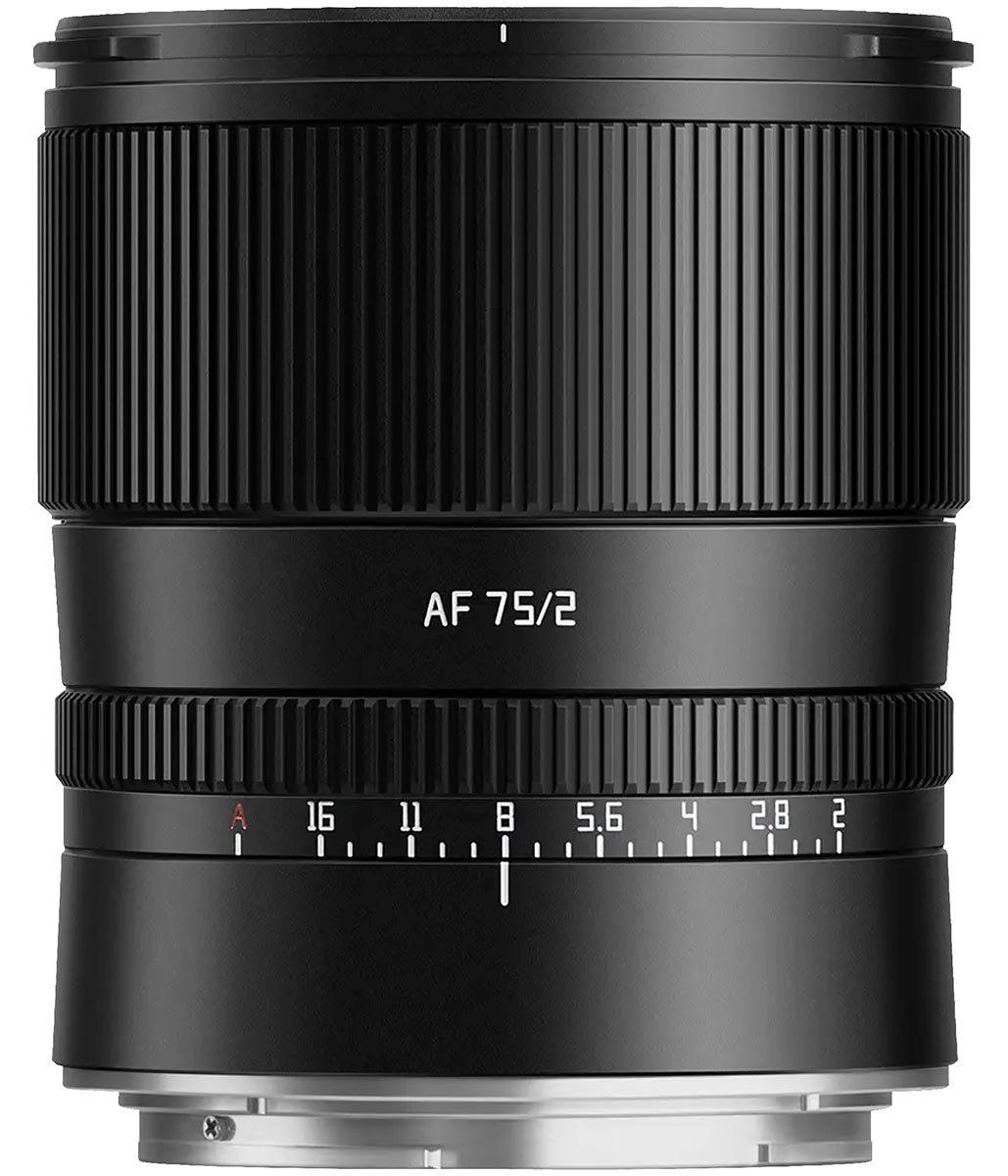

These technical aspects reinforced my impression that TTArtisan’s optical design team prioritized portraiture while being mindful of its utility as a general-purpose lens. The only optical drawbacks I have with the lens are that slightly out-of-frame light sources can create noticeable flare blobs compared to other, more expensive lenses.
For a small lens, it handles well. The all-metal body feels great. On the aperture ring, there are two modes for controlling the nine-bladed aperture: an A setting for when you prefer to set an f-stop electronically from the camera, and a manual setting with 1/3-stop clicks for direct aperture control. When you need to focus manually, the wide, ribbed focus ring connects to the focus-by-wire mechanism with no detectable latency. AF speed is also very fast due to the use of a lead screw stepper motor.
The lens is compact, measuring 2.6x2.8 inches, and relatively lightweight at 11.6 ounces. It features an internal focus design, maintaining its length regardless of the focus point.
Additional Tech Specs
- Diagonal Angle of View (full frame cameras): 32 degrees
- f/stop range: f/2 to f/16, controllable in 1/3-stop increments via the click-stopped control ring on the lens or by using the A setting for controlling aperture with the camera
- Diaphragm: 9 blades
- Near Focus Distance: 29.52 inches (0.75 meters)
- Filter size: 62mm
- Included Lens Hood: Squared off and scalloped, metal

Most small music clubs are notorious for having terrible lighting. But the combination of the TTArtisan f/2 lens when wide open with the face-recognition autofocus made easy work of nailing the focus on Welsh singer Tom Jenkins’ eye.

For full-frame cameras, the TTArtisan AF 75mm F2 competes with a handful of OEM and non-OEM 85mm f/1.8 models. Nikon makes the Nikkor Z 85mm f/1.8 S. For the L-mount system, there are the Panasonic Lumix S 85mm F1.8 and the Leica APO-Summicron-SL 90mm f/2 ASPH. For E-mount cameras, there are the Sony FE 85mm f/1.8 and the Zeiss Batis 1.8/85. These lenses range in price from $600 to $6,200 for the Leica 90mm. In the same sub-$400 price range as the TTArtisan 75mm F2, there are also 85mm f/1.8 lenses made in a variety of mounts by Meike, Vitrox, Samyang, Yongnuo, and 7Artisans.
On a full-frame camera, the 75mm focal length covers 32 degrees as opposed to 28˚30’ of the 85mm focal length for the E, L, and Z system lenses. For the APS-C Fujifilm X-mount cameras, its 21.33-degree angle of view positions it between Fujinon’s XF 50mm and 90mm offerings.
Capturing images with this lens is a pleasure. Autofocus is snappy and as accurate as your camera, and the manual focus ring is wide and nicely textured. With the option to control aperture through the camera or directly on the lens, I found myself choosing the latter more often and selecting the electronic option only when using shutter and priority modes.

For an event at a local micro-brewery, the swift autofocus action and focal length of the TTArtisan 75mm f/2 made it an ideal choice for capturing a group portrait.
While the lens’ optical performance, handling, and price make it extremely attractive, like any machine, it is not perfect. All lenses have some compromises, and this one is no exception:
- The focus-by-wire system means there is no focusing scale or distance indicator on the lens.
- Unlike other lenses with both an aperture ring and an A setting, there’s no lock on the A setting.
- Near focus distance is 2.64 feet.
- The bokeh produced when stopping down the 9-blade diaphragm is good, but nothing to write home about.
- There is no built-in image stabilization option; you are dependent on your camera’s IBIS. However, this is also true for competing 85mm lenses, including Nikkor and Sony.
- In strong backlight, even when using the lens hood, the lens can flare.
It’s hard to believe a lens this inexpensive is so good, but it is. For event photographers, a prime lens will never replace a high-quality zoom as an all-around workhorse. However, as a photographer who primarily works on location, photographing portraits, people, and performances—sometimes in low light—a sharp, fast, short-telephoto prime lens assuredly has its place in my bag. The combination of optical quality, fast aperture, size, and weight of the TTArtisan AF 75mm F2 makes it a versatile tool that empowers both photographers who travel and those who want to try working with a prime.
Ellis Vener is a portrait and commercial photographer based in Atlanta.